For the Love of Dogs
What a frightened dog taught me about the fear of God
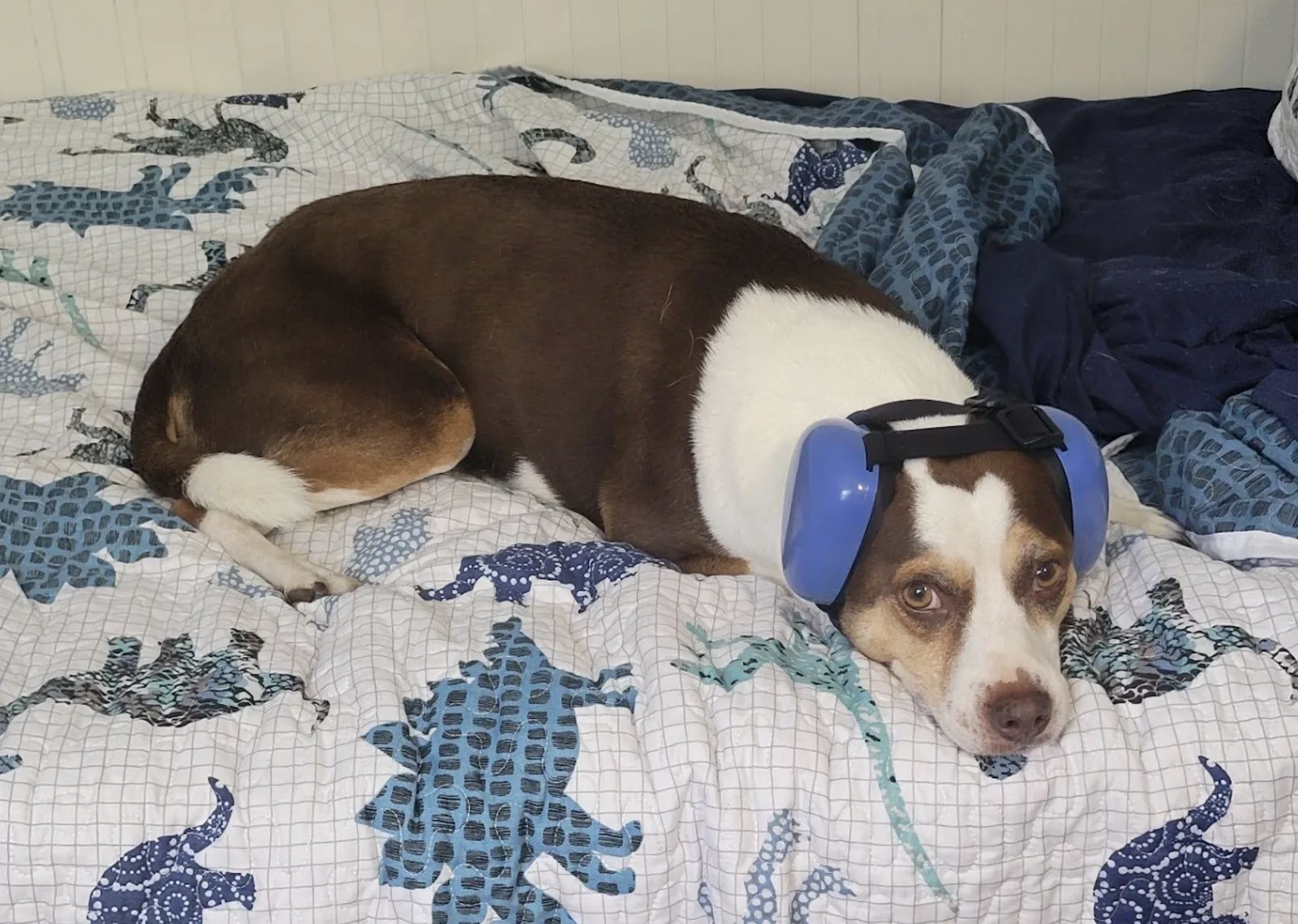
Pickle, in his thunder earmuffs.
When I adopted Pickle, he was terrified of me. He'd been a stray for the first two years of his life, and someone, at some point, had not been kind — you could read it in him. The first time I tried to play fetch, he cowered: he thought I was throwing the ball at him. He still flinches when I carry anything across the room, bracing for it to land on him. Thunder and fireworks undo him, so he has earmuffs. Actual dog earmuffs. I bought them.
The first time Pickle growled at me — I was trying to force him to do something — my instinct was to intimidate him: show him I was bigger, let him know I would not tolerate aggression. It terrified him. It confirmed the one thing he already believed, that I was dangerous, and a dog that certain of danger can't learn anything else. He was too overwhelmed with fear to obey his fear. It didn't even buy me the obedience fear is supposed to buy.
So I did what the behavior books kept telling me: I stopped trying to frighten him.1 When he first came to me he was a terror on the leash — growling and lunging at every dog we passed. My instinct was to correct it hard: a sharp word, a yank, let him know it wasn't allowed. Instead I filled my pockets with treats. When another dog came up the path, I'd move us aside, put ten feet between us, and feed him one treat after another while the other dog passed. I never scolded him for the aggression. I set it up so the right thing was the easy thing, and paid him in love for it. The growling thinned, and then it stopped.
I didn't stop being stern — I still hold clear boundaries. I just stopped trying to intimidate him into keeping them. It was slow. It worked.
Nine years on, Pickle trusts me. It feels immeasurably better to be loved by a dog than feared by one. I've had it both ways.
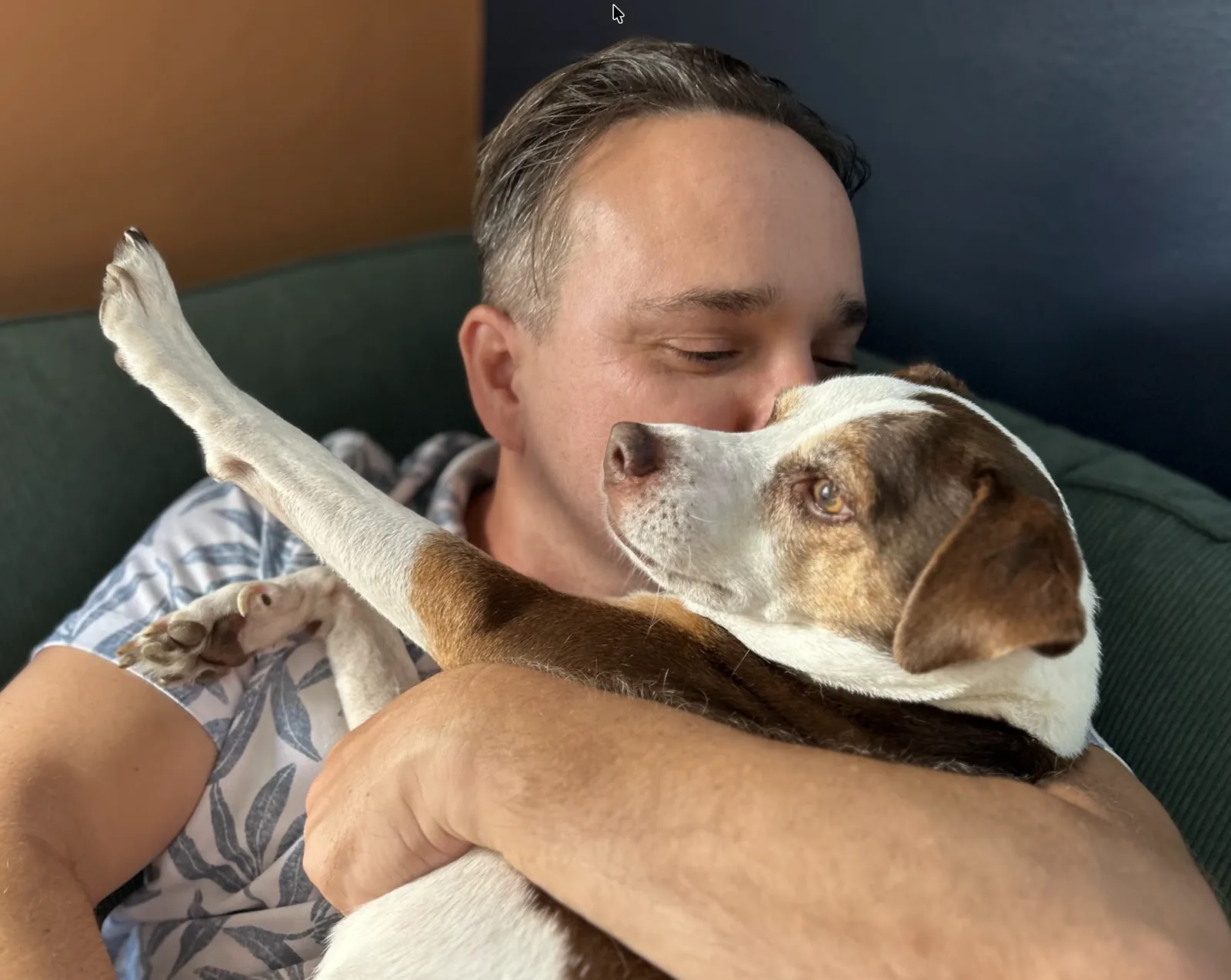
Nine years in.
Fear is not love, and it does not make love.
With some dogs, fear doesn't paralyze — it weaponizes. A beaten dog fears one hand and bites all the rest. The compliance is real — they mind the one they fear — but nothing in them was won over; they only learned where the danger was and arranged themselves around it. Pickle broke the other way, into a fear too big to function. Neither is love. Neither is what love makes.
There is usually no cruelty in it. The one who rules by fear mostly believes he's doing right — I did. Trying to intimidate Pickle out of his fear felt like leadership. It was a sincere mistake about how love works.
This isn't "never say no." I say no to Pickle every day — he'd still eat what's on the counter, bolt into the road, swallow the one thing in the yard engineered to kill him. Loving him is not letting him do whatever he wants; it's the opposite. The line was never whether you say no. It's what the no is for — to keep them safe, or to make them afraid of you. Same word. Opposite animal.
I didn't want Pickle to fear me — the thought was unbearable, my sweet boy flinching when I reached for him. I wanted him to trust me.
And here is the part that undoes me. Pickle is certain he understands the world. He does not. He is terrified of the vacuum and cannot be reasoned out of it. He is convinced that his barking is the only thing keeping the mailman from murdering us all — the proof being that it works, every single day. He is a small, confident expert on a world he has entirely misread — and I love him more for it, not less. I have started to suspect I am exactly this to whoever holds my leash. Sure I know what's going on. Wrong about most of it. Pulled back, more than once, from a road I was certain was fine. Loved anyway.
That is what I had backwards. I was afraid of the one who keeps me the way Pickle was afraid of me — obeying to stay out of trouble, going cynical the moment I thought no one was watching.
We've inherited an instruction to be afraid of whatever is larger than us — as if reverence and dread were the same thing. They aren't. The old word for standing before something vast and good meant awe: you go very still; you don't cower.2
Being afraid of what loves you is exactly what Pickle did when I first brought him home.3
Here is the difference.
Fear says: do what I say, or you'll suffer.
Love says: do what I say, or you'll suffer — but not by my hand. My instructions are the fence at the edge of the cliff, not the fist. Over the edge is the fall. I can see the edge and you can't, and I am asking you to trust me because I love you.
And if there is a love over us at all, it can want no less from me than I wanted from him. What I'm being taught, slowly, is the other thing: not to fear the master but to trust them. To be a good boy — not scared of what happens if I'm not, but because I've started to believe someone wants me to make it home.
When the first thunder comes, Pickle doesn't run from me — he runs to me. He finds me wherever I am and holds my eye until I attend to him. So I attend to him. I get the earmuffs I bought him, make a place for him against my side, lay a blanket over him, and hold him while the thunder goes on outside, indifferent to us both.
I can't call off the storm. His ears are better than mine; the sky is enormous and it terrifies him, and I can't change that. What I can do is make a place at my side and stay there until it passes.
For a long time I thought being good meant getting the storm to stop — being obedient enough, afraid enough, that nothing would ever break. It doesn't work like that. The thunder comes anyway. Being good, it turns out, is knowing where to go when it does: not away, not into a corner to hide, but toward the one who loves you, to the place already made at their side.
I still flinch. The sky still frightens me. But more and more, when it opens, I look for my master instead of the corner — and I am learning there's a place kept for me there. A blanket. An arm. And someone who won't leave me alone in it.
Footnotes
-
The training book I followed was Karen Pryor's Don't Shoot the Dog! The New Art of Teaching and Training — the reward-based approach I shifted to. Modern veterinary-behavior guidance agrees: the American Veterinary Society of Animal Behavior's Position Statement on Humane Dog Training (2021) holds that only reward-based methods should be used, because aversive, punishment-based methods raise the risk of fear, anxiety, and aggression and can damage a dog's relationship with its owner. See also Gal Ziv, "The effects of using aversive training methods in dogs—A review," Journal of Veterinary Behavior 19 (2017): 50–60, reviewing seventeen studies to the same effect. ↩
-
The word behind "the fear of the LORD" (Proverbs 9:10) is Hebrew yirah (Strong's H3374), which ranges from dread to reverent awe; in the wisdom literature it stands parallel to the knowledge of God, reading as awe rather than terror. Flattened to "fear" in English, it sounds harsher than the Hebrew. ↩
-
1 John 4:18 (KJV): "There is no fear in love; but perfect love casteth out fear: because fear hath torment." The Greek there is phobos (Strong's G5401) — a word that can mean reverence, but here the tormenting, punitive fear that love drives out, not the reverent awe of yirah. Cf. 4:8, "God is love." ↩