I Believe in You
What faith was before we broke the word
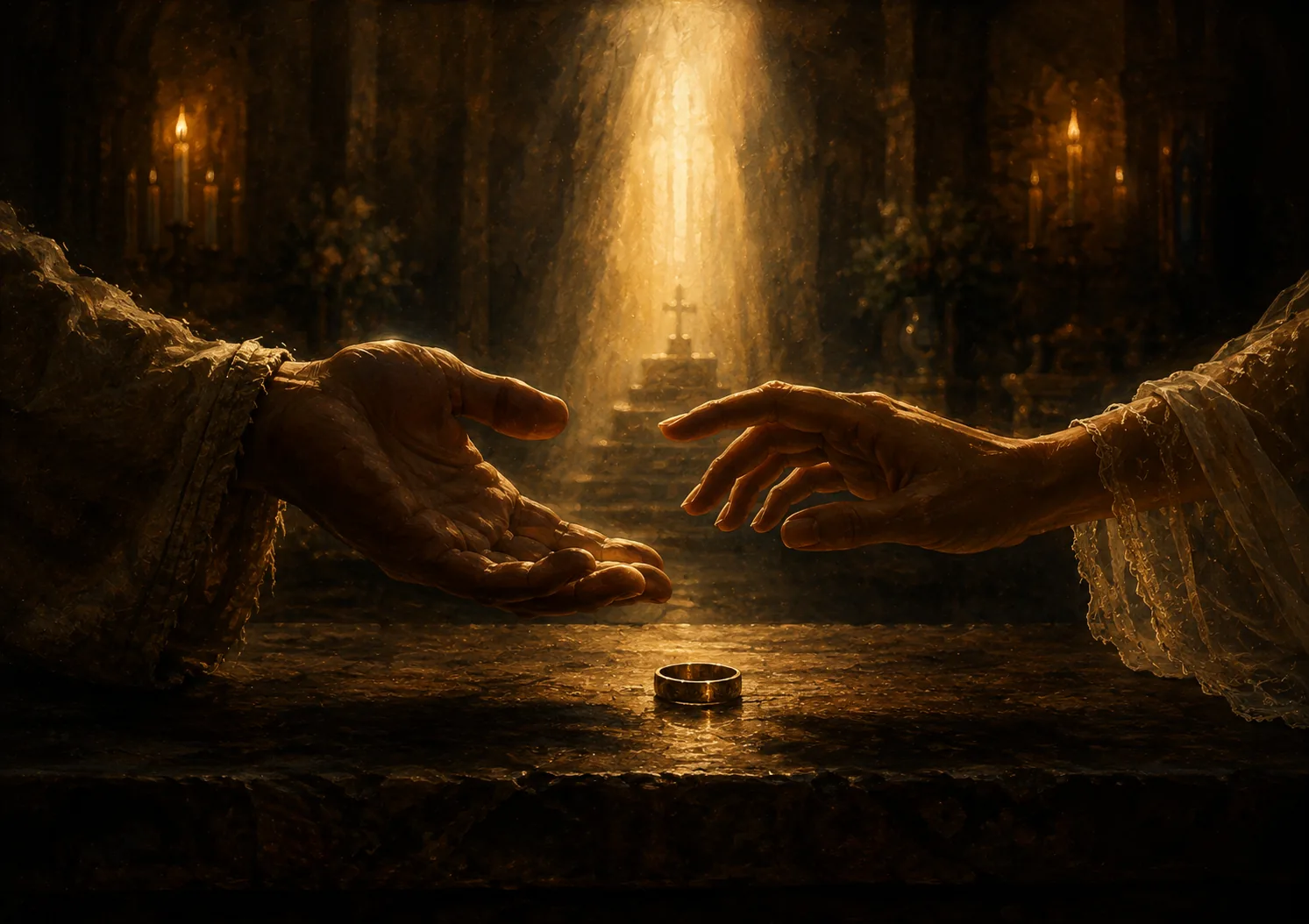
I. I Believe in You
You have said this, and meant it.
The night before the hard thing — the surgery, the audition, the day in court — someone who loves you takes your face in their hands and says it: I believe in you. And whatever you heard in those four words, it was not a report on your existence. Your existence was not in question. You were standing right there. They were not saying I have concluded that you are real; they were saying something enormous and particular and impossible to say any other way, and you knew exactly what it was, and it went straight past your mind and landed somewhere lower down.
Now set another sentence beside it: I have faith in you. Notice that it means the same thing. Not something close; the same thing. You could swap them at the door of the operating room and lose nothing. Two of the most ordinary sentences in the language, and neither one is about whether anybody exists — and the two are interchangeable. That is a strange fact to sit still under, and worth sitting under: almost everything that has gone wrong in the last two centuries of arguing about God is folded up inside it.
Here is the trouble in one line. There is another way we use the word believe, and it is not this way at all, and we have let the two collapse into one. I believe it's going to rain. I believe the keys are in the drawer. I believe there is intelligent life somewhere in the galaxy. Those are opinions — guesses about facts, held more or less firmly, rising and falling with the evidence. And that is the sense we now hear, by reflex, when someone says I believe in God. We hear a person reporting the odds: given the uncertainty, my estimate is that a God exists. We hear a hypothesis, held without proof, about an invisible fact.
But that is not what the words are doing when a mother says them to a child at the free-throw line. And it was never what they were doing in the mouth of the tradition that built its whole life on them. The person who first wrote I believe in God was not rating a probability. He was doing what you do at an altar. The word for that thing has a history, and we have lost it, and losing the word cost us the thing. What follows is an attempt to find it again — starting from the one sentence you have already said, and already meant.
II. Two Words in One
Start by pulling the two senses apart, because everything follows from the fact that they are not the same, and not even the same kind of thing.
Call the first one belief-that. Its object is a proposition — a statement that can be true or false. I believe that it's raining. It lives in the head; it is a verdict on the evidence; you can hold it at any strength from a hunch to near-certainty, and its strength tracks the case for it. Give me a reason and it goes up; give me a counter-reason and it goes down. It is, at bottom, an opinion — a very useful kind of thing, the kind of thing science is made of, and the kind of thing you want your engineer to have plenty of about the bridge.
Call the second one belief-in. Its object is not a proposition but a person. I believe in you. It does not live in the head; it lives in the will and the affections. It is not a verdict on evidence — it is a stance you take, a leaning-toward, a decision to trust and to stay. And here is the test that shows the two are different in kind and not merely in degree: they can come apart completely, in both directions.1 You can believe that every true thing about a person — that she is competent, honest, and kind, each proposition well supported — and still, in the moment it costs something, fail to believe in her. And you can believe in someone — throw your lot in, stake yourself, stand there when it is expensive — well past the point where the propositions you could cite would justify it. A parent believes in a child the world has written off. That is not bad statistics. It is a different act entirely.
The philosophers who have worked this seam have tried, some of them, to reduce the second to the first — to say that believing in your friend is just believing that she has a list of good qualities, plus a warm feeling.2 Even at their most reductive they cannot quite make it go: there is always a residue left over, an element of trust, of esteeming and entrusting, that the flat proposition I think she is real and competent does not contain and cannot supply. That residue is the whole thing. That residue is what the mother hands the child at the free-throw line, and it is not a fact she is reporting. It is a self she is offering.
Which is why the plainest human picture of belief-in, stripped of every distraction, is a person at an altar saying two words. I do. No one has ever mistaken a wedding vow for a claim about the groom's existence. The bride is not announcing her opinion that he is real. She is pledging herself — her loyalty, her future, her whole weight — to a person standing in front of her whom she cannot see the inside of and cannot prove. The vow does not report a fact about the world. It puts something into the world that was not there before. Hold that picture. It is the oldest meaning of the word we are chasing, and it is about to turn out to be the biblical one.
III. The Word Remembers
Lead with the claim the etymology will support, and then let it support only what it can. The older language kept these two senses apart, and though the seam has been painted over, you can still find it in the grain of the words.
Begin with believe itself. It is built — this is not in dispute — on the same ancient root that gives us love, and gives us the old word lief, meaning dear.3 To be-lieve is kin to to be-love. I have to be careful here, because there is a beautiful overclaim waiting in this fact and I would rather hand it back than lean on it: it is not that Old English speakers went about defining "believe" as "to love" — the earliest sense is a reconstruction, hedged by the people who reconstruct it. What is solid is the kinship of the roots, and the direction it points. The taproot of believe is closer to holding dear than to rating probable. Whatever else the word was, it grew out of the soil of loyalty and love, not the soil of evidence and opinion.
And the split I have been describing is not something I am reading back into history. It is on the record. There was a time when English kept the labor divided between two words: belief carried the sense trust in God, and faith carried the sense loyalty to a person, pledged by promise or duty.4 Then, in the fourteenth century, the words traded places and jobs. Faith took over the religious sense; belief was pushed the other way, toward mental acceptance that something is true — and by the fifteen-hundreds it had hardened into the definition a dictionary will still give you, the fatal one: the conviction of the truth of a proposition — and then three words that ruin everything — without knowledge. That is the moment the trap was set. From then on, to say I believe in God could be heard as I hold, without knowledge, the opinion that a God exists — and the sentence a bride says at an altar was quietly refitted to mean the sentence a gambler says at a table.
One more word, the most important one, because the whole tradition put it first. The creeds do not begin I have concluded that. They begin credo — I believe — and credo is built on cor, the Latin for heart (the same root under cordial, and courage, and record).5 To say credo is to do something with the heart. Here is the second piece of honesty. There is a cherished gloss that says credo is cor plus do, "I give my heart," and it is very nearly right and not quite. The second half of the word is not the verb to give; it is an older root meaning to place, to set, to put.6 So the accurate rendering is a shade less sentimental and, I think, better: not I give my heart but I set my heart on — I put my trust here, I entrust myself. It is the language of a deposit, of a thing handed over for safe keeping; the same root gives us creditum, a thing entrusted, which is why, when we lend money on trust, we still say we extend credit. The creed was never a checklist of propositions a person certified as true. It grew out of a vow — the thing a new believer said at baptism, closer in form to a soldier's oath of loyalty than to a scientist's estimate. Credo meant: here is where I place my heart.
Wilfred Cantwell Smith, who spent a career on exactly this, put it as plainly as it can be put: to believe, in older English, was to belove — to hold dear.7 The word we now use for holding a shaky opinion about an invisible fact once meant holding a person dear. We did not just change how we talk. We forgot what we were talking about.
IV. The Demons Pass the Test
If the distinction were only a matter of English usage, it would be a curiosity. It is more than that, and the tradition itself is where the knife comes out. Scripture does not merely permit the line between believing-that and believing-in; it draws the line, and then it uses the line to condemn the wrong kind of faith by name.
Here is the verse, and it should stop you. "Thou believest that there is one God; thou doest well: the devils also believe, and tremble."8
Read it slowly. The demons believe that there is one God. On the question that our whole modern argument treats as the entire game — does God exist? — the demons are not agnostics. They are not even theists in the hopeful, uncertain way a person might be. They know. Their belief-that is flawless, better-evidenced than yours or mine will ever be, a proposition held with total conviction and zero doubt. And James's verdict on that faith is devastating and flat: thou doest well — said the way you would say it to a parrot that got the answer right — and then, the devils also believe, and tremble. The one population in all of scripture with certain, unclouded knowledge that God exists is the population of hell, and their certainty is indistinguishable from terror.
So whatever the faith is that the tradition asks of you, it cannot be this. It cannot be assent to the proposition God exists, because the damned have that in full and it saves no one. The thing being asked for is of another kind entirely — the kind you cannot get to by being more sure. You could raise your confidence that God exists to a hundred percent, could have it proved to you past all possibility of doubt, and be, by this verse's own accounting, no closer to faith than a demon. Certainty was never the thing. The demons are certain. What the demons cannot do — what they refuse, which is why they tremble — is the other thing: to trust, to hand themselves over, to say I do.
V. What the Tradition Actually Asked
If the faith being asked for is not belief-that, then the natural question is what it is — and the answer is written into the very words the tradition used, in every language it used them. Follow the word back and it says the same thing each time: trust, faithfulness, fidelity, the setting of the heart. Never once: a good opinion about an uncertain fact.
Start in Hebrew, because the taproot is there. The word is emunah, and it does not mean intellectual assent — it means firmness, steadfastness, faithfulness, reliability.9 It is what a thing has when it holds; it is said of a pillar that bears weight and of a friend who does not leave. Its root is aman — and if that root sounds familiar in your mouth, it should, because it is the root of amen. The word a congregation says to seal a prayer, to throw its whole assent behind what was said — let it be firm, let it stand, truly — is the very word for faith. To say amen is to perform an act of emunah: not to note that a proposition is probable, but to plant yourself on it. When the tradition wants to show you faith, it does not point to a person weighing evidence. It points to Abraham, of whom it says the sentence Paul would build half his theology on: "And he believed in the LORD; and [They] counted it to him for righteousness."10 The verb is from that same root — he entrusted himself, he leaned his weight on God — and what was counted to him as righteousness was not the accuracy of his cosmology. It was the leaning.
Then cross into Greek, where the New Testament lives, and the word is pistis, with its verb pisteuō. Reach for the standard lexicon: one of its two governing definitions of the verb is not an opinion at all but to entrust oneself.11 The word means trust, fidelity, faithfulness, the loyalty that binds two parties in a covenant — the same word a Greek would use for keeping faith with an ally. And watch what John's Gospel does with the grammar, because it is almost untranslatable and it gives the whole thing away. John does not, as a rule, write that you believe that something is the case. He writes pisteuō eis — you believe into. Whosoever believeth into him should not perish.12 You cannot believe into a proposition; the phrase is nonsense applied to a fact. You can only believe into a person — move toward, adhere to, entrust yourself, fall in. The grammar itself is a body leaning across a threshold.
So here is the shape of what happened, and it is a translator's tragedy in four steps. The Hebrew emunah, steadfast faithfulness, was carried into Greek as pistis, trust and fidelity, which was carried into Latin as fides, the loyalty of a pledge — and then into an English faith that still held some of it, and finally shunted onto an English belief that had, as we have seen, been hollowed out into an opinion held without knowledge. Each handoff was faithful enough. But by the end of the relay the word at the finish line meant something close to the opposite of the word at the start. The tradition asked will you entrust yourself? and the question reached us as do you happen to think it's true?13
VI. About the Unseen, Not the Unevidenced
There is one verse that the modern misunderstanding leans on harder than any other — the verse everyone reaches for to prove that faith just is believing without evidence — and it is worth stopping on, because it says very nearly the reverse of what it is made to say.
"Now faith is the substance of things hoped for, the evidence of things not seen."14 There it is, the case for the prosecution: faith deals in things not seen, therefore faith is belief in the unproven, therefore faith is exactly the epistemic vice its critics say it is. But look at the two words the English softens. Substance is hypostasis — a heavy, concrete word; in the legal papyri of the period it is the word for a title-deed, the document that stands under a claim and guarantees it. And evidence is elenchos — not a gap where evidence should be, but the Greek word for proof, for the cross-examining test that demonstrates a thing is so. So the verse is not confessing that faith lacks grounds. It is claiming, audaciously, that faith is the grounds — the title-deed of what is hoped for, the proof of what is not seen.
And that last phrase is the one that has been misread for centuries by turning one word into another. Things not seen is not things not evidenced. The unseen is not the unproven. There is a vast territory of the real that no eye has ever fallen on and that is not thereby doubtful — your own mind, to begin with, which you have never seen and do not doubt; the loyalty of your oldest friend, which does not show up on any instrument and which you would stake your life on. Faith, on the tradition's own account, is not the willful ignoring of evidence about the visible. It is the faculty by which a person stands firm toward the invisible — the same faculty, exactly, by which you stand firm toward a friend across a distance you cannot see into. The critics have caught a real fish in the wrong net. There is a kind of "faith" that means believing against the evidence. The tradition's word was never it — and its own most-quoted sentence on the subject says the opposite in the plainest Greek it has.
VII. The Two Who Make the Same Mistake
Now the strongest possible version of the other side, in its own words, because if I am right it is not only wrong but wrong in a way that reveals the whole confusion at once.
Richard Dawkins has said it as well as anyone, and he has said it more than once, so it is fair to take it as his settled view: "Faith is the great cop-out, the great excuse to evade the need to think and evaluate evidence. Faith is belief in spite of, even perhaps because of, the lack of evidence."15 Concede it fully: a great deal of it is true and the concession costs me nothing. There really are people who use the word faith to mean precisely that — the willed holding of an improbable belief in defiance of the evidence, with the strain of the holding counted as a virtue and the demand for evidence treated as the sin. That faith exists. It is common. And it deserves every word of Dawkins's scorn; I have no interest in defending it, and neither did the tradition, whose own scripture (we just read it) says faith is a title-deed and a proof, not a refusal to look.
But here is the turn, and it is the whole point of the essay. That definition — faith is belief without evidence — is a modern stipulation, and the one who most fiercely attacks it and the one who most fiercely defends it are making the identical mistake. The New Atheist and the fundamentalist agree, completely, on what faith is. Both of them define it as assent to an improbable proposition. They differ only on the follow-through — one prosecutes the assent as a crime against the intellect, the other preaches it as a duty of the soul — but they are bent over the same object, arguing about the same thing, and it is the wrong thing. It is the broken half of a word. Somewhere back in the fourteen-hundreds the language snapped belief-in off from belief-that, and the trust-and-fidelity half fell to the floor and was swept up, and the opinion-about-a-fact half was left on the table — and here are two armies who have spent a century fighting over the piece on the table, each certain the other is the enemy, neither having noticed that the thing they are fighting about is a fragment. The atheist is right that belief-that God exists, held without evidence is a poor foundation for a life. The believer who builds on it has built on the same poor thing. They are, God help them, on the same side of the only line that matters, and the line runs somewhere else entirely — between the piece on the table and the piece on the floor.
VIII. The Vow
So come back to the altar, where we started, because everything has been walking toward it.
No one has ever asked the bride, before she says I do, to first establish that the groom exists. The question would be a kind of madness; it would mean she had misunderstood, at the deepest level, what she was there to do. She is not there to certify a fact about the world. She is there to pledge a self — to hand over her loyalty and her future and her whole weight to a person she cannot see the inside of and could never prove, and to do it not because the evidence has forced her hand but because she has decided, freely, where to place her heart. I do is belief-in in its purest human form. And it is, to the letter, the word the tradition used for faith in God. Faith is the I do, said to the One you cannot see.
One last thing, laid down lightly, because it is the deepest reading and the close should not be freighted with it. The tradition's own central phrase for the faith that saves — pistis Christou — is grammatically ambiguous in a way that has kept scholars busy for fifty years, and one of the two readings is quietly enormous.16 It can mean faith in Christ — our trust, directed at Him. But it can also mean the faith of Christ — His own faithfulness, His own fidelity unto death, as the thing that actually saves. And if that reading holds, then even faith turns out not to be a burden laid on us — not a proposition we must strain to believe, not a feat of certainty we must perform — but first of all His steadfastness, into which we are invited to lean. The vow that matters most was already spoken, and faithfully kept, by someone else. Ours is only the amen.
I am not going to end by handing you a proof that God exists. That was never the thing being asked, and to offer it now would be to make, at the last line, the very mistake the whole essay has been trying to undo. I am going to do something smaller and, I think, harder. I am going to take the question we have all been trained to think is the religious question — do you believe that God exists? — and set it down on the floor next to the other broken piece, where it has been lying all along, and leave the cleared place empty. And in the empty place I will put back the question the word was always asking, the one the bride answers, the one that has nothing to do with whether you can prove anything and everything to do with what you will do with the one life you have been handed. Not what do you believe? But: in whom? To whom will you give your heart?
Footnotes
-
The distinction between belief-in and belief-that is developed by H.H. Price, Belief (London: Allen & Unwin, 1969) — his Gifford Lectures, delivered 1960 — and in "Belief 'In' and Belief 'That'," Religious Studies 1.1 (1965), 5–27. Belief-in takes a person (an object of trust and reliance) as its object; belief-that takes a proposition. ↩
-
Price himself leans partly reductive — much "belief in" can be unpacked into a set of "beliefs that" — yet concedes an irreducible evaluative element (esteeming the object as good) that propositional belief lacks. Non-reductive accounts (in the religious-epistemology tradition, and W.C. Smith's use of it — see §III n. 5) hold trust/self-commitment to be sui generis. Either way, the residue of trust is granted; that is all the argument needs. ↩
-
believe ← Old English belȳfan / gelēafa, from Proto-Germanic ga-laubjan (cf. German glauben, Gothic galaubjan), from Proto-Indo-European leubh- "to care, desire, love" — the root also of love, lief ("dear"), and libido. The root kinship is standard (Watkins; OED; etymonline). The gloss that the Germanic verb meant "to hold dear" is offered by the etymologists themselves with a "perhaps" — a reconstruction of the semantic bridge, not an attested Old English definition. Claimed here only as far as it goes: shared root, and the direction it leans. ↩
-
Per etymonline, belief formerly carried the sense "trust in God," while faith meant "loyalty to a person based on promise or duty"; in 14c. translations faith took the religious sense and belief was pushed toward "mental acceptance of a thing as true." The noun belief narrows by the 1530s to "conviction of the truth of a proposition or alleged fact without knowledge." (etymonline.com/word/belief; /word/believe.) ↩
-
Latin crēdere "to trust, confide, entrust, believe," from PIE ḱred-dʰeh₁- = ḱerd- "heart" (→ Latin cor; English cardiac, cordial, courage, record) + dʰeh₁- "to put, place, set." The Sanskrit cognate śrad-dhā- ("faith, trust") is the identical "heart + place" compound. The heart-connection is consensus (de Vaan, Etym. Dict. of Latin; Watkins). ↩
-
This is the honest flag. The popular parse credo = cor + dō ("I give my heart") mistakes the second root: it is dʰeh₁-, "to put/place/set" (behind Greek títhēmi, English do), not dare / deh₃-, "to give." The two fell together in Latin form, which is how the folk refinement got in. "I give my heart" captures the spirit and tidies the grammar; the older, exact sense is to set the heart on / to entrust. ↩
-
Wilfred Cantwell Smith, Faith and Belief: The Difference Between Them (Princeton, 1979); cf. Belief and History (1977). His thesis: faith is the whole person's orientation of trust and self-commitment; belief, in modern English, has "degenerated" into holding an opinion about a proposition — so that rendering the pistis / fides / emunah / śraddhā of the traditions as "belief" misrepresents them. Smith is much criticized (the charge is a genetic fallacy — an older meaning is not thereby the true one — and that faith cannot be wholly emptied of propositional content). Both cautions are fair; the argument here needs only that the two are different in kind, which even his critics grant. ↩
-
James 2:19 (KJV). The Greek verb is pisteuō (believe/trust); the demons' response is phrissousin, "shudder, bristle." James's whole argument in 2:14–26 turns on the uselessness of a pistis that is bare propositional assent (the demons have it) apart from the trust that acts — which is why the chapter insists faith without works is dead. The verse is the tradition making the belief-that / belief-in distinction in its own voice. ↩
-
Hebrew emunah (אֱמוּנָה), "faithfulness, steadfastness, reliability," from the root aman (אמן), "to be firm, reliable" — whence also amen (אָמֵן), "truly, let it be firm." Used of human steadfastness (Hab 2:4) and of God's (Deut 32:4; Lam 3:23). Habakkuk 2:4, "the just shall live by his faith," most naturally reads by his faithfulness; note the disputed suffix (the righteous one's fidelity, or God's — the Septuagint has ek pisteōs mou, "by my faith[fulness]"). ↩
-
Genesis 15:6 (KJV). The verb is he'emin (Hiphil of aman): trusted, relied on, entrusted himself to. Paul makes it the hinge of Romans 4 and Galatians 3:6 — Abraham reckoned righteous by trust, prior to law and apart from works. ↩
-
BDAG (the standard NT Greek lexicon) gives two principal senses for pisteuō; the second is "to entrust oneself to an entity in complete confidence," and even the first — "to consider something to be true and therefore worthy of one's trust" — is defined through trust, not bare assent. pistis ranges over trust, confidence, faithfulness, fidelity, and (in the wider Greek world) a pledge or guarantee given in a relationship. The fullest recent study is Teresa Morgan, Roman Faith and Christian Faith: Pistis and Fides in the Early Roman Empire and Early Churches (Oxford, 2015): pistis/fides is primarily relational trust binding persons, not first of all propositional belief. (Matthew Bates, Salvation by Allegiance Alone [2017], presses pistis toward "allegiance"; it is a stronger, contested reading — noted, not leaned on.) ↩
-
John 3:16 (and 3:18, 6:29, 20:31): pisteuō eis + accusative, "believe into." Grammatically unusual — one does not "believe into" a proposition — and read by most exegetes as adherence to, self-entrusting to, a person. John 20:31 holds both together: "that ye might believe that Jesus is the Christ… and that believing ye might have life through his name" — belief-that issuing in belief-into. Don't sever them. ↩
-
The relay emunah → pistis → fides → faith → belief. Each translation is defensible; the drift is cumulative, and lands (per §III) on an English "belief" that by the 1530s meant "conviction of a proposition without knowledge" — the far end from Hebrew firmness/fidelity. ↩
-
Hebrews 11:1 (KJV). hypostasis = "that which stands under," foundation, substance; in Hellenistic legal usage, a title-deed or guarantee of ownership. elenchos = proof, conviction, the evidence that tests and demonstrates (cf. the verb in 2 Tim 3:16, "reproof"). The verse predicates assurance and proof of faith regarding things unseen — a claim about the invisible, not a licensing of the unevidenced. ↩
-
Richard Dawkins, from a lecture at the Edinburgh International Science Festival, 15 April 1992, printed as "A scientist's case against God," The Independent (London), 20 April 1992. The line is frequently misattributed to The God Delusion (2006); it predates that book by fourteen years. Cognate definitions ("blind trust, in the absence of evidence, even in the teeth of evidence") recur in The Selfish Gene and "Viruses of the Mind." Read generously: Dawkins's target — willed belief against the evidence — is real and worth attacking; the error is that he has mistaken it for the whole of what the word means. ↩
-
pistis Christou (Galatians 2:16, 20; 3:22; Romans 3:22; Philippians 3:9): the genitive is ambiguous. The objective reading, "faith in Christ" (our faith directed at Him), is traditional (defended by James D.G. Dunn). The subjective reading, "the faith[fulness] of Christ" (His own faithful obedience as the ground of salvation), was pressed by Richard B. Hays, The Faith of Jesus Christ (1983), and is supported in various forms by Morgan and others. Galatians 2:16 is the flashpoint, containing both the phrase and the verb "we believed in Christ" in one sentence. Offered here as a reading, held lightly — the close does not depend on settling it. ↩