Jealous of a Calf
On the fear of God, and the room where it was said.
I. The Residue
Isaiah watches a man make a god, and refuses to skip a single step of it. The man has a tree. He cuts it down. He burns half of it — warms his hands at it, bakes his bread on it, roasts his dinner over it, and says, with real satisfaction, Aha, I am warm, I have seen the fire. Then he takes what is left. Not the heartwood, not the first cut: the residue, the offcut, the part that would not fit in the stove. He carves it, stands it up, kneels down in front of it, and prays. Deliver me; for thou art my god.1
The prophet is not being unfair. He is being exact. That is what the competition looked like.
This is the part of the Old Testament that modern readers skim, because we assume the argument is over and we won it. But it is the situation every sentence in the Law was spoken into, and two of that Law's most famous claims cannot be read at all without it. When the God of Israel says thou shalt have no other gods before Me, the other gods on offer are not rival infinities. They are not competing accounts of the ground of being. They are, in the plainest and most literal sense, objects — a bull cast out of jewelry, a pole in the ground, a length of lumber that an hour ago was going to be firewood.
We don't read it that way, because two attributes of that God have become unsayable in educated company. The first is that God is to be feared. The second is that God is jealous — and the text does not soften it; it says the name is Jealous.2 Between them, those two words have done more to make the God of the Old Testament sound like a bad husband than every conquest narrative combined. A being who demands to be feared and cannot stand to be shared: we know that man. We have met him. Some of us grew up in his house.
I am not going to soften either word. Word-softening is what has been done to this material for a century, and it doesn't work; the reader can smell it, and the words come back the moment the sermon ends. Instead, both of them go back in the room where they were said. Both turn out to mean something other than what we hear, and — this is the part that surprised me — they turn out to mean the same thing, approached from two sides.
And the room has a consequence I didn't expect when I started, which is most of why I am writing this down. If the jealousy was aimed at a calf, then it was never aimed at anybody's rival infinite — because nobody has one. There cannot be two. Which means the commandment we have spent three thousand years using as a boundary between religions was never a boundary between religions at all. The line it draws runs somewhere else, and it runs through the middle of each of them, including mine.
II. Two Fears in One Sentence
I should say where I am standing. I was raised without any of this — no church, no God-language, nothing to lose my faith in. Jesus found me as an adult, late, and I can tell you exactly which half of the inheritance went down easily. God-fearing needed no explaining: my first experience of authority was a fearful one, so a God you had to watch out for was a shape I already knew the feel of. God is love was the sentence that sounded like a slogan. That is the wound it is written from. It is not the argument, and I will not lean on it again.
Here is the argument, and it starts with a concession, because the move I am about to make is one you have every right to distrust.
The move is: the original word didn't mean what you think — in the Hebrew it means awe. You have heard it from a pulpit. It is a favorite of the reassurance industry, and it is very often a fraud. James Barr spent a career on exactly this, showing how theologians build doctrines out of etymologies and then smuggle a word's entire lexical range into a single verse — the root fallacy, and what he named illegitimate totality transfer.3 He was right. A word does not mean everything it has ever meant, and a Hebrew dictionary is not a decoder ring for getting out of a hard text.
So, precisely: Yirah doesn't secretly mean awe. It runs the whole range, terror to reverence, exactly as the English word fear once did. In 1611 the reverence sense was ordinary — ordinary enough that an English dictionary was still separating the reverent kind from the frightened kind two hundred years later, which is the whole reason God-fearing was ever a compliment.4 The King James translators were not wrong. English drifted. The word narrowed under us until it meant only the flinch, and we kept reading the old sentence with the new word in it.
Which would leave us where we started, if the text did not settle it itself. It does, and it does it in one verse.
The people are at the mountain. There is thunder and fire and a sound like a trumpet, and they are so frightened they beg Moses to take the message himself and spare them the voice. And Moses answers them:
Fear not: for God is come to prove you, and that [Their] fear may be before your faces, that ye sin not.5
Fear not — and, in the same breath, that [Their] fear may be before your faces. Both words come off the same Hebrew root. One is a verb he tells them to stop; one is a noun he wants left standing. That is not a translator's fumble and it is not a modern rescue: it is the sentence making a distinction, in the one place the distinction matters most, at the mountain, to people who were already terrified. Whatever Moses is telling them to drop, and whatever he wants them to keep, cannot be the same thing.
And you can find the difference elsewhere by usage, without touching an etymology. The wisdom literature sets the fear of the LORD in parallel with the knowledge of the holy — the second line glossing the first, which is what Hebrew poetry does.6 Deuteronomy names what is required of Israel and puts fearing God and loving God inside a single sentence, as one requirement.7 Note what that costs you if the word means dread. You cannot command a phobia. You can command an orientation — a direction to face, a thing to hold steadily in view — and you can command love, which is also not a feeling you can produce by deciding to. Put those together and you have the shape of what is being asked: not a flinch, but attention that does not look away.
The concession, and it belongs on the page rather than in a note.
There are texts where the fear is terror and no amount of lexicography touches them. Uzzah puts out his hand to steady the ark when the oxen stumble — a reflex, a good one, the instinct of a man who does not want the holy thing in the dirt — and he dies there beside it.8 I have no reading of that which makes it comfortable, and I distrust everyone who does. It stays on the page.
The claim I am making is smaller and firmer than the one that would explain Uzzah. It is this: the fear the Law commands is not the fear the Law tells you to drop. Two things, one root, distinguished in one sentence by the man who was standing there.
III. Jealousy Is a Covenant Word
The other word is harder, because it does not sound like a mistranslation. It sounds like a confession.
The Hebrew is qanna', and its distribution is strange enough to be worth stating carefully. As an adjective it is used of no one but God — five verses, six occurrences, and one of them is the astonishing line in Exodus 34 where it is not a description but a name: the LORD, whose name is Jealous.9 I want the precision here, because this is exactly where an essay like this overclaims and gets knocked over: the root is ordinary, and it is used of human beings all over the Hebrew Bible. It is the adjective, the fixed epithet, that belongs to God alone.
And the register it belongs to is not the throne room. It is the marriage law. The word's ordinary home is the covenant between two people who have promised each other exclusively, and the spirit that rises in one of them when the promise is in question.10 That is the frame the text is reaching for when it applies the word to God — not a king guarding his prerogatives, but a spouse.
Which brings up the distinction English has almost entirely lost. Envy wants what another person has. Jealousy guards what is already one's own. They are not two intensities of the same thing; they are aimed in opposite directions. Envy looks across at a rival and wants to take his place. Jealousy looks at a bond it is already inside of and refuses to see it divided. We collapsed them into one word somewhere along the way, and now every time the Old Testament says jealous the modern ear hears envious — and hears, therefore, a God anxious about Their standing among competitors.
Which matters, because the accusation people actually make — that this is a God anxious about being outranked — is an accusation of envy. And envy is the word the text did not use.
I don't think that finishes it. A covenant word is still a possessive one, and I will not share you is a sentence that has been used to justify a great deal of harm by people who had no business saying it. Naming the philology does not dissolve that. What dissolves it is a different question, and it is a historical one:
Who, exactly, was the rival?
IV. There Were No Rivals
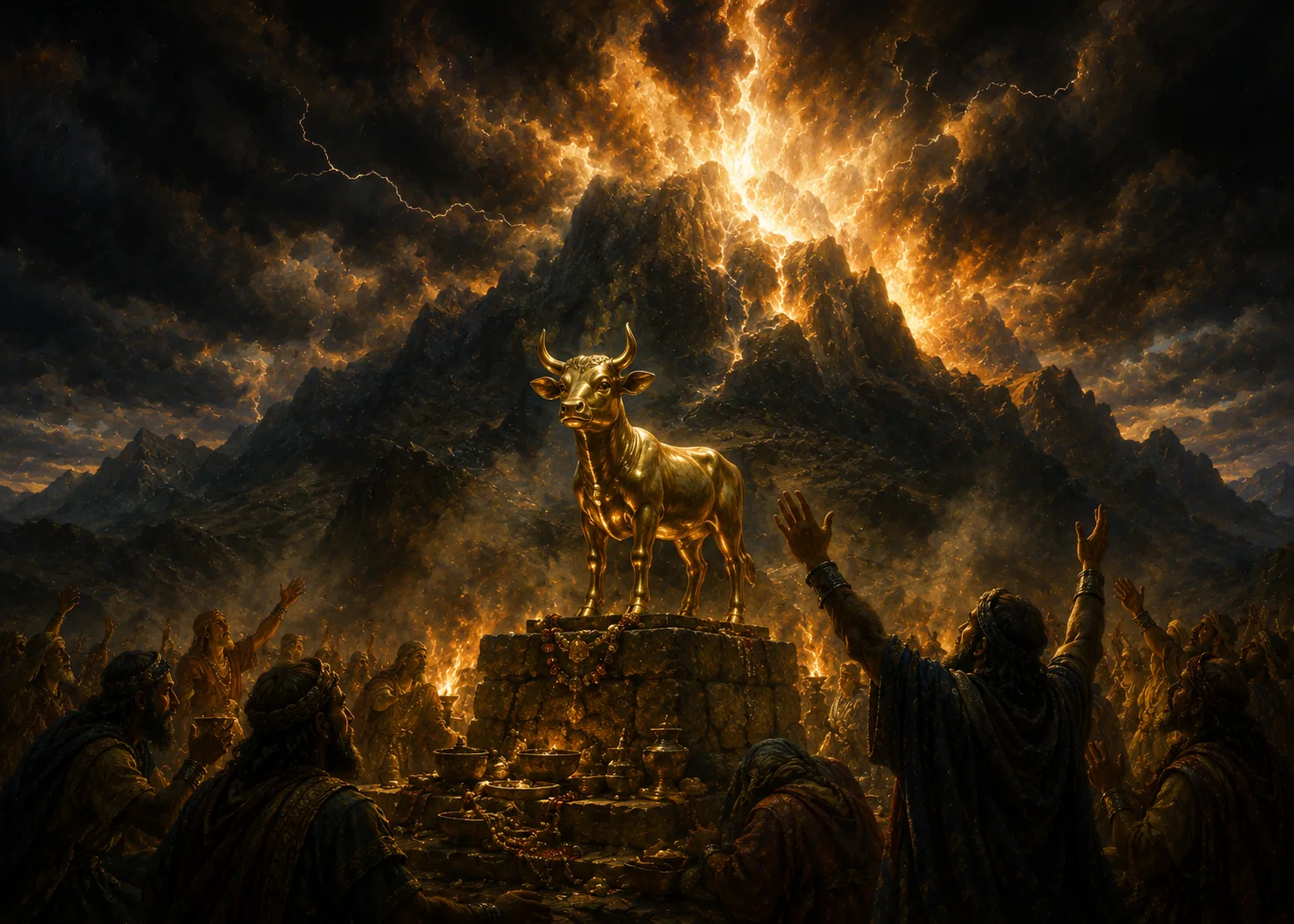
The scene is famous enough that we have stopped looking at it. Moses is up the mountain too long. The people ask Aaron for gods to go before them. Aaron tells them to bring the gold, and they do, and he casts a calf, and they say: These be thy gods, O Israel, which brought thee up out of the land of Egypt.11
Two hundred years or so later, a king does it deliberately. Jeroboam, needing his new northern kingdom to stop walking to Jerusalem to worship, makes two calves of gold, puts one in Bethel and one in Dan, and says — the same sentence, almost word for word — behold thy gods, O Israel, which brought thee up out of the land of Egypt.12 So this is not a panic in a desert. It is a standing institution, with royal backing and a functioning priesthood, and it lasted.
Now, the honest scholarship, because it cuts against the cheap version of my point and I would rather run it myself than have it run at me.
The people who made these calves weren't simpletons who thought a cow made the world. Across the ancient Near East, gods were routinely depicted standing on a bull — the animal serving as the deity's mount or pedestal, the way a throne serves a king. Baal appears astride the bull in Aramean reliefs; at Ugarit the high god El carries the epithet Bull. On that reading the calf at Sinai was not the god at all. It was the pedestal for a god who remained invisible, and the sin was not zoolatry but a breach of the ban on images.13
Some scholars accept that reading; others answer, reasonably, that in actual ancient practice the line between a god and its image blurred almost immediately, which is why every prophet who attacks idolatry attacks it as though the statue were the point — because for the man kneeling, it was.
And here is why I am glad to concede the sophisticated reading: it makes the situation worse, not better. Take it at its most refined, and the alternative to the God of Israel was furniture for a local weather-god — a piece of temple equipment representing a being who ruled a region, could be relocated, and had colleagues. Take it at its most ordinary, and it was the furniture itself. Either way, nothing in that room was infinite. Nothing in that room made anything.
The prophets say so, and they are funnier about it than we are. Elijah, on Carmel, watching four hundred and fifty men shout at an altar all morning, waits until noon and then offers suggestions: shout louder, he says, maybe he is talking, or busy, or on a journey — or peradventure he sleepeth, and must be awaked.14 The joke only works because Baal was the kind of god who might, in fact, be asleep. It wouldn't land against the God who has no competitor to be preferred over.
One more piece of the room, and it is the one that keeps this from being an essay about foreigners. On storejars at a desert waystation called Kuntillet 'Ajrud, dated to around 800 BCE, someone wrote out blessings by YHWH of Samaria and his asherah.15 That is Israelite handwriting, invoking the God of Israel by name, paired with something else. A second one on the same site blesses by YHWH of Teman and his asherah and then finishes may he bless you and keep you — which is the priestly blessing out of Numbers, word for word, with the addition carried along inside it. Whatever the exact meaning of that pairing — the scholarship argues about it — the practical situation is not in doubt, and the prophets describe it constantly: the covenant kept alongside a second arrangement, insurance taken out quietly, the name retained and the exclusivity dropped.
So the jealousy language is not aimed at strangers who never knew better. It is aimed at people who believed they were keeping the covenant.
And that is what dissolves the insecurity reading. Jealousy of a peer is insecurity. There was no peer. A God who has to worry about being displaced by a mount for a storm-god is not the God who had just emptied Egypt; the anxiety would be incoherent. Whatever the jealousy is protecting, it cannot be a position that was never under threat.
And once you have seen that, a second thing follows that is harder to say in public, because the same reasoning does not stop at the desert.
V. There Cannot Be Two
We now use thou shalt have no other gods before Me as a boundary marker between religions — my God against your God, the jealousy being what makes the border hostile. That reading is unavailable, and the reason is not tolerance. It is arithmetic.
There cannot be two infinites. Two would have to differ, and to differ is for one to have something the other lacks — a place where one stops and the other keeps going. That place is a limit, and a limited infinite is not one. This is not a modern ecumenical convenience; it is the standard scholastic proof of the unity of God, and Aquinas runs it straight off the infinity of the divine perfection: if there were many, they would have to differ, and to differ is to be missing something.16 The same argument is the spine of tawhid in Islam and of the Shema in Judaism.
So when a Christian and a Muslim argue about God, whatever they are doing, they are not arguing about two infinites. There is only one who answers to that description, and both of them are pointed at Them.
In the Muslim case the word gives it away before the argument starts. Allah is not the proper name of a rival deity. It is the Arabic word for God — al-ilāh, "the god" — cognate with the Hebrew Eloah and with the Aramaic Alaha that Jesus Himself would have used for God in His own language.17 Arabic-speaking Christians used it before Islam existed and use it today; an Arabic Bible opens with Allah creating the heavens and the earth. Whatever else is in dispute between the two religions, at the level of the word the "different God" question is a question about a translation.
And the Qur'an makes the claim itself, in the specific case. Addressing Jews and Christians — the People of the Book — it instructs believers to dispute with them only in the better way, and to say: We believe in that which hath been revealed unto us and revealed unto you; our Allah and your Allah is One, and unto Him we surrender.18 The word standing in that sentence where an English Bible would put God is the word the last paragraph was about.
The commandment is there too, in the same shape. The gravest sin in Islam is shirk — associating a partner with God, setting anything at all alongside the One.19 Change the vocabulary and you are standing at Sinai. And the most concentrated statement of the doctrine in the Qur'an would not have been out of place at the mountain: Say: He is Allah, the One!… He begetteth not nor was begotten. And there is none comparable unto Him20 — with, elsewhere, the phrase that has anchored a thousand years of Muslim negative theology: naught is as His likeness.21 That is Maimonides' sentence in another accent.
Now the harder case, because it is further away and the vocabulary genuinely differs.
When the Upanishads reach for the reality underneath everything, they decline to describe it. The refusal has a name — neti neti, which Müller renders bluntly as "No, no" — and it is applied to every predicate that offers itself, on the grounds that each one would be a limit on One who has none. What is left is nirguna Brahman: without attributes, ungraspable, not to be had by any description that would make it one item among items.22 A reader who has just come through Maimonides — every positive statement about God is already an error, only the negations hold — will recognize the operation exactly. Two traditions with no meaningful contact, running the same method, for the same reason: not because anyone agreed to, but because of what the infinite is. And the tradition's oldest text carries the line most often quoted for exactly this — ekaṃ sad viprā bahudhā vadanti, which Griffith renders "To what is One, sages give many a title."23 Read the whole verse rather than the fragment and it settles its own meaning: the titles it goes on to list are Indra, Mitra, Varuṇa, Agni, Yama, Mātariśvan. It is a statement about names, which is the whole of what I want it for. Its later career as a charter for religious pluralism is a development of the modern schools, and I am not resting anything on that.
Which raises the objection a Western reader has been holding since that paragraph started: yes, but they have statues. Rooms of them. Whatever the philosophers say, the practice is images, and images are what the commandment was about.
The tradition's own answer deserves to be heard before it is dismissed. The form is not held to be the infinite. It is held to be a form the formless takes for the sake of someone who has to love with a human heart and cannot love an abstraction — saguna standing in front of nirguna, a face lent to the faceless.24 The devotional traditions are built on precisely that: God as a You to be adored rather than an it to be dissolved into — which is the argument of Krishna Is Not Christ.
I don't think it settles the question, and I'm not going to pretend it does. Whether a form confessed to be a form protects you — or whether it is exactly the arrangement Sinai forbade, the right name on the wrong object — is a live question, and I am leaving it open. It is also, and this is the part worth noticing, an argument Hinduism has been having with itself for more than a thousand years, formless against formed, and it didn't need Sinai to start it.
VI. Same God, Different Accounts
None of which makes the traditions the same, and the version of this argument that says so is worth nothing.
The disagreements are not decorative. Judaism does not grant that God became a man, and from inside the Shema the Christian claim that God did is precisely the thing in question. Islam is more specific still: the Qur'an denies the sonship in as many words, warns Christians against saying "Three," and denies the crucifixion outright — they slew him not nor crucified him, but it appeared so unto them.25 I hold that the crucifixion happened and that it is the center of everything. Those two sentences cannot both be true. Somebody is wrong about a Friday outside Jerusalem, and that is not a difference of emphasis.
Now notice where every one of those disagreements sits. Not one of them is about the infinite. They are about what that God has done — whether They took a body, whether the body was Their Son, whether He died on a Friday afternoon. Every live dispute between these traditions is a dispute about the Son. Not one is a dispute about the Father. Ask instead who is being disagreed about — who the Shema confesses, who tawhid insists on, who neti neti refuses to describe — and the argument has nothing to work with, because there is nobody else it could be. There is only one infinite, and the arguing parties are all facing it.
That is not a truce and it costs nothing. The Christological disagreements stay exactly as sharp as they were a paragraph ago; I have not moved them an inch. They are simply not disagreements about which God, and they never were.
A reader who has been with me a while will want to put an essay of mine in the way here, one called Krishna Is Not Christ, and it is the right objection to raise. But look at what that essay refuses and what it grants. It refuses the identity of the two figures: the names, which are not cognate, and a devotion organized around a God who wins set next to one organized around a God who bleeds. What it grants, in its own last sentence, is the referent — Someone had been sung to all along, in a language the singer couldn't speak, and was recognized at the end. The refusal is about the Son. The grant is about the Father. I was making this distinction before I had a name for it.
So here is the distinction the whole thing rests on, and it is not a compromise: a disagreement about what is true of someone is not a disagreement about who is being discussed. It is nearly the opposite. Contradiction requires a shared subject. Two people who describe one person incompatibly are, by that very fact, talking about one person; if they were describing two different people there would be no contradiction at all — just two accounts sitting quietly side by side, with nothing to argue about. The heat between these traditions is evidence of a common referent, not evidence against it.
Which puts both of the usual moves out of reach. The Christian who says Muslims worship a different god has made a claim the arithmetic does not allow. The person who says the differences don't matter has made a claim the texts do not allow. Both are ways of not having the conversation: the first refuses the shared subject, the second refuses the disagreement.
And now the commandment can be put where it actually goes. It does not run between the traditions. It runs through each of them.
Every one of them holds both things at once. Islam has tawhid, and has in every century people its own scholars accuse of shirk. Judaism has the Shema, and had, demonstrably, Israelites blessing by YHWH and his asherah at a desert waystation. Hinduism has neti neti, and has the image argument I just declined to settle. And Christianity — the tradition I am inside, and therefore the one I have any standing to be rude about — has the whole apophatic lineage, and also a mass-produced portrait of a mild Northern European man that hangs in ten thousand halls and is, for a very large number of people, simply what God looks like.26
So the question the second commandment puts to you was never is your neighbor's God the wrong one. It is a worse question than that, and it is addressed to the reader rather than to the neighbor: is the thing you are actually kneeling in front of infinite — or is it the residue?
Which means the text still owes us a reason. If the jealousy is not protecting a position, and was never a border, it is protecting something. It gives one.
VII. What the Harm Actually Is
Psalm 115 walks the length of an idol and inventories it, part by part, the way you would inventory a body at an autopsy. Silver and gold, the work of men's hands. A mouth that does not speak. Eyes that do not see. Ears that do not hear, a nose that does not smell, hands that do not handle, feet that do not walk. It is a catalogue of absences.
Then the psalm turns, and the turn isn't what a modern reader expects:
They that make them are like unto them; so is every one that trusteth in them.27
That is the indictment. Not God is offended. Not the Almighty will not stand for it. The charge is about what happens to the worshipper. You become like what you worship. Kneel to something with no eyes and your own sight narrows; give your life to something that cannot answer and you'll slowly become someone who doesn't expect an answer. The psalm says it as a flat statement of consequence, the way you would warn someone about a chemical.
Which is precisely why a lover's word is the right word for it. Jealousy in the covenant sense is not concern for one's own standing; it is refusal to watch the other person be diminished by something that cannot love them back. If God is not in danger of being displaced — and nothing in that room could displace anything — then the jealousy is not on Their own behalf. It is on yours. The objection to the calf is not the insult. It is what the calf will do to the face of the person kneeling in front of it.
The tradition noticed this a long time ago. Maimonides, reading the whole of the Law and the Prophets, points out that the vocabulary of burning anger, provocation, and jealousy is applied to God in one connection only: idolatry. Nowhere else. And then he presses it somewhere no modern preacher would follow him — arguing that a person who believes God has a body provokes that jealousy more than an idolater does, because they have made the statue on the inside, where no commandment can reach it.28
Whatever that is, it is not a deity defending a threatened standing. It is closer to a physician's severity: an insistence, sounding harsh from outside, about what a false picture does to the mind holding it. (The larger case about pictures of God belongs to the companion essay They/Them.)
VIII. Allegory Is the Oldest Reading, Not the Escape Hatch
At this point somebody is entitled to object that I am doing what religious people always do with the embarrassing parts: turning a story about a cow into a metaphor about the human heart, and thereby getting to keep a text I no longer believe.
It's a fair suspicion, so here is where the allegorical reading of this particular story comes from. It's not from the nineteenth century, and not from a seminary trying to survive Darwin.
It is from Paul, who does it to this exact story, in writing, within a generation.
He is capable of stating the method outright — which things are an allegory, he says of Hagar and Sarah, and then reads them as the two covenants.29 But it is in the letter to Corinth that he does it to the calf. He walks the congregation through the exodus — the cloud, the sea, the water from the rock — and then says: Neither be ye idolaters, as were some of them; as it is written, The people sat down to eat and drink, and rose up to play. That last line is a verbatim quotation of the golden calf feast. And Paul's reason for citing it is explicit: these things were written for our admonition.30 Not they did that. We are in it.
So the allegorical reading of the golden calf is not a liberal softening of the Old Testament. It is the New Testament's own handling of it, performed by the apostle least willing to give ground on anything.
The lineage after him is continuous and mainstream. Origen distinguishes the senses of scripture and reads for the spiritual one as a matter of course. Gregory of Nyssa writes an entire book on Moses built in two explicit halves — first the historia, the story as told, and then the theōria, the contemplation of what it means for a soul; the calf is in there, ground to powder and drunk.31 Augustine, who is nobody's idea of a loose reader, states the rule flatly: whatever in scripture cannot, taken literally, be referred to purity of life or soundness of doctrine is to be taken as figurative.32 The medieval schools formalized it into four senses and taught it as ordinary competence.33
But notice why Augustine had to write a rule down. Allegory is dangerous. It can make a text say anything, and in the hands of people who wanted it to, it has. A method that can dissolve any sentence you dislike is not a method; it is an appetite.
So here is the limit I am accepting, and I would like to be held to it: allegory that keeps the plain sense and adds to it is reading. Allegory that deletes the plain sense to spare our feelings is editing. I'm not proposing that the calf is a symbol and never happened to anybody. I am proposing the opposite: that it happened, that it kept happening, that a king later institutionalized it — and that the reason it was written down is that we are in it too. The story is not dissolved. We are enrolled.
IX. Keeping the Name and Swapping the Object
Read it that way and three details in Exodus 32 stop being scenery. None of them requires an allegorical key. They are all plain sense; they just do the work by themselves.
First: the gold was already theirs. Aaron doesn't send anyone to a mine. He says, Break off the golden earrings, which are in the ears of your wives, of your sons, and of your daughters — and they do, off their own ears, and bring it to him.34 That gold has a history. It is the gold they walked out of Egypt wearing, the payment for four hundred years. The idol is made entirely out of what they were given on the way out. Nobody in this story acquires anything to build it. They spend what they were handed.
Second: they attached the right story to the wrong object. These be thy gods, O Israel, which brought thee up out of the land of Egypt. Look at the sentence. The exodus is true. It happened, and it happened to them, and they are correctly naming it as the central fact of their lives. Every word of the confession is accurate except the object it points at. They did not lose the story. They kept the story, in full, in the right words, and aimed it at a statue.
Third — and this is the one that reorganized the essay for me — Aaron proclaims a feast to the LORD. By name. Having built the calf, having watched the people hail it, he builds an altar in front of it and announces a festival to the LORD, using the covenant name of the God who brought them out.35
Which means the golden calf is not the story of a people leaving their God for a different one. There is no defection in it. Nobody converts. They keep the name, the story, the festival, the altar, and the priest — and swap the object.
That is the only version of idolatry that was ever actually available to anybody, then or now. The Israelite at Kuntillet 'Ajrud did not renounce YHWH; he blessed by YHWH and added something. Jeroboam did not found a new religion; he kept the exodus sentence and moved the furniture closer. Nobody wakes up and decides to worship a cow. What happens is smaller and much more familiar: the thing you were promised is slow, and the invisible is difficult, and there is something right here that can be seen, and touched, and improved, and carried at the front of the column — and the name stays on it the whole time.
I will not give you a list of contemporary idols. The list is the sermon, and the sermon is how this material gets wasted; you would recognize your own items and file them under other people anyway, which is what lists are for. The story is more precise than a list. What it names is not a set of objects but a preference — for a god who can be managed. Something with a location. Something you can carry, feed, improve, and be reassured by on the days when reassurance is what you came for. The calf's appeal was never that it was divine. It was that it was there, and it was portable, and it did exactly what you would expect an object to do, which is nothing.
And this is where the first word comes back, because the two commandments turn out to be one instruction seen from two sides.
You do not stand in awe of something you can manage. Yirah — the fear that is attention you cannot look away from, the thing Moses wanted left standing after the terror was told to sit down — is the one response a calf can never earn. It is not that the calf is forbidden and separately God is to be feared. It is that where the awe is real there is no calf, because nothing you could cast out of your own jewelry could produce it. And where there is a calf, a fear does remain — the other one, the one Moses said to drop. The fear that has torment. Because an object you have made load-bearing has to be kept fed, and defended, and can be lost.
(That the criterion has always been the will done rather than the name said is the argument of The Sheep in the Basement and In the Name; here it is enough to notice that Aaron said the name perfectly.)
Which is the whole of it, and it is smaller and stranger than the tyrant we made of it. A jealous God was never jealous of another infinite; there is not one to be jealous of. Not of Mecca, and not of Vrindavan. Jealous of a calf.
X. The Objections
Six, in the strongest form I can give them.
"This is a word study used as a dodge." Partly true, and I would rather concede it than defend it: the original word really means move is a standard evasion and Barr was right to name it. That is why the argument here does not run on etymology at all. It runs on usage — two forms of one root in one sentence at Sinai, giving opposite instructions; a poetic parallel that glosses fear with the knowledge of the holy; a legal sentence that asks for fear and love as one thing. And it is why Uzzah is still on the page, unexplained. A dodge would have taken him off it.
"The historical framing is condescending — primitive people worshipped cows." It would be, and the objection has teeth, but the text got there first and refused it. Scripture does not record the calf as something foreigners did. It records it as something the covenant people did, at the mountain, six weeks after the deliverance, with God's own name proclaimed over the altar — and then again, deliberately, with a king's authority and a functioning clergy. And the best scholarship on the pedestal reading says these were not credulous people; the object was theologically sophisticated. Which is not a defense of them. It is the removal of our last excuse for reading it as somebody else's problem.
"You have laundered a violent book into a kind one." This is the hard one, and I am not going to answer it, because I cannot. There are texts in the Old Testament — commanded slaughter, the ban, cities put to the sword — that no reading of yirah touches and that I do not address. I am making a claim about two words in a specific setting, not issuing an acquittal for a library. If you came here for the whole ledger to be balanced, it isn't, and I would be lying to tell you the fear question settles the rest. It doesn't. It settles the fear question.
"This is perennialism with extra steps — you have flattened three religions to be agreeable." It would be, if the claim were that the differences are surface. It isn't, and I put the sharpest of them on the page in the Qur'an's own words rather than in a paraphrase that would have gone down easier. Perennialism says the traditions teach the same thing in different idioms. I'm saying something more specific and a good deal less comfortable: that the identity holds at one level and the disagreements sit at another. There is one infinite and they are all addressing Them — that part really is flat, and I'm not going to dress it up. What they cannot agree on is what that God has done: whether They took a body, whose Son He was, what happened on a Friday outside Jerusalem. Somebody is wrong about that Friday. It is not a difference of idiom, I haven't dissolved it, and it is not a disagreement about which God is being discussed.
"You quoted one verse of the Qur'an and ignored the rest." I quoted the verse that makes the claim and the verses that cut against my own tradition, which is the right ratio if either. But the real form of this objection is better than that: I'm not a Muslim, and a Muslim reader is entitled to be wary of a Christian arriving with tawhid in hand to settle a Christian argument. Fair. So the load I am putting on it is deliberately minimal, and it is not in dispute among Muslim theologians of any school: God is one, has no partner, and nothing whatever is like Them. I need nothing further, and the same courtesy is owed in the other direction.
"Allegory lets you keep the text by not believing it." It can, and that is why I named the limit: keeping the plain sense and adding to it is reading; deleting the plain sense to spare our feelings is editing. By that standard I have added nothing to Exodus 32. Every detail I leaned on — the earrings, the sentence, the feast proclaimed in God's name — is in the plain text, sitting there in the narrative, doing nothing but waiting for somebody to notice that it is a description of us.
XI. Fear Not, and Let His Fear Be Before You
The New Testament makes the same split the mountain made, in a different language and without appealing to the Hebrew at all: there is no fear in love; but perfect love casteth out fear: because fear hath torment.36 The fear with torment in it — that one goes. The letter is not quietly retiring the yirah of the mountain; it's doing in Greek what Moses did in Hebrew, which is to distinguish two things that English has one word for.
So we are left with the sentence we started with, and it is the whole instruction rather than a contradiction in it: Fear not — and that [Their] fear may be before your faces.
What is left after the torment is taken away is not comfort, and I wouldn't sell it as comfort. Standing in front of Someone who is actually infinite doesn't become cozy with familiarity. It becomes something more useful than cozy. It becomes unmanageable — no location, no dimensions, nothing to carry at the front of the column, nothing you could improve, nothing that fits in a stove. Which is, when you look at it, the only condition under which you were never going to build it out of your own jewelry.
The calf never asked anything of anybody. That is what made it so easy to love.
Footnotes
-
Isaiah 44:16–17, KJV: "He burneth part thereof in the fire; with part thereof he eateth flesh; he roasteth roast, and is satisfied: yea, he warmeth himself, and saith, Aha, I am warm, I have seen the fire: And the residue thereof he maketh a god, even his graven image: he falleth down unto it, and worshippeth it, and prayeth unto it, and saith, Deliver me; for thou art my god." The whole passage runs 44:9–20. ↩
-
Exodus 34:14, KJV: "For thou shalt worship no other god: for the LORD, whose name is Jealous, is a jealous God." Cf. Exodus 20:5. ↩
-
James Barr, The Semantics of Biblical Language (Oxford University Press, 1961). Barr's targets are the root or etymological fallacy — treating a word's derivation as its meaning — and what he named illegitimate totality transfer, importing a term's entire lexical range into a single occurrence. His central case study was Kittel's Theological Dictionary of the New Testament. ↩
-
On the semantic range: yirah (Strong's H3374) is glossed "fear, reverence, awe," and the range runs from terror to reverence by context. For the English side, Webster's American Dictionary of the English Language (1828) still lists the two senses as separate things under fear: "In good men, the fear of God is a holy awe or reverence of God and his laws, which springs from a just view and real love of the divine character… This is filial fear," against "Slavish fear [which] is the effect or consequence of guilt; it is the painful apprehension of merited punishment" — with "Reverence; respect; due regard" listed separately again as sense 9. A lexicographer writing two centuries after the King James, in English, drawing the same line drawn here, and citing 1 John 4:18 for the fear that goes. The sense was alive then and is not now. ↩
-
Exodus 20:20, KJV: "And Moses said unto the people, Fear not: for God is come to prove you, and that [Their] fear may be before your faces, that ye sin not." Fear not is the verb yare' (Strong's H3372); [Their] fear is the noun yir'ah (H3374). Same root, one sentence, opposite instructions. The bracketed pronoun is mine — the King James has his. Where a quoted verse has a pronoun for God I substitute in brackets rather than silently, here and throughout, so the King James's own wording stays visible. ↩
-
Proverbs 9:10, KJV: "The fear of the LORD is the beginning of wisdom: and the knowledge of the holy is understanding." The second clause glosses the first in the ordinary way of Hebrew parallelism; fear here is yir'ah (H3374). ↩
-
Deuteronomy 10:12, KJV: "And now, Israel, what doth the LORD thy God require of thee, but to fear the LORD thy God, to walk in all his ways, and to love him, and to serve the LORD thy God with all thy heart and with all thy soul." ↩
-
2 Samuel 6:6–7, KJV: "And when they came to Nachon's threshingfloor, Uzzah put forth his hand to the ark of God, and took hold of it; for the oxen shook it. And the anger of the LORD was kindled against Uzzah; and God smote him there for his error; and there he died by the ark of God." ↩
-
Hebrew qanna' (Strong's H7067), "jealous," occurs six times in five verses — Exodus 20:5; Exodus 34:14 (twice: El qanna and qanna shemo, "his name is Jealous"); Deuteronomy 4:24; 5:9; 6:15 — and in that adjectival form is predicated of God alone. The related noun and verb (qin'ah, qana') are used of human beings throughout the Hebrew Bible; the exclusivity claim applies to the epithet, not to the root. ↩
-
The word's ordinary setting is the marriage covenant — see the jealousy ordinance of Numbers 5:11–31, where "the spirit of jealousy come upon him, and he be jealous of his wife" (5:14, KJV). The form there is the noun qin'ah (Strong's H7068), not the adjective qanna' the essay is tracking — the claim is about the register the word belongs to, not an identity of forms. ↩
-
Exodus 32:4, KJV: "And he received them at their hand, and fashioned it with a graving tool, after he had made it a molten calf: and they said, These be thy gods, O Israel, which brought thee up out of the land of Egypt." ↩
-
1 Kings 12:28, KJV: "Whereupon the king took counsel, and made two calves of gold, and said unto them, It is too much for you to go up to Jerusalem: behold thy gods, O Israel, which brought thee up out of the land of Egypt." One was set in Bethel and one in Dan (12:29). ↩
-
On the bovine as the mount or pedestal of a deity in ancient Near Eastern iconography — Baal/Hadad standing on the bull in Aramean reliefs; the epithet Bull attached to El at Ugarit. The pedestal reading of the calf goes back to Th. Obbink (1929) and was carried into the English-language mainstream by W. F. Albright, From the Stone Age to Christianity (Johns Hopkins); it is the majority position. The objection is not a minority eccentricity either: Rami Arav, "The Golden Calf: Bull-El Worship" (TheTorah.com, 2022), argues that northern Israel worshipped El/YHWH in the form of a golden bull, the image being the deity's representation rather than its furniture. I have named the positions from the secondary literature rather than page-citing the monographs. ↩
-
1 Kings 18:27, KJV: "And it came to pass at noon, that Elijah mocked them, and said, Cry aloud: for he is a god; either he is talking, or he is pursuing, or he is in a journey, or peradventure he sleepeth, and must be awaked." ↩
-
The Kuntillet 'Ajrud inscriptions, from a waystation in the northeastern Sinai, dated to roughly 800 BCE, published in Ze'ev Meshel's excavation report (Kuntillet ʿAjrud (Ḥorvat Teman): An Iron Age II Religious Site on the Judah-Sinai Border, Israel Exploration Society, 2012). Inscription 3.1: ברכת. אתכמ. ליהוה. שמרנ. ולאשרתה — "I bless you [pl.] by YHWH of Samaria and his asherah." Inscription 3.6 does the same for YHWH of Teman and continues "may he bless you and keep you" — which is the first line of the Aaronide priestly blessing, Numbers 6:24, in its own words, with and his asherah added to it. What his asherah denotes — a goddess, a cult object, or a shrine — is disputed, as is the identification of the figures drawn on the same jars; the citation here rests on the inscriptions, not the drawings. The pronoun is left exactly as the inscription has it: this is quoted as evidence of what people actually wrote, and substituting into it would destroy the thing it is cited to prove. (Readings as given in the published scholarship on the site; I have not consulted the excavation report itself.) ↩
-
Thomas Aquinas, Summa Theologiae I.11.3, arguing the unity of God from the infinity of the divine perfection: were there many gods they would have to differ, and to differ is to lack. Cf. I.7 on divine infinity. The argument is not peculiar to Aquinas; it is the common scholastic proof, and structurally the same reasoning stands behind tawhid. ↩
-
Allāh is usually derived as a contraction of the Arabic definite article al- with ilāh, "god" — "the God"; the older Arab grammarians also held it to be a proper name, derived from nothing (Lane, An Arabic-English Lexicon, Book I, p. 83). For the cognate set, Brown-Driver-Briggs gives it under אֱלוֹהַּ (Eloah, the singular beside Elohim): Samaritan, Aramaic אֱלָהּ, Syriac, Arabic, and Sabean אלה. Arabic-speaking Jews and Christians used the word before Islam and use it now: Arabic Bibles render Genesis 1:1 as fī l-badʾi khalaqa llāhu as-samāwāti wa-l-arḍ — and the Arabic text's own footnote glosses the word as Elohim. Jesus's own language was Aramaic, in which the word for God is Alāhā. ↩
-
Qur'an 29:46 (al-'Ankabūt), Pickthall: believers are to dispute with the People of the Book only in the better way, saying "We believe in that which hath been revealed unto us and revealed unto you; our Allah and your Allah is One, and unto Him we surrender." Pickthall renders the Arabic Allāh untranslated throughout, which is why the word appears here where an English Bible would read God. Quotations from the Qur'an keep Pickthall's wording entirely, pronouns included; the bracketing convention is applied only to the King James. ↩
-
Shirk — "association," the setting of any partner alongside God — is in Islam the gravest sin and the one the Qur'an singles out as unforgiven where unrepented — "Lo! Allah forgiveth not that a partner should be ascribed unto Him" (4:48, Pickthall); tawhid, the divine oneness, is its positive statement. ↩
-
Qur'an 112 (al-Ikhlāṣ), Pickthall: "Say: He is Allah, the One! Allah, the eternally Besought of all! He begetteth not nor was begotten. And there is none comparable unto Him." ↩
-
Qur'an 42:11 (ash-Shūrā), Pickthall: "Naught is as His likeness; and He is the Hearer, the Seer." The Arabic — laysa ka-mithlihi shay' — is the anchor verse of Muslim negative theology. ↩
-
Bṛhadāraṇyaka Upaniṣad II.3.6, tr. Max Müller (Sacred Books of the East XV, 1884): "Next follows the teaching (of Brahman) by No, no! for there is nothing else higher than this (if one says): 'It is not so.'" Müller renders neti neti as "No, no"; the commoner English gloss is "not this, not this." Müller's own note at the passage gives the parallel loci — III.9.26, IV.2.4, IV.4.22, IV.5.15 — so the formula is a refrain rather than a single saying. The refusal of every predicate offered for the ultimate, on the ground that a predicate is a limit; hence nirguṇa Brahman, "without attributes." ↩
-
Ṛg Veda I.164.46, tr. Ralph T. H. Griffith (1896): "They call him Indra, Mitra, Varuṇa, Agni, and he is heavenly nobly-winged Garutmān. To what is One, sages give many a title: they call it Agni, Yama, Mātariśvan." The half-line ekaṃ sad viprā bahudhā vadanti is the part usually quoted alone; the verse's own list is of titles, which is the only sense the body uses. Its broader career as a statement of religious pluralism is later, and pressed hardest by modern neo-Vedānta. ↩
-
On the standard defense of image-worship — that the mūrti is a form the formless takes for the devotee rather than a claim about what the infinite is. The saguṇa (with attributes) / nirguṇa (without) distinction is Śaṅkara's and runs through the commentaries securely attributed to him; I have left out the usual supporting flourish that he also composed devotional hymns, because the authorship of the stotras that circulate under his name is disputed and the argument does not need them. The internal disagreement is real and long-running: other schools hold the image to be the deity in a stronger sense. ↩
-
Qur'an 4:157 (an-Nisā'), Pickthall: "they slew him not nor crucified him, but it appeared so unto them." The denial of the sonship is at 112:3 ("He begetteth not nor was begotten") and 19:35 ("It befitteth not (the Majesty of) Allah that He should take unto Himself a son"); the warning against saying "Three" is at 4:171. ↩
-
The portrait, and the case that a picture of God held in the mind is the idol the commandment was actually about, are the argument of They/Them; it appears here only as Christianity's instance of a pattern the other traditions have their own versions of. ↩
-
Psalm 115:8, KJV: "They that make them are like unto them; so is every one that trusteth in them." The inventory of the idol's absent senses runs 115:4–7. ↩
-
Maimonides, Guide of the Perplexed I.36: in the Law and the Prophets the language of burning anger, provocation, and jealousy is applied to God only in reference to idolatry; and he argues that belief in God's corporeality provokes it more gravely than idol-worship does. Cited here as a witness on the distribution of the wrath vocabulary; his doctrine of negative attributes (Guide I.50–60) is the argument of They/Them. ↩
-
Galatians 4:24, KJV: "Which things are an allegory: for these are the two covenants; the one from the mount Sinai, which gendereth to bondage, which is Agar." ↩
-
1 Corinthians 10:7, KJV: "Neither be ye idolaters, as were some of them; as it is written, The people sat down to eat and drink, and rose up to play" — quoting Exodus 32:6. Paul states the hermeneutic in the same passage at 10:11 — "Now all these things happened unto them for ensamples: and they are written for our admonition" — having called them "our examples" at 10:6. ↩
-
Gregory of Nyssa, The Life of Moses, composed in two parts — the historia, a summary of the narrative, followed by the theōria, its contemplation. Gregory announces the division in the work's own preface, and the treatment of the pulverized calf falls in the second part. No section numbers are given here: the divisions in common use come from the modern critical editions rather than from Gregory, and the claim made in the body is only about the book's structure. ↩
-
Augustine, De doctrina christiana III.10: "Whatever there is in the word of God that cannot, when taken literally, be referred either to purity of life or soundness of doctrine, you may set down as figurative." He glosses purity of life as the love of God and neighbor, and soundness of doctrine as the knowledge of them. ↩
-
Origen, On First Principles IV.2, on the senses of scripture; and the fourfold sense as it is set out in Aquinas, Summa Theologiae I.1.10. ↩
-
Exodus 32:2–3, KJV: "And Aaron said unto them, Break off the golden earrings, which are in the ears of your wives, of your sons, and of your daughters, and bring them unto me. And all the people brake off the golden earrings which were in their ears, and brought them unto Aaron." ↩
-
Exodus 32:5, KJV: "And when Aaron saw it, he built an altar before it; and Aaron made proclamation, and said, To morrow is a feast to the LORD." ↩
-
1 John 4:18, KJV: "There is no fear in love; but perfect love casteth out fear: because fear hath torment." The Greek is phobos (Strong's G5401), which has its own range; the point made here is structural rather than lexical. This is not a claim that phobos carries yirah across from the Hebrew — it is the observation that the letter draws the same line the mountain drew, marking off a fear that love removes from a reverence it does not. ↩