Nobody Crosses on Evidence
Not because the evidence is weak. Because the crossing is a change in who is arguing. What opened at the cross was a way, not a place — and the fight you have never backed down from may already be over.
I. The Corner
For a while, some years ago, I stood on sidewalks in Portland holding up a screen. When work took me to New York, and to London, I stood on sidewalks there too.
The screen played footage from inside factory farms. My job, and the job of the people standing with me, was to hold it where people were walking, and then to invite them into a conversation about what they had just seen.
Few accepted the invitation.
What I was doing was sincere, and everything after this depends on that being true. The suffering on that screen is real. Nothing here walks that back, and if any sentence here reads as a man distancing himself from a cause in order to make a point about himself, I have written it badly. The goal was to end suffering. It is still the goal.
What I had wrong was not the horror. It was everything else.
At the time I had an explanation for the people who kept walking, and it came so easily that it never presented itself to me as a theory. They don't want to know. Say that sentence out loud and listen to what it does. In five words it sorts a public sidewalk into two kinds of person — the ones who will look and the ones who won't — and it files the man saying it on the better side, unprompted, free of charge. I did not experience this as arrogance. I experienced it as grief. That is the part I'd like other people to understand, and it's the part that makes the whole thing worth writing down: the sorting did not feel like judgment. It felt like caring more.
And the strange thing, the thing I could not make sense of for years afterward, is that the argument was airtight. That was the whole reason I was standing there. I was not asking anyone to accept a doctrine or trust my character or join anything. I was asking them to look at a recording of a thing that was happening, at that moment, while they were buying lunch. There was no counter-evidence. There has never been any counter-evidence. I was holding as strong a hand as anybody gets dealt in a public argument, and I was losing it, over and over, to people who simply kept walking. Three cities, two continents, one result.
For a long time I believed the loss was a failure of nerve — mine, for not being persuasive enough, or theirs, for not being brave enough. Both of those explanations have the same shape. Both of them say the crossing did not happen because somebody was not good enough at it.
Neither of them is true. Nobody crosses on evidence.
The footage was not weak. The people walking past were not short of information. What was between us was not a shortage of anything, and it could not have been closed by a better screen, a better argument, or a better man holding it. Something else was there — something with a shape, which I could feel every time we set up and could not name — and I have been trying to name it ever since.
It starts a long way from a sidewalk.
II. From the Top to the Bottom
At the east of the garden, after the expulsion, God sets a guard. The King James is unusually specific about what the guard is for: cherubim, and a flaming sword which turned every way, to keep the way of the tree of life.1
Notice the object of that sentence. What is guarded is not the tree. It is the way.
Hold that, because the Greek translation the first Christians read renders that Hebrew word with the one that turns up in the mouth of a man about to be killed for saying things like it: I am the way.2 And on the afternoon He is killed, the curtain in the temple — woven, the instructions in Exodus say, with cherubim, the same figures set at the same distance for the same purpose3 — is torn in twain from the top to the bottom.4 From the top. From the God-ward side, which is the reading The Way Home Is Down makes at length. The sword was not sheathed. It was passed through.
Submitting a will to God is older than the cross. Abraham's was given over, and Job's, and the psalms are full of people doing it. What could not happen was the coming home. The way was guarded. Submission was available and return was not. And what came through the guard was not a submitted will. It was a man for whom the separation itself had ended — a larger thing than obedience, and what following Him finally means, and the subject of another essay. The letter to the Hebrews names the curtain and the body in one breath: there is now boldness to enter by a new and living way, which He hath consecrated for us, through the veil, that is to say, His flesh.5 The road runs through the place where the separation stopped.
So the tear is not where the choice began. It is where the yes acquired somewhere to arrive.
What opened was a way. Not a place. Not a territory anyone was moved into, not a door that swung and left a visible gap in the air over Jerusalem. A road. And a road has a property that a place doesn't have, which is that it is nothing at all to a person who is not walking on it. Lay a road across a country and the country looks, to anybody standing still in it, exactly as it did the day before. The grass is the same. The weather is the same. Everyone is where they were.
Which is the first honest answer to the obvious question. If something genuinely happened on that Friday — if the guard came down, if the way home stopped being barred — then why does the world look like this? Why is the news what it is? Where is the difference?
The difference is not in the world. It is in who is walking.
That gives us two stories running through one set of streets. Not two worlds; there's one world, and everyone in it is buying lunch on the same afternoon. Two stories about what the afternoon is, and what a person is, and whose the day belongs to — and for a very long time those two stories have been near enough identical from outside that nobody could tell, by looking at a street, which one the people on it were living in.
That's the situation. The rest of this is an attempt to say what the two stories actually are, why they cannot stay indistinguishable, and what happens as they pull apart.6
III. Two Wills
The two stories are two wills. That is the whole argument in one line.
There is a will that defends itself. And there is a will that seeks the LORD's will, out of love.
Everything else — the two ways of reading a sidewalk, the two accounts of what a day is for — comes off that one distinction and nothing else. The stories are not made of different events. The people in them are not in different places and are not headed for different weather next Tuesday; they are running on different wills, and a will is invisible.
Take the will that defends itself first, since it's the one I know from the inside. It is not wicked and it is not stupid. It is a will that experiences itself as a separate thing with a boundary, in a world of other separate things, and it does what any such thing would do: it holds its position, it keeps its accounts, and it decides. It decides constantly. It rates what happens to it, sorts what it meets into what serves it and what threatens it, and issues findings. That last habit is the gavel, and I'm taking the image from The Way Home Is Down, which makes the case for it.7 The short version is that adjudicating the world is not an occasional vice of a separate self. It is what a separate self is for. Take the judging away and the thing has no function left.
The other will wants what God wants, because it loves Them. That is the whole of it. It is not a better-informed will; it does not know the plan, it has not been shown the route, and it has no more access to the shape of the world than I had on that sidewalk. What it has is a different answer to a single question — whose day is this — and the answer changes what it does with every hour in it, without changing one visible fact about the hour. And even that is the door and not the room; what is on the far side of a will given over is not mine to argue.
And that answer is not a sentence anybody has to be able to say. I have argued at length in The Highest Peak that what the last sorting asks for was never a word produced correctly at the entrance, and the scene the tradition itself uses for it turns on that: the ones who are welcomed are confused, and ask when they ever saw Him hungry.8 Neither group knew where He had been standing. So the second will is not handed out with the word God in a person's mouth. Some of them have it and are running the first one; some who have never used it have set the gavel down and spend their days on somebody else's trouble. What is being described here is a posture, and postures are legible in what a person does with an afternoon, which is exactly why the two stories look alike from a street corner.
The word the tradition uses for the change from the first to the second is metanoia, and our translations render it repentance, which sends English speakers somewhere the thing itself does not go — toward remorse, toward having felt sufficiently bad about it. The prophets are not asking for a feeling; they are asking for a turn: turn ye, turn ye from your evil ways.9 And where the change is shown rather than named, it is shown as exactly that. The younger son in the far country does not first feel terrible; he comes to himself, and then he gets up and goes.10 The mind changes and the feet follow, and neither of those is a journey to a different country — he was in the far country the whole time, and the turn happened where he stood.
IV. The Kingdom Is Not Somewhere
The kingdom is not a place. It is where God's will is done — not a poetic gloss but the plain sense of the prayer, which is why the prayer puts the two in apposition: Thy kingdom come. Thy will be done in earth, as it is in heaven.11 The second line is not a further request. It is what the first one meant.
If it isn't a place, there is nowhere to steer to — which is why this was never a fork you get to make from above.
You cannot pick the better one. There is no selecting it, no aligning to it, no technique for arriving in the version of your life where it worked out; a sibling essay, Where the Timelines Agree, argues at length that there is no such steering. The fork is between wills, it is available in the next five seconds, and it has to be taken again after that.
And the prayer's apposition tells you what it would mean to be unable to abide there. A will that has not been given over does not get turned away at a gate; there was never a clerk at the end of the road checking your pronunciation — which is The Highest Peak's sentence. It is worse and simpler than exclusion. A will whose entire function is to adjudicate has, in a country where the adjudicating is not its to do, nothing to do. Not nothing permitted. Nothing to do. That is the sense in which good and evil, as we know them, are not operating there: not that cruelty and kindness have stopped differing, but that the rating of what God wills was never our office, and a self that exists to hold the office cannot stay in a room where the office does not exist.
Which is not the same as being kept out, and the difference matters at the end. The way is open to everyone; nothing was withheld and nobody was screened. A person can be standing on the road and not walking it, and that's the ordinary condition, and it is mine on most days.
One boundary on that, and it is not a small one. This is a claim about adjudicating God, not about telling right from wrong. The difference between a kind act and a cruel one is real and is worth a life, and an essay that blurred it would have made itself into a muzzle.
V. Everything It Builds
In the story of separation the independent will has apparent free rein, and everything it builds carries the seed of its own destruction.
Take a fence, because it is the plainest thing a defended will makes, and because what is true of it is true of the rest.
A fence is an answer to a question about what is outside it. It does not discover the answer — it asserts one, and from then on the answer has to go on being true, and keeping it true is somebody's job every year from now on. Nobody has ever built a fence and been finished.
Start from what the will is. A will that defends itself requires something to defend against. That is not a psychological observation; it is what the words mean. Defense is a two-place relation, and if you subtract the second term the first one has no content. So a self constituted by defending is a self that cannot be at rest in the absence of a threat — and where it does not find one, it will find one anyway, because the alternative is not peace, it is the dissolution of the only thing it knows how to be.
Watch what that does to its works, and notice first that most of them look nothing like fences. It builds hospitals, and raises children, and writes music that will outlast every border anybody ever drew. But everything it builds, it builds for the defense — and a thing built for the defense is a fence whatever else it also is. The hospital, the child, the music, the reputation, the case, the account of who did what to whom: each of them is marking a line, and each of them has to go on being held. And the line has to be held against something the line itself defined. The threat is not discovered by the defense; it is constituted by it. So the cost never ends and it never falls, because nothing inside the arrangement can ever discharge it — there is no state of the world in which the defended will is finished defending. That is the seed, and it goes in at the founding, and it goes into the good things worst of all, which is why they are the hardest to set down.
And the cost comes out of the thing being defended. You keep the reputation by spending the friendships it was for. You hold the border by spending the country behind it. You keep the position by spending the work it was supposed to make possible. So nothing has to defeat the arrangement. It consumes what it was built to protect, and that is a destruction rather than a decline.
None of that is new here. The Knowledge of Good and Evil argues that what was taken at the tree was a worldview — the conviction that reality is split into two powers with a referee's seat between them — and that the split is the wound. That essay makes the case at the level of knowledge: seeing double. I'm making it one layer down, at the level of will: not seeing two, but defending against the second one you see. The two are the same disease described at different depths, and the second is where the destruction actually enters, because a mistaken picture does not build anything and a defended will builds constantly.
I am not telling you which century you are in. The claim above is structural. It was true of every empire that ever congratulated itself on its defenses, and it is true this afternoon, and it will be true of arrangements nobody has thought of yet. It has no date in it, no schedule, no signs to read off the news, and I'm not going to give it any. A great deal of writing that sounds like this one gets its energy from an implied clock, and the clock is always the tell — it is the separate will doing the one thing it does, promoted to cosmology.
And nothing here is a sentence being handed down. The freedom to build like that is real freedom, and it is not being withdrawn; the road out of the garden was a genuine road, and I've argued alongside The Freedom to Walk Away that a love which cannot be refused is not love. Whatsoever a man soweth, that shall he also reap12 is not a threat of retaliation. It is a description of terrain — the ground you end up standing on is the ground your steps took you to — and The Highest Peak says so at length. The independent will is not being punished. It is being permitted, exactly as advertised, and permission is the whole of what it asked for.
VI. The Gulf
Two stories, one street, no visible difference. That was §II's answer, and it is only the first half of the truth, because the two do not stay indistinguishable.
Nothing could keep them there. A will expresses itself in what it does, and what it does accumulates. Give a defended will and a given-over will the same street and the same century, and for a long while you will see two people who look about the same — both working, both tired, both fond of their dogs. Give them long enough and you get two different sets of institutions, two different accounts of what a person is, two different things done with a stranger. The divergence starts as interpretation, which is invisible. It does not stay there.
And as it widens, something opens between the two that is worse than disagreement.
From inside the story of separation, handing your will over is not humility. It is insanity. Look at it from there honestly — I can, because I lived there, and a good deal of me has never moved out — and the proposal is that you should stop adjudicating a world that is visibly on fire, surrender the only instrument you have ever had for protecting anything, and do so on the authority of Someone you cannot produce. There is no version of that which looks responsible. It looks like a man dropping his end of the rope.
And from the other side the reverse is just as stark. Watching a will grip its gavel harder while what it built with the gavel comes apart in its hands does not read as prudence either.
So the gulf. And now the thing I could not have told you on that sidewalk.
Nobody crosses on evidence.
Not because the evidence is bad. Because the story of separation is a closed evidentiary system. A will that defends itself is not a neutral instrument that happens to hold a mistaken view; it is a generator of confirmations. Everything it meets, it meets as a claim to be adjudicated, and it adjudicates from where it stands, and the finding comes back the way findings do. Show it a horror and it will file the horror correctly and reach for the gavel. Show it a kindness and it will file that too. The evidence is not weak on this side of the gulf. It is all on this side of the gulf, and there is no quantity of it that adds up to a crossing, because the crossing is not the conclusion of an argument. It is a change in who is arguing.
That looks like a contradiction of something I have already published. I Believe in You argues that faith is unseen, not unevidenced — that Hebrews is describing something you cannot see rather than something you have no reason for, and that the two get confused constantly to the tradition's cost. I still think that's right. The claim here is not its opposite. What is unavailable at the gulf is evidence of the kind the defended will accepts, which is the kind that arrives as a finding and settles a case. The crossing is the other thing that essay named: belief-in rather than belief-that, which is a vow and not a verdict. You do not conclude your way into it. You say it, and then you are the one who said it.
Which puts the obvious question back. You have just argued that argument cannot cross the gulf. What, precisely, do you think you are doing?
Fair. And the answer is not that this one is special. I'm not trying to walk anybody across. I don't know how. What an essay can do is smaller: describe the shape of the thing, so that the person who is already unclenching has a word for what is happening to them, and so that the person doing what I was doing on that sidewalk might stop mistaking a gulf for a failure of nerve. Nobody was ever argued across. I wasn't. Jesus found me, and I could not reconstruct for you the argument that did it, because there wasn't one.
Which is what I was doing wrong on the corner, and it took me years and a different kind of work to see it.
I was standing on my side of a gulf, holding out reasons.
I had the reasons. I have never stopped having them. And I was offering them to people in the one currency that cannot buy a crossing, and calling the failure of the transaction a fact about their character.
So I stopped, and went and did something else. I volunteered at Odd Man Inn, a farmed-animal sanctuary in Washougal — a place where the most-used animals in the world are simply allowed to live out their lives. I built shelters. I raised fences — the other kind, the kind built so that someone can be left alone inside it. I shoveled pig poop, which is more of the work than anyone tells you. Nobody was persuaded of anything at a fence post. Nobody walked past and was converted. It was, by the only metric I had been using on that sidewalk, a total collapse in reach.
Focusing on the solution instead of the problem made all the difference.
I don't fully know why yet. But the shape of it is clear enough to name. On the corner I was fighting the vision I didn't want, which required a them, which required a fence, which required me to keep the gavel in my hand in order to be of any use at all. At the sanctuary I was building the thing I did want, which required nothing from anyone except the next fence post. The goal never changed. The will did, and everything else moved.
VII. Why It Stops Looking Reasonable
The ask this tradition makes is a hard one, and it is a reasonable one. Set down the independent will. Stop rating the world. Trust the One who is actually holding the accounts. That is difficult in the way a real change is difficult, and ordinary people have managed it in kitchens and prisons and hospital corridors without any special equipment.
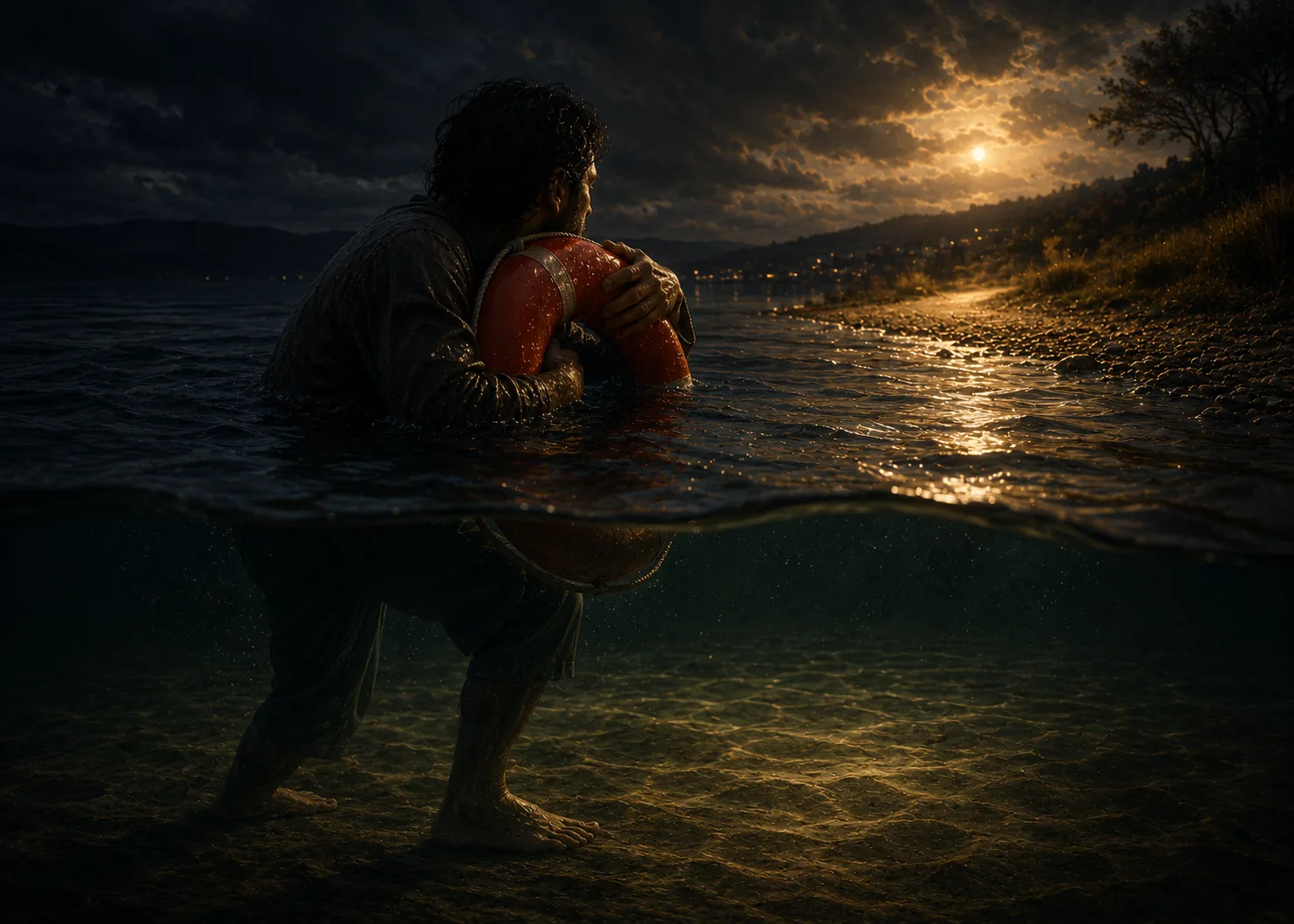
Now put the same person in open water at night, holding a life preserver.
Ask them to let go of it and you're not making a philosophical proposal. Whatever you can see about the depth of the water, they can't; what they have is the thing in their hands and the fact that they are still up. And the colder it gets, the more obviously right it is to hold on. Nobody in that water has ever been talked out of it by someone standing on a dock.
The apparent evils in the story of separation do not merely make it harder to put the gavel down; they make holding it feel obligatory.
A person watching something monstrous is not being asked, in that moment, to give up a petty habit of criticism; they're being asked to lay down what feels like the last instrument of justice in a world that has clearly run out of them. And the worse it gets, the more the instrument seems required — which is the whole difficulty, and it doesn't run on the century. It runs on how much of the horror a person has let themselves see. Every atrocity is genuine evidence that someone must judge — and there is no argument you can make to a person in that state that does not sound, correctly, like a request that they stop caring.
So the story defends itself with the very thing that proves it needs judging. The grip tightens on the way down. And the tighter it gets, the further the two stories part, which makes the crossing look more insane, which tightens the grip again. The trench seals itself, and it seals hardest in exactly the people who are most awake to how bad it is.
That is not a diagnosis of anyone else. I dug that trench. I dug it while holding a screen, and the depth of it was in direct proportion to how much I had let myself look.
I cannot use the state of the world as evidence for any of this. Where the Timelines Agree establishes why: the badness of a moment is not evidence about the route, in either direction, and a slice of a thing reports nothing about the whole of it. So this is a mechanism and not a reading of the times. I am not telling you the world is worse than it was. I don't know whether it is. What a defended will does with a horror is what it has always done with one, and the response is self-sealing.
VIII. Three Ways This Becomes Cruel
Three things can be done with this that would make it worth not having written.
(a) "Good — then I'm on the right one."
This is the one the structure hands you free of charge, and it is the dangerous one, because it does not feel like a verdict on anybody. It feels like relief.
There is no instrument for auditing your own will, and the moment a person has concluded they are on the good story, the thing that reached the conclusion was the first will, doing the only thing it knows how to do — rating, sorting, issuing a finding, and this time filing itself on the better side. That is the move from §I with a cosmology bolted on, which is the worst upgrade it has ever received. This piece does not come with a chair to sort a sidewalk from. I had one of those. It is exactly what failed.
Which disposes of its second form too — so the people still gripping the gavel are the destruction. I was the one dug into a camp, and not as a young man's phase I have grown out of; the same reflex is available to me this afternoon and gets taken more often than I would like. A count of camps was never a moral theory. There are not two kinds of person. There are two wills, and both of them have been in me today.
(b) "So stop fighting injustice."
No, and this is where the boundary from §IV gets its teeth. Discernment reads an act; the gavel sentences a person. That distinction is The Way Home Is Down's and it is made properly there: naming a cruelty as cruelty is what love requires, and refusing to file the human being who did it onto the far side of a line marked evil is a different operation entirely. You can do the first with total seriousness and never do the second. The test that essay put on the table is one I'll take on this one: any use of these ideas that makes it easier to hurry a survivor, to hush a victim, or to spare a perpetrator the naming of what he did has inverted the argument into its enemy. If a reader can turn any of it into a muzzle, I've written it badly, and I would rather know.
And the biography refuses the quietist reading without my help. The sanctuary was not withdrawal from the fight. It was fences, in the morning, in the rain, for animals nobody else was going to take. If the alternative to the gavel were doing less, I would not be making this argument, because I have done both and one of them involves considerably more shoveling.
(c) "So the suffering is the world getting what it had coming."
The inference I have refused before, and it does not get in through the back door because the subject is large. Deviation causes suffering does not entail suffering implies deviation — one is a claim about a road, the other is a verdict on a person, and the second is not contained in the first. The Highest Peak makes that case at length, and points out that the two places our own scripture puts the inference in someone's mouth are the two places it is condemned: Job's friends, who are told ye have not spoken of Me the thing that is right,13 and the disciples asking who sinned that a man was born blind, who are answered in one word before they are answered in any others. Neither.14
Scale it up and it gets worse rather than better. Nothing here licenses reading a catastrophe, a nation, or a year as a verdict on the people inside it. That is the oldest false comfort there is, and an essay about the end of a story is precisely where somebody would go looking for it.
IX. Yoda
There are not two kinds of people.
The Highest Peak ended by refusing to leave you with a mountaintop. Where the Timelines Agree ended by refusing to leave you with a coordinate. Two wills was a way of pointing. If what you are carrying out of this is a picture of two kinds of people, or two roads with the better sort walking one of them, I have handed you a cleaner map to the wrong country. There is one world, and one road, and a will that is given over or is not — in the same person, on the same afternoon, more than once.
What survives is small enough to carry and old enough that I did not find it.
Thy will be done is not a request, and it is not resignation dressed for church. It is the thing itself — the sentence by which a will stops being its own. You don't say it to learn what happens next. You say it to do it, and then it is done, and then in about four minutes you will need to say it again. It's available in a hospital corridor and on a sidewalk and at a fence post. It was available while I was standing there with the screen, and I would not have understood the offer.
At the sanctuary I fell in love with a pig named Yoda.
Yoda was small, and scrappy, and he never backed down from a fight.
I have thought about him for years afterward, because of the one thing about him I could not fix and could not explain to him: he was already inside the fence — on land where nothing was coming for him, fed by people whose whole purpose was that he should get to live out his life — and he was still a small animal who would not back down from a fight.
I don't know what he thought he was braced for. I never will, and it isn't mine to say. What I know is that there was no way to tell him, and that this was not a limitation of his intelligence but of the situation: the only thing that could have reached him was time, and being fed, and the fight never arriving, over and over, until the readiness had nothing left to hold up.
And he was loved the whole time. Whatever he believed about his position did not slow that down at all.
That is what I have instead of a plan, and it is not much of one. People I love are dug into the trench, gripping the gavel harder as the reasons to grip it multiply, and the better I understand the mechanism the less it tells me about how to reach anyone inside it. I know what does not work, because I did it on sidewalks in three cities with an unanswerable argument in my hands. Nobody crosses on evidence, and I had the evidence. It is tragic, and I do not know how to help them.
One thing I have seen. Rock bottom has humbled a great many people who could not be reached any other way; that is the whole testimony of the rooms, and The Sheep in the Basement is where I have written about what happens there. My hope is that the same is true one size larger — that the separate self, clinging to its particular story of separation the way someone clings to a life preserver in water they could stand up in, comes to the end of what clinging can do, and unclenches, and turns.
A hope like that sits one inch from wishing the bottom on somebody, and anyone who reads this and starts looking forward to a reckoning has ended up back on the corner with the screen. Nobody has ever been improved by being right about that.
I don't know how far off any of this is, or whether off is even the right word for something that is not a schedule. I know the way was opened from the other side, and that it is a way and not a place, and that the only motion available on it is the next step, and that the step is not a technique.
And the fight you have never backed down from — the one you have needed, the one that has kept you alive, the one you would be a fool to set down while the world looks like this —
nobody is coming.
You are already inside the fence.
Footnotes
-
Genesis 3:24, KJV: "So [They] drove out the man; and [They] placed at the east of the garden of Eden Cherubims, and a flaming sword which turned every way, to keep the way of the tree of life." The King James reads he in both places. The subject is the Father, and this publication's pronoun for the Father is They/Them, so the substitution is made in brackets — the bracket marking the word as mine rather than the text's, since an unmarked pronoun inside a quotation reads as the original and lets an inherited grammatical accident pass for revelation. ↩
-
John 14:6 — and the verse before it is Thomas asking how can we know the way?, so the answer arrives as a reply to a question about a road. The bridge between the two is the Septuagint, which renders the Hebrew derek of Genesis 3:24 with hodos — the word John's gospel uses. In the King James they are simply the same English word, which is a fact about the translation and not about either original; the Greek Old Testament is what makes the connection a real one rather than an artifact, and the body says so rather than resting on the English. ↩
-
Exodus 26:31 — the veil "of blue, and purple, and scarlet, and fine twined linen of cunning work: with cherubims shall it be made." The connection between the woven cherubim and the cherubim at Eden's gate is an interpretive one, made at length in The Way Home Is Down. ↩
-
Matthew 27:51; the parallel is Mark 15:38. The texts specify from the top to the bottom; reading that as from the God-ward side is interpretive, and is offered as such — again, that essay's argument and not this one's. ↩
-
Hebrews 10:19–20, KJV: "Having therefore, brethren, boldness to enter into the holiest by the blood of Jesus, by a new and living way, which He hath consecrated for us, through the veil, that is to say, His flesh." The deity pronouns here are the Son's and already match house practice, so no bracket is needed. The letter is drawing the same line drawn above — the curtain, and a way through it — and that is to say, His flesh is its own gloss, not mine: the text identifies the curtain with the body. What that identification means for what He was — and for what following Him asks past obedience — is the argument of a separate essay, and is only pointed at here. ↩
-
The Greek apokalypsis is an uncovering — the removal of something that was over a thing. It is the title of the last book of the New Testament and the root of the English apocalypse, which has traveled a long way from it. I mention the derivation because a torn curtain is a strikingly literal instance of it, and I am leaning on it for nothing: what a word was modeled on is not what a sentence means, and no claim here rests on the etymology. Nothing here draws on Revelation's imagery or its sequence, which belong to a different argument. ↩
-
The image reads the fall as the taking of a seat — a verdict seized that was never ours — rather than as the breaking of a rule. Borrowed here for one turn, and the demarcation is worth keeping straight: that essay argues the gavel was seized; this one asks why it is now being gripped harder. ↩
-
Matthew 25:37 — "LORD, when saw we Thee an hungred, and fed Thee?" ↩
-
Ezekiel 33:11, KJV. The prophetic call is consistently to turn — the Hebrew shuv, to turn or to return — rather than to feel, and that is the claim the body makes. It is a claim about the call, not about the Greek: the relationship between shuv and metanoeō across the Septuagint is not one-to-one (shuv is more often rendered epistrephō), and nothing here rests on a lexical equation or on the derivation of metanoia, which would be a claim about what the word was modeled on rather than about what it is used to mean. The verses either side sharpen rather than soften it: 33:10 is the people saying "if our transgressions and our sins be upon us, and we pine away in them, how should we then live?" — despair over guilt — and 33:11 answers that despair not with a demand for more of it but with turn; and 33:12 says the day of the turn, not the record before it, is what counts. ↩
-
Luke 15:17–20, KJV — "And when he came to himself…", then "I will arise and go to my father", then "And he arose, and came to his father." The parable is walked at length in The Way Home Is Down and its elder brother belongs to Nothing to Get; one clause is taken here. One thing to say plainly, because a reader checking the verses will find it: the son does confess — "I have sinned against heaven, and before thee" — and he rehearses it at 15:18–19 and says it at 15:21. The body's claim is about the order. What comes first, at 15:17, is he came to himself: a realization, not a feeling, and the confession is the content of a return already decided on, not the thing that decided it. The order is the argument, and the confession is disclosed here rather than hidden. ↩
-
Matthew 6:10. ↩
-
Galatians 6:7. The reading of the verse as terrain rather than as retaliation is The Highest Peak's, §VII. ↩
-
Job 42:7. The house convention capitalizes the deity pronoun (of Me); the King James lowercases it. ↩
-
John 9:2–3. The remainder of the answer — but that the works of God should be made manifest in him — is a live translation question, since the Greek carries no punctuation and where the sentence divides changes whether the blindness is given a purpose at all. The argument here rests on the first word and only on it. ↩