Not a Bodhisattva
The Buddha asked how suffering ends. Jesus asked something else.
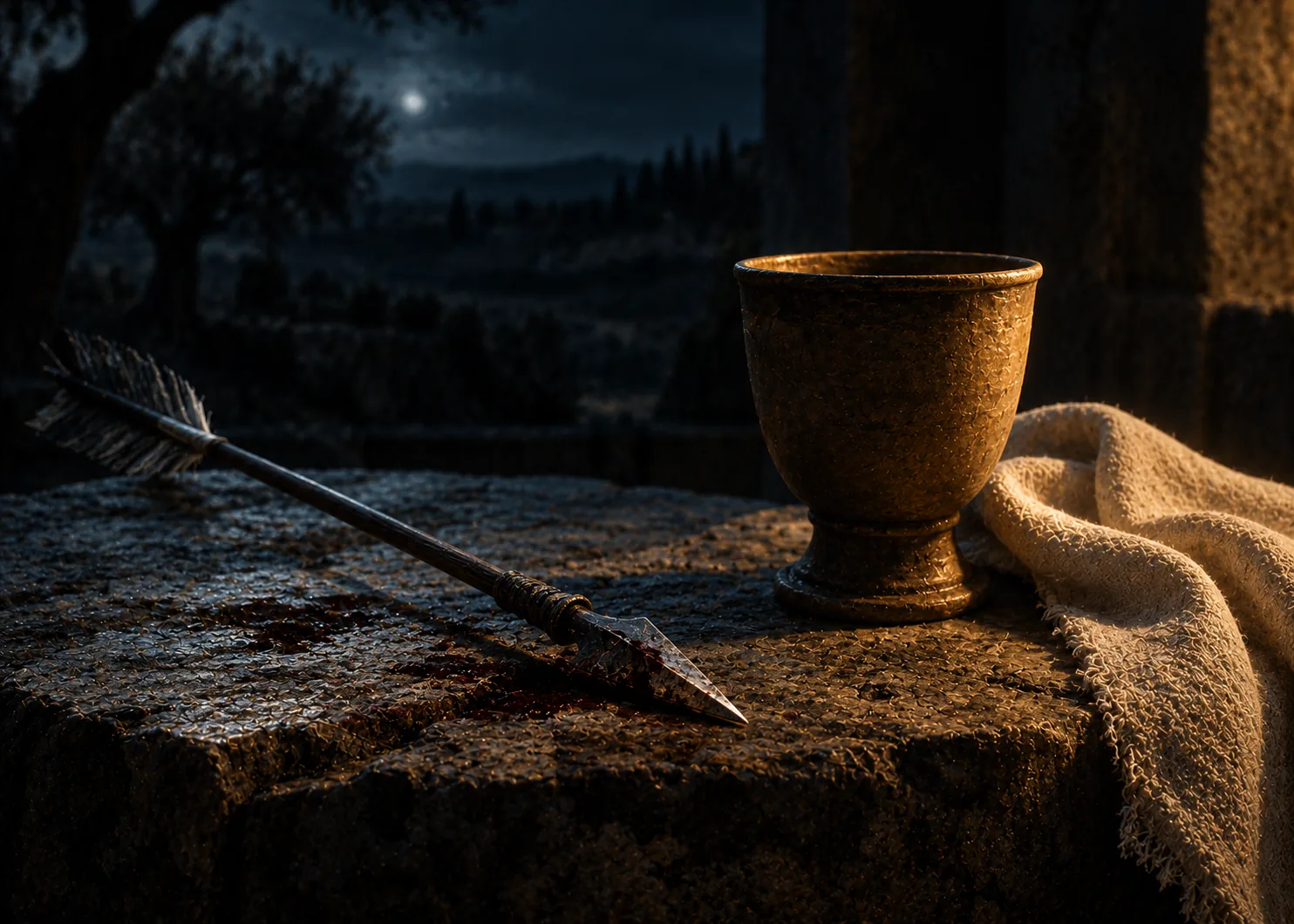
I. The Arrow
There's a story the Buddha told about a man shot with a poisoned arrow. The man's friends bring a surgeon, and he refuses to let the arrow be pulled until he knows who shot him: whether the archer was a noble or a brahmin or a merchant or a worker; his name and his clan; whether he was tall or short or of middle height; dark or brown or golden-skinned; from a village, a town, or a city. Whether the bow was a long bow or a crossbow, and what the string was made of, and what the shaft was cut from, and what kind of feathers were on it, and what it was bound with, and what kind of point was on the end of it. The Buddha's verdict is flat. The man would die, and every one of those things would still be unknown to him.1
The Buddha told it to a monk named Māluṅkyāputta, who had been pressing him on the questions he wouldn't answer. Is the world eternal? Is it finite? Are the soul and the body one thing or two? Does an awakened one exist after death? The Buddha set all of them aside, and he gave a reason as clear as any founder of a religion has given for anything: they don't help. None of them leads to dispassion, to cessation, to peace, to awakening. None of them is the arrow. Get the arrow out.
So what is the arrow? The Buddha said that too, more than once, and the sentence deserves to be heard in his own words: Both formerly and now, what I teach is suffering and the cessation of suffering.2 That is the whole of it, by his own account. Not the origin of the world, not the nature of the soul, not the name of whoever shot you. Pain, and the end of pain.
That is honesty of a high order. Religions tend to bury their question under their answers. The Buddha put his on the table with nothing on top of it and then refused every question that wasn't it, and if the measure of a teaching were its candor about what it is for, the Dharma would be hard to beat.
It's also what makes the difference I'm after visible. Because the question the Buddha put on the table — how does this stop? — can only be asked by someone who is hurting. It's the patient's question. It belongs to the man on the ground with the shaft in him, and it's a good question, and he's right to ask it. But a surrendered self, when it finally speaks, doesn't ask it. It asks something else — and the something else isn't a better answer to the Buddha's question. It's a different question, put to Someone the Buddha had no one to put it to.
Jesus of Nazareth didn't come to end suffering. He did the will of the One who sent Him, and it took Him through suffering rather than out of it. The resemblance between Him and the bodhisattva of the Mahayana is real on the surface and deserves to be taken at full strength, because it's the strongest thing the other side has. But a bodhisattva is the hero of the arrow question, and He was not.
II. The Patient's Question
The four noble truths have the shape of a physician's chart, and the tradition has long read it that way. Here is the disease: suffering, dukkha, the ache that runs through even the pleasant things because they don't hold. Here is its cause: craving, taṇhā, the thirst that reaches and clutches. Here is the prognosis: it can cease. Here is the prescription: the eightfold path.3 Diagnosis, cause, prognosis, treatment. Whoever laid it out that way was thinking like a doctor, and the patient in front of a doctor is a self in pain.
The diagnosis isn't in dispute, and the gospel can't dispute it. That the clutching self is the source of its own suffering isn't a Buddhist finding that a follower of Jesus has to hold at arm's length. It's the argument of The Knowledge of Good and Evil almost line for line, and of The Novelist DM after it: separation isn't punished with suffering; separation is the suffering, the clenched fist that is its own ache. On the diagnosis, the two traditions could sign the same chart.
And then the Buddha did the consistent thing, and went looking for the patient. The one asking for the cure — the self that suffers, that craves, that wants out — he examined it, aggregate by aggregate, and reported that it wasn't there. Not the body, not feeling, not perception, not the mental formations, not consciousness: none of them is a self, none of them is mine.4 The person asking how do I stop hurting turns out, on inspection, to be a bundle of conditions with nobody at the center. And so the cure for the patient's question is the discovery that there was no patient. The question dissolves with the one who asked it.
That's what nirvana means as a word: a blowing-out, the way a flame goes out when the fuel is gone.5 The fires are greed, hatred, and delusion, and what goes out is not a being. The tradition is careful about that; it refuses the view that anything is annihilated as firmly as it refuses the view that anything is eternal, and the refusal is in its oldest collections.6 What goes out is the constructing. The reaching stops. The bundle is no longer re-bundled. That is the end of suffering, and it is exactly the end the question was asking for, once the question is followed honestly: the pain ends because the one in pain was never the kind of thing that could be kept.
The tradition I follow agrees that the separate self isn't finally real. I've argued it at length and don't take it back: nothing is separate from God, the wall the self builds around itself is a misconception, and what it does from behind the wall is real harm from an unreal position. The difference from the Dharma isn't there.
The difference is that the Buddha's question was the patient's question, taken at its word. How does this stop? And the answer, honestly pursued, is that it stops when you find there's no one for it to be happening to. That is a solution. It is a solution to that question. And it's a solution by dissolution — not the annihilation of a being, which the tradition denies, but the ceasing of the one who asked, into conditions that no longer gather. What is on the far side of that, the tradition won't say; the Buddha set that question aside with the others. It will say only that whatever is there isn't a self, and its silence is the honest kind.
III. The Other Question
There's a man in a garden at night who asks the arrow question too. O My Father, if it be possible, let this cup pass from Me.7 That's the patient speaking. He's afraid, He's in anguish, and He would like it to stop. Nothing in the sentence is above the arrow; it's a man on the ground asking for the shaft to be pulled, and anyone who wants Him serene here has to get past exceeding sorrowful, even unto death and the sweat Luke's gospel describes.8
And then the second half of it, which isn't an answer to the first. Nevertheless not as I will, but as Thou wilt.
The second half changes the question, not the mood. The first asks how does this stop. The second asks what do You will — and it hands the first half over to the second, unresolved. He doesn't stop wanting the cup gone. He stops making that the question. What He wants is set inside what Someone else wants, and the sentence He ends on is addressed to that Someone in the second person, the way you speak to a face.
That question wasn't available to the Buddha. Not because he lacked the courage for it — the night under the Bo tree is not the record of a coward — but because there was no one to put it to. A companion essay, The Novelist DM, argued that the difference between the Buddha and Jesus comes down to this: the sage woke by his own long looking and answered to no one above him, and Jesus stood at that same height and handed the whole of it back to a Father. Follow that difference into the question each of them could ask. What do You will has a Who in it, and without one it can't be asked at all. What's left, with no one above the seeker, is a question about the seeker's own state — and the Buddha, honest about what he was for, chose the one about suffering. Not because the people who ask it are selfish; the Mahayana is the proof of how far from selfish the asking can be driven. But what would You have me do needs someone above you to ask it of, and there was no one.
The surrendered self's question presupposes a Who. That's the whole difference. Thy will be done has a Thy in it. The cessation of suffering has nobody in it at all, by design, and the design is honest.
It isn't a difference between East and West, either. Krishna Is Not Christ is about a tradition as Indian as the Dharma that has a word, prapatti, for exactly this surrender, because it has a Someone to surrender to. The line runs between traditions with a Who above the seeker and traditions without one, and the Buddha, deliberately, built without one.
And the answer to His question wasn't the end of suffering. It was the cup.
IV. He Did Not Come to End Suffering
The objection is in the gospels themselves, and it's a strong one: He healed people constantly. Matthew has Him going through all Galilee healing all manner of sickness and all manner of disease among the people, and the sick brought to Him from as far off as Syria.9 If you wanted to build a case that Jesus was a man who set out to end suffering, you'd hardly have to leave the fourth chapter of the first gospel. He fed the hungry. He wept at a tomb. He touched lepers. Whatever else He was, He was someone who couldn't walk past pain.
All of that is true.
But there's a scene in Mark that shows what the healings were and what they weren't. In Capernaum, after an evening in which all the city was gathered together at the door and He healed many, He gets up a great while before day and goes out alone to pray. Simon comes after Him with the news you'd expect: All men seek for Thee. A whole town of sick people is waiting. And He says: Let us go into the next towns, that I may preach there also: for therefore came I forth.10 He walks away from the line at the door. A man whose purpose was the cessation of suffering might do that too, to reach more of it; a physician with a district does it. But that isn't the reason He gives. Luke has the same scene with the reason in one word: for therefore am I sent.11
Sent. That's the grammar He reaches for, again and again, when He says why He's here. I came down from heaven, not to do Mine own will, but the will of [Them] that sent Me.12 The healing was what the Father's will looked like on a particular day in a particular town. It was never the project. When the will pointed at the next town, He went to the next town, and the sick still waiting at Capernaum stayed sick. The reason wasn't that the next town hurt more. The reason was that He was sent. That's a servant's reason.
He never promised the end of suffering to anyone who followed Him, either. He promised the opposite. In the world ye shall have tribulation.13 Whoever would come after Him should deny themselves and take up a cross — the instrument, whatever else it is. And when His own suffering came He didn't end it; He went to meet it. He stedfastly set His face to go to Jerusalem.14 Isaiah's phrase for Him was a man of sorrows, and acquainted with grief15 — acquainted, the way you're acquainted with a neighbor: someone you know by name and don't try to move out of the building.
I don't think He loved suffering. The garden settles that. But He didn't come to end it, and the people who follow Him have known it, because the sign they took for the front of their buildings was an instrument of execution.
V. The Bodhisattva
The Mahayana turned the Dharma toward others. The earlier ideal was the arhat, the one who reaches the cessation of their own suffering. The Mahayana's ideal is the bodhisattva, who vows to reach full awakening for the sake of every being and not to leave until all of them are out. Śāntideva's vow, from the eighth century, is the form most often quoted: As long as space abides and as long as the world abides, so long may I abide, destroying the sufferings of the world.16 And earlier in the same poem there's a line that could sit in the Sermon on the Mount without a seam showing: All those who suffer in the world do so because of their desire for their own happiness. All those happy in the world are so because of their desire for the happiness of others.17 And there's the vow that turns the physician's chart of the first sermon into a first-person aspiration: May I be the doctor and the medicine and may I be the nurse for all sick beings in the world until everyone is healed.18
The stories go further than the vows. In one of the best known, a prince finds a tigress starving beside her cubs and, seeing that she'll eat them, lies down in front of her so that she eats him instead.19 There are bodhisattvas whose whole office is to hear the cries of the world. There is the transfer of merit, in which whatever good you've earned is handed to beings who haven't earned any. Whoever has read the gospels and then reads this material feels the recognition at once, and scholars have felt it too: there are books of parallel sayings, and there's a serious Buddhist reading of Paul's made Himself of no reputation as the self-emptying the Mahayana calls śūnyatā.20 Anyone who wants to say that Jesus looks like a bodhisattva has the texts on their side.
And they do. The compassion is real. The self-giving is as complete as any the world has recorded — a man lying down for a tigress isn't a lesser image than a man on a cross, and anybody who tries to rank the two is playing a game the gospels don't play. If the question were who gave more, no honest reader could settle it, and it's a bad question anyway.
It's a bad question because giving isn't what makes a bodhisattva. The vow is. And the vow is a vow to end suffering — the Buddha's question, exactly as he asked it, with the scope widened from one being to all beings and the term extended to the end of time. Destroying the sufferings of the world: that's the arrow, pulled from everyone. The Mahayana didn't change the question. It made it enormous. The bodhisattva is the hero of the patient's question, the one who won't rest until every patient has been treated.
And there the surface parts. Jesus made no vow.
VI. The Vow and the Sending
A vow is undertaken. The tradition is precise about this, in its ordinary telling: the mind of awakening, bodhicitta, arises in a person; they resolve; they take on the path and walk it across incalculable ages, perfecting one virtue after another by their own resolve and their own effort. There are buddhas above them, and the tradition is exact about what those buddhas do: the vow is made in a buddha's presence, and a buddha predicts that it will be fulfilled — the Buddha's own vow, in the tradition's telling, was made before the buddha Dīpaṅkara, ages before the Bo tree.21 But a prediction isn't a commission. The buddha confirms a vow the bodhisattva made, and hands down no will for them to do. The compassion is the bodhisattva's own. Nobody sent them. That isn't a criticism. It's the shape of the thing, and it's the shape of the hero, which is why Campbell reached for the Buddha under the tree the first time he laid out the hero's ordeal.22 I argued in The Mask Comes Off Last that the villain of every story is the separate self seen from outside. The bodhisattva is the best thing a self can resolve to be. It is still something a self resolves.
Jesus was sent. The verbs He uses about Himself are a servant's verbs, and He's relentless about it. The Son can do nothing of Himself. I seek not Mine own will, but the will of the Father which hath sent Me. As the Father gave Me commandment, even so I do.23 Even the compassion is handed upward: the Father that dwelleth in Me, [They do] the works.24 He doesn't resolve; He obeys. He isn't the hero of a journey He undertook. He's the one who was told to go to the next town and went.
A bodhisattva undertakes. A servant is sent. That's the difference, and it isn't a difference of degree.
The end of each story shows it, in what's left. The bodhisattva's wisdom is that the beings they vow to save are, in the final analysis, empty. The Diamond Sutra has the Buddha say that a bodhisattva liberates countless beings and not a single being is liberated, and that anyone who holds on to the perception of a being isn't a bodhisattva at all.25 That isn't a contradiction the tradition stumbled into. It's the point, held with pride, and rightly: compassion and emptiness are one thing seen from two sides, and the vow to end all suffering is fulfilled when the suffering, the sufferers, and the one who vowed have all been seen through. Dissolution all the way down, and consistent about it.
What's left at the cross is persons. Father, forgive them — them, a plurality of persons, named as persons in the act of killing Him. To day shalt thou be with Me in paradise — thou, and with. And then, from the cross, He gives His mother to a friend and the friend to His mother: Woman, behold thy son. Behold thy mother.26 He's making a family out of the instrument of His death. The last things He does don't see through anyone; they give each person to another — a son to a mother, a mother to a son, a companion to a dying man. At the bodhisattva's end, no being is liberated, because a being was a perception, and the bodhisattva has let the perception go. At His, every person is still there, and each has been handed to someone else.
VII. Dissolution and Distinction
The difference isn't that Buddhism thinks the separate self is an illusion and the gospel doesn't. The gospel does. I've said so, and read the tree in Eden as the birth of the separating self and the way home as its undoing. On anattā — that the self you spend your life defending was never the kind of thing that could be defended — the two traditions are nearer than either side's apologists like to admit.
The difference is what's on the far side of the wall when it comes down. A companion essay, The Distance That Love Needs, argued that separate is not distinct: separation is the wall, and it's the wound; distinction is the twoness a love needs to happen in, a someone here and a Someone there, and it's the design. The wall comes down. The someone remains.
In the Dharma, when the wall comes down, the tradition refuses to promise anyone behind it; asked, it will say only that whatever is there isn't a self, and then it stops. In the gospel, when the wall comes down there's a face, and the gospel promises it. Paul's word for the end of everything isn't cessation; it's face to face — then shall I know even as also I am known, a knower and a known, both still there.27 And the end of the story in Revelation is the end of suffering, in as many words: God shall wipe away all tears from their eyes; and there shall be no more death, neither sorrow, nor crying, neither shall there be any more pain.28 There are eyes in that sentence. Someone is wiping them. The end of suffering isn't attained by the sufferer; it's given, by a hand, to a someone who is still there to have a face for the hand to touch.
Two verbs, then, for the two ends. Nirvana is blown out. Resurrection is raised.29 A word's history isn't an argument. But the words were chosen by people describing something, and the things they described are different. One is a flame with no more fuel. The other is a body standing up with its wounds still in it, telling a friend to put a hand in the side.30
That's why the surrendered self doesn't ask the patient's question. Not because it's above pain — the garden again — but because it isn't the patient. The patient wants out. The servant wants to know what's wanted. And what's wanted, it turns out, isn't the servant's disappearance. It's the servant.
VIII. Four Objections
But Buddhism has surrender too. The Pure Land schools built everything on it. Shinran taught that a person can do nothing by their own power and must entrust themselves wholly to Amida's vow — other-power, not self-power — and Karl Barth, of all people, called that school the nearest thing to Reformation grace outside the church.31 It's the strongest objection there is. Shin Buddhism is surrender, and the resemblance to Paul isn't superficial. And Amida is a someone — named, addressed, called on — which is why this objection and no other reaches the root of the argument. But he is a bodhisattva who vowed, and what is entrusted is the vow. Amida's vow is a vow to bring every being who calls on him to the Pure Land, and from there to nirvana. It's the arrow question, answered by another's hand instead of your own. The surrender is the means; the end is the end the Buddha named. In the garden the surrender purchases nothing. There's nothing on its far side that it was for. The cup is still drunk. That's the difference between entrusting yourself to a vow and giving yourself to a will: a vow has a term, and when the term is met you're out. A will is Someone's, and you're Theirs. Barth granted the whole parallel and then said it settled nothing, because what saves isn't the shape of grace but who is giving it.
Christianity promises the end of suffering too. You quoted the verse. You've just moved the same goal to the far side of death. The verse is there and it stays. But nobody in the gospels is told to pursue it; they're told to seek first the kingdom, and all these things shall be added.32 A goal is what you organize a life around. A gift is what arrives when the life was organized around something else. The end of suffering in the gospel is the second kind, and making it the first kind builds the Buddha's religion with a cross on the front of it. That religion exists.
This is triumphalism. You've ranked two traditions and put yours on top. I've ranked nothing and no one. The Buddha's attainment isn't mine to grade, and I've said that what he found about the self is true. Two questions are two questions; saying so isn't a verdict on the people who ask either one. And if there's an idol anywhere in this, it's on my side of the aisle. A Christianity that runs on the patient's question — come to Jesus and your pain will end, in the prosperity version or the therapeutic one — has adopted the Buddha's question without his honesty about the self, and it's a worse religion than his. It promises the cessation and keeps the self that wanted it. The Dharma at least knew you couldn't have both.
Suffering is real, and you're romanticizing it — telling people their pain is God's will. The harm is real; nothing here says otherwise, and the garden is my witness that He didn't want the cup. There's also a line I drew in The Way Home Is Down and hold here: if any of this is ever used to explain another person's suffering to them, it has been turned inside out. Nothing here is about anyone's pain but my own, and the only question in it is the one I ask about mine. It doesn't say suffer more. It says the question isn't how do I make this stop, and that a different question is available, and that it has a Someone at the other end of it.
IX. The Cup
The man on the ground with the arrow in him wants it out, and he's right to want it out. The Buddha was right to pull it, right to refuse every question that got in the way of pulling it, and right, at the end, about who was and wasn't lying there. I have no correction to offer him.
There's another man, on His knees, a stone's cast from His sleeping friends,33 who wants the cup gone and says so, and then asks the other question. Nothing is pulled out of Him. What's left, once the wanting has been set inside what Someone else wants, is not nobody. It's a man on His knees talking to His Father. He's still there. That is what the second question keeps that the first one can't: the one asking it.
I can't tell you what the answer to the second question is. It was a cup for Him, and He drank it, and on the third day He was standing up again, wounds and all. I don't know what it will be for you. I only know that it isn't asked by a patient, and it isn't answered by relief, and that the one who asks it isn't dissolved by the asking.
He stood up and went out to meet them.34 And the last thing He did in that garden, when one of His friends drew a sword and took off the ear of a man who had come to arrest Him, was touch the ear and heal it.35 He hadn't come to end suffering, even then. That was just what the will looked like that night, on the way to the cup.
Footnotes
-
Majjhima Nikāya 63, the Cūḷamāluṅkya Sutta, in Ñāṇamoli and Bodhi, The Middle Length Discourses of the Buddha (Wisdom, 1995). The catalogue is the sutta's own, in its order — caste, name and clan, height, complexion, village or town or city, the bow, the bowstring, the shaft, the feathers, the binding, the arrowhead — and the Buddha's conclusion in that translation is that all this would still not be known to that man and meanwhile he would die. ↩
-
Majjhima Nikāya 22 (the Alagaddūpama Sutta) §38, in Bhikkhu Bodhi's rendering, which the body quotes exactly; the Saṃyutta Nikāya has the same sentence at 22.86, to Anurādha, worded I make known just suffering and the cessation of suffering. The undeclared questions and the reason for leaving them undeclared — because it is unbeneficial, it does not belong to the fundamentals of the holy life, it does not lead to disenchantment, to dispassion, to cessation, to peace, to direct knowledge, to enlightenment, to Nibbāna — are MN 63, same translation. ↩
-
Saṃyutta Nikāya 56.11, the first sermon. The Buddha calls himself an unsurpassed physician and surgeon at Itivuttaka 100 (John D. Ireland's translation), and the reading of the four truths as a physician's formula — the disease, its cause, its cure, the medicine — is set out in Rupert Gethin, The Foundations of Buddhism (Oxford, 1998), ch. 3, p. 63. ↩
-
Saṃyutta Nikāya 22.59, the Anattalakkhaṇa Sutta, by tradition the Buddha's second discourse: each of the five aggregates — form, feeling, perception, volitional formations, consciousness — is examined under the refrain this is not mine, this I am not, this is not my self (Bodhi). ↩
-
Sanskrit nirvāṇa, Pāli nibbāna: literally a blowing out or extinguishing, as of a flame — the fires being greed, aversion or hatred, and delusion (Gethin, Foundations, pp. 74–75 and the glossary). The three fires are the Fire Sermon's, Saṃyutta Nikāya 35.28, burning with the fire of lust, with the fire of hatred, with the fire of delusion (Bodhi). An etymology records what a concept was modeled on, not what a sentence means. ↩
-
Annihilationism (ucchedavāda) and eternalism (sassatavāda) are both among the views the Buddha declines; the pair is surveyed under those names in the Brahmajāla Sutta, Dīgha Nikāya 1 (Bodhi's translation heads the sections Eternalism and Annihilationism), and the refusal of all exists and all does not exist alike is the Kaccānagotta Sutta, Saṃyutta Nikāya 12.15. ↩
-
Matthew 26:39 — one sentence in the King James, the two halves joined by a colon. Deity pronouns in this essay's quotations carry the house capital — My, Me, Thou — where the King James lowercases them; the wording is otherwise untouched, and where the Father's pronoun has been changed rather than merely capitalized it stands in brackets. ↩
-
Matthew 26:38, My soul is exceeding sorrowful, even unto death; Luke 22:44, His sweat was as it were great drops of blood falling down to the ground. ↩
-
Matthew 4:23–24. ↩
-
Mark 1:33–38. The town at the door is verse 33; the pre-dawn prayer, verse 35; Simon's All men seek for Thee, verse 37; and for therefore came I forth, verse 38. ↩
-
Luke 4:43, I must preach the kingdom of God to other cities also: for therefore am I sent. ↩
-
John 6:38. The King James reads the will of him that sent me; the bracketed pronoun is the author's. ↩
-
John 16:33; the cross is Luke 9:23, take up his cross daily, and its parallels. ↩
-
Luke 9:51, in the King James spelling. ↩
-
Isaiah 53:3. ↩
-
Śāntideva, Bodhicaryāvatāra 10.55, in Kate Crosby and Andrew Skilton's translation, The Bodhicaryāvatāra (Oxford World's Classics, 1996). Śāntideva wrote in the late seventh or the eighth century. ↩
-
Bodhicaryāvatāra 8.129, same translation. ↩
-
Bodhicaryāvatāra 3.8 in the Tibetan numbering (3.7 in the Sanskrit), here in Stephen Batchelor's rendering, A Guide to the Bodhisattva's Way of Life (Library of Tibetan Works and Archives, 1979): May I be the doctor and the medicine / And may I be the nurse / For all sick beings in the world / Until everyone is healed. ↩
-
The tigress is the first story of Āryaśūra's Jātakamālā, where the bodhisattva is a brahmin ascetic with a disciple; the telling with the prince — Mahāsattva, the youngest of a king's three sons — is the Suvarṇaprabhāsa, the Golden Light Sutra, ch. 18 in R. E. Emmerick's translation (Pali Text Society, 1970). The starving tigress and her cubs are in both. The bodhisattva who hears the cries of the world is Avalokiteśvara — in Kumārajīva's Chinese, the one who perceives the world's sounds — whose chapter is the twenty-fifth of the Lotus Sutra. ↩
-
The parallel-sayings genre: Marcus Borg (ed.), Jesus and Buddha: The Parallel Sayings (Ulysses Press, 1997). The reading of Philippians 2:7 — made Himself of no reputation, the Greek ekenōsen, emptied — as śūnyatā is Masao Abe's, in "Kenotic God and Dynamic Sunyata," in John B. Cobb Jr. and Christopher Ives (eds.), The Emptying God: A Buddhist-Jewish-Christian Conversation (Orbis, 1990), pp. 3–65. ↩
-
The vow of the ascetic Sumedha before the buddha Dīpaṅkara, and the prediction that follows it, are told in the Buddhavaṃsa and open the Nidānakathā, the introduction to the Pāli Jātaka. The Mahayana pattern — the aspiration (praṇidhāna) made before a buddha and the buddha's prediction (vyākaraṇa) of its fulfillment — runs through the Lotus Sutra, which predicts buddhahood for Śāriputra in its third chapter and for four more disciples in its sixth. ↩
-
Joseph Campbell, The Hero with a Thousand Faces (1949), Prologue, "The Hero and the God": directly after the sentence that states the monomyth, the Buddha beneath the Bo Tree, on the Immovable Spot, approached by Kama-Mara, is the first instance Campbell gives of the hero's ordeal. ↩
-
John 5:19, The Son can do nothing of Himself; John 5:30, I seek not Mine own will, but the will of the Father which hath sent Me; John 14:31, as the Father gave Me commandment, even so I do. ↩
-
John 14:10. The King James reads the Father that dwelleth in me, he doeth the works; the bracketed pronoun and verb are the author's. ↩
-
The Vajracchedikā Prajñāpāramitā, the Diamond Sutra, ch. 3, in Red Pine's translation (Counterpoint, 2001): And though I thus liberate countless beings, not a single being is liberated. And why not? Subhuti, a bodhisattva who creates the perception of a being cannot be called a bodhisattva. Conze's rendering of the same passage: although innumerable beings have thus been led to Nirvana, no being at all has been led to Nirvana. ↩
-
Luke 23:34; Luke 23:43, in the King James's two words, To day; John 19:26–27. ↩
-
1 Corinthians 13:12. ↩
-
Revelation 21:4. ↩
-
The New Testament's ordinary verbs for the resurrection are egeirō, to raise or wake, and anistēmi, to stand up; He is risen (Matthew 28:6) is egeirō in the aorist passive, ēgerthē. Offered, like nirvāṇa above, as a record of what each tradition reached for when it named its end. ↩
-
John 20:27, Reach hither thy finger, and behold My hands; and reach hither thy hand, and thrust it into My side. ↩
-
Shinran (1173–1263), founder of Jōdo Shinshū; the teaching that jiriki, self-power, cannot bring a person to birth in the Pure Land and that only tariki, the other-power of Amida's vow, can, is set out in the Tannishō, his sayings as recorded by the disciple Yuien. Amida's Primal Vow is the Eighteenth of the vows in the Larger Sukhāvatīvyūha Sūtra: birth in the Pure Land for all who entrust themselves and say the Name, perhaps even ten times; and birth there, in Shinran's teaching, is the attainment of supreme nirvana. Karl Barth, Church Dogmatics I/2, §17, in an excursus on Jōdo Shinshū (T&T Clark, pp. 340–344), calls it the most exact and plausible parallel to Reformation Christianity outside it — and then argues that the parallel decides nothing, because what distinguishes the Christian religion is not that it is a religion of grace but the name of Jesus Christ. ↩
-
Matthew 6:33. ↩
-
Luke 22:41, about a stone's cast; the friends asleep, 22:45. ↩
-
Matthew 26:46, Rise, let us be going: behold, he is at hand that doth betray Me; and John 18:4, where He went forth to meet the men who had come for Him. ↩
-
Luke 22:50–51: And one of them smote the servant of the high priest, and cut off his right ear. And Jesus answered and said, Suffer ye thus far. And He touched his ear, and healed him. John 18:10 names the servant Malchus and the friend with the sword Peter; Luke alone records the healing; Matthew 26:51–52, Mark 14:47, and John 18:10–11 have the ear and not the touch. Luke sets the scene on the mount of Olives, at the place (22:39–40); the garden is John's word (18:1) and Gethsemane is Matthew's and Mark's. ↩