Rising After Falls
The practice is not staying. The practice is the return.
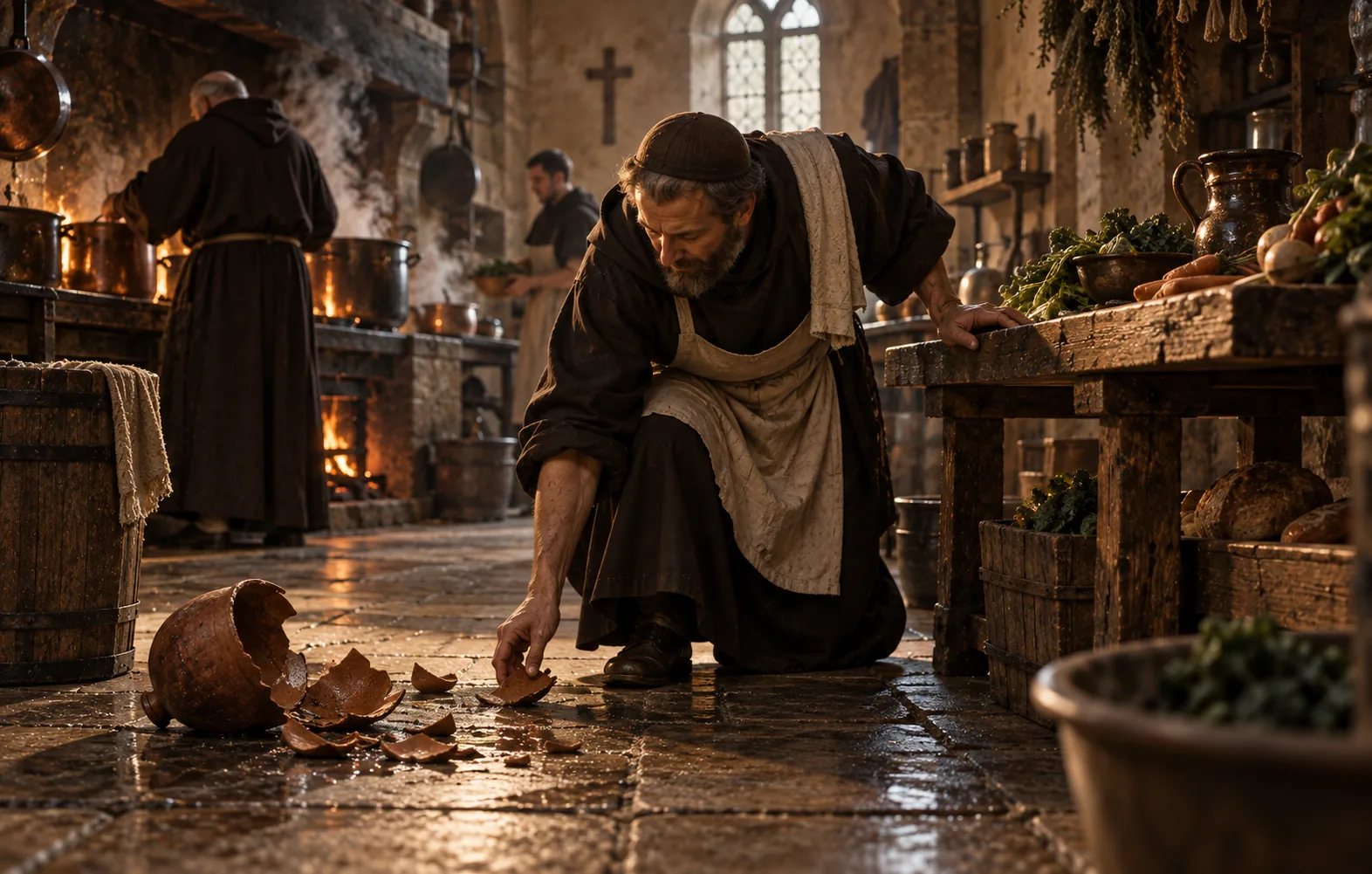
I. The Kitchen
What gets written about Brother Lawrence is the kitchen. A lay brother in a Paris monastery in the sixteen-hundreds, awkward and lame, who said he possessed God among the pots and the shouting as fully as on his knees at the altar.1 It's the best-known thing about him and it deserves to be. It isn't the strangest thing he said, and it isn't the most useful.
The strangest thing is in the second of the four conversations a priest wrote down after visiting him.2 Asked what he did when he failed, Lawrence said he confessed the fault, told God plainly that he'd always fail if left to himself, and then, in the priest's words, "gave himself no further uneasiness about it."3 A letter gives the reason: "trouble and disquiet serve rather to distract the mind, than to re-collect it."4 The failure he means is a lapse in the practice, a duty missed and the thread dropped. For his sins he kept a confessor, and said he needed one.5
You were taught the opposite, and so was I. Feeling bad about a failure is how you show you took it seriously. The remorse is the receipt. Lawrence says the remorse is a second failure, and it costs more than the first, because the first only interrupted the practice and the second keeps you out of it.
You know the shape of this if you've tried to keep any discipline at all. You miss the thing. Then you spend the rest of the hour on having missed it. The missing took a moment; the disquiet takes the morning. And the disquiet feels like fidelity, which is what makes it so hard to put down. It feels like the part of you that still cares. Lawrence's claim is that it's the part of you that left.
II. The Return
The practice he keeps getting taken away from isn't a state. Lawrence called it the practice of the presence of God, and the phrase gets heard as one: a continual awareness, held without a break, achieved by the very holy. That isn't what he describes. What he describes is a return. Lawrence's mind wandered, and by his own account it wandered for years.6 The instruction is to bring it back "mildly and with tranquillity, as often as we find it wandering."7 The practice is not staying. The practice is the return. Attention that never wandered would need no practice at all.
A practice made of returns is built on falls. Every return presupposes one. If you can't fall without disquiet, you can't return without disquiet, and then the practice itself becomes a source of the trouble it was supposed to relieve. You're thinking that sounds like laxity. It isn't. It's the condition of the practice being possible at all.
And it's how the habit forms. Habit, he says, comes from repeated acts, and once formed it produces its acts in us "without our care."8 By the end of his life it was as hard for him not to think of God as it had once been to think of Them.9 That's a habit built out of forty years of returns.10 Not forty years of unbroken presence. Forty years of coming back.
III. Whatever Becomes of Me
There's a reason he could come back without fear, and it isn't temperament. For four years as a young monk Lawrence was sure he was damned, and by his own account nobody could have talked him out of it.11 What ended it wasn't an argument. It was a decision. Whatever became of him, saved or lost, he would go on acting for the love of God, because at least until death he'd have done what was in him to love. After that, he says, he lived in liberty and continual joy.12 The fear didn't leave because he answered it. It left because he stopped requiring an answer before he'd go on.
This is why the practice has to be rooted in love and can't be rooted in fear. Fear makes every fall final. If the question underneath the practice is whether I'm acceptable, then each failure is evidence, and the disquiet is the reasonable response to evidence. If the question underneath is how I return, a failure is only the place I return from.
The bhakti tradition says the same thing in its own vocabulary. The fall isn't news about who you are. Grace comes first. The Gita's chapter on devotion walks down the whole ladder of what a person can actually manage — hold your mind on God; and if you can't, work for Him; and if your heart fails at that too, "bring Me thy failure."13 Two traditions agree here, and it's the part that's hardest to do.
IV. Tuning
A string doesn't stay in tune. It drifts with heat, with playing, with time, and the string isn't blamed for it. A player who was disquieted by drift couldn't tune at all, because tuning requires listening, and disquiet is noise. What you do is sound the string against the reference and adjust. Then you play, and later you do it again. Being in tune isn't a state you reach once. It's a relation you keep, in time, by correction.
You don't get to skip the drift. That isn't a failure of the string. That's what a string is.
What you tune to doesn't move. It's there whether or not you're listening for it, Lawrence says, "nearer to us than we are aware of."14 You don't produce it by listening. You find it by coming back.
V. The Satsang Where the Pitch Is Audible
This can be done alone, and Lawrence did it alone: he needed no director, and he said nobody perceived it.15 But the return is easier with other people, and I learned that in a satsang — the word means the company of the true, and in practice it is people on a floor, singing. In kirtan you sing the names of God as that tradition sings them, together, with whatever voice you have. Nobody asks whether you're qualified. The words were in a language I didn't speak, and for the first weeks they meant nothing to me. The mind wanders, the way it always does, and you bring it back to the sound. What's different from doing it alone is that the reference is audible. When you drift, the others are still on the note. You don't have to find the pitch from memory. You hear it, and you come back to it. I don't know a better description of what a satsang is for.
I've told the story of that satsang, and what it did to me, in Krishna Is Not Christ. After Jesus found me I wasn't sure I should go back. What I knew was that the love I'd felt for God there was real and could be trusted, and I go back weekly now. What I go back for is the satsang.
What brings me back when I'm alone is something else. When I start to feel lost I put on worship music, most of it love songs to God, and it always brings me back to the love I feel for the LORD, the One Infinite Love of my life. It does something the kirtan doesn't do for me, and the reason is in the words. It was my thinking mind that wandered, and what brings a thinking mind back into line is words it can follow. A pitch tells you you've drifted. Words tell a thinking mind where home is. Kirtan gave me the satsang. Worship gives me the words. You're thinking I've just ranked my songs above theirs. The reason isn't whose they are. It's whose language. For someone whose tongue those names are in, the kirtan does what the worship does for me.
The practice isn't kirtan. It's worship: the same devotion, in a language you speak, addressed to Christ. Lawrence wouldn't have sung the names I sang in the satsang; a Carmelite in Paris in the sixteen-hundreds, he addressed his practice to Christ, and the songs I return by are addressed to Him. Krishna Is Not Christ is where I argued that the devotion is one and the cross has no twin. The first teacher Lawrence had on the subject wasn't a book. It was a tree in winter, stripped of its leaves, which he looked at once at eighteen and understood would be green again.16 What he took from it wasn't a doctrine. It was a trust, and it held for the rest of his life. The trust is the same, his and mine. The words are not, and the ones that bring my mind back are in my own language, sung to Him.
VI. The Kitchen, After All
The kitchen matters, then, but not because a kitchen is holy. It matters because the kitchen is where you fall. Under load, with people calling for things, you lose the thread. It's where he fell. When the work was done he examined how he'd done it, and if badly he asked pardon, "and without being discouraged, he set his mind right again, and continued his exercise of the presence of GOD, as if he had never deviated from it."17 The claim is that the return works there too, in the noise, mid-task, without stopping, and that after enough returns there's no longer a difference between the time of business and the time of prayer.18 Not because the business became prayer. Because the returning became continuous.
The last letter we have from him was written in the week he died.19 It says what he'd been saying for forty years: know God, seek Them often by faith, seek Them within. Lawrence knew he was repeating himself. In an earlier letter he'd written that he was always saying the same thing, and that it was true, because it was the best and easiest method he knew.20 A practice that can be stated in one sentence and takes a lifetime to do isn't a small thing. It survives its practitioner's failures, because it's made of nothing but the recovery from them.
Lawrence fell in the kitchen. That's why the kitchen is what gets written about.
Footnotes
-
Fourth Conversation: "The time of business," said he, "does not with me differ from the time of prayer; and in the noise and clutter of my kitchen, while several persons are at the same time calling for different things, I possess GOD in as great tranquillity as if I were upon my knees at the Blessed Sacrament." Awkward is his own word for himself (First Conversation: "a great awkward fellow who broke everything"); lame, the Second Conversation's account of the wine trip to Burgundy, where he "could not go about the boat but by rolling himself over the casks." ↩
-
The Practice of the Presence of God: The Best Rule of Holy Life, being conversations and letters of Brother Lawrence (Nicholas Herman of Lorraine, died 1691), the Epworth Press authentic edition, as reprinted by the Christian Classics Ethereal Library. The four conversations were recorded after each visit by the priest who made them, Joseph de Beaufort, vicar general to the archbishop of Paris; the letters are Lawrence's own. Quoted throughout exactly as that edition prints it, including its capitals for God's pronouns, which are the edition's and not this essay's. ↩
-
Second Conversation: "That when he had failed in his duty, he only confessed his fault, saying to GOD, I shall never do otherwise, if You leave me to myself; 'tis You must hinder my falling, and mend what is amiss. That after this, he gave himself no further uneasiness about it." ↩
-
Eighth Letter: "If it sometimes wander, and withdraw itself from Him, do not much disquiet yourself for that; trouble and disquiet serve rather to distract the mind, than to re-collect it; the will must bring it back in tranquillity." ↩
-
Second Conversation: "he had no need of a director to advise him, but that he needed much a confessor to absolve him. That he was very sensible of his faults, but not discouraged by them; that he confessed them to GOD, and did not plead against Him to excuse them." ↩
-
First Letter: "I found no small pain in this exercise, and yet I continued it, notwithstanding all the difficulties that occurred, without troubling or disquieting myself when my mind had wandered involuntarily." Second Letter: "for the first ten years I suffered much … During this time I fell often, and rose again presently." ↩
-
Sixth Letter: "we must do our business faithfully, without trouble or disquiet; recalling our mind to GOD mildly and with tranquillity, as often as we find it wandering from Him." ↩
-
Fourth Conversation: "we should not wonder if, in the beginning, we often failed in our endeavours, but that at last we should gain a habit, which will naturally produce its acts in us, without our care, and to our exceeding great delight." ↩
-
Fourth Conversation, in his own words: "Thus," said he, "by rising after my falls, and by frequently renewed acts of faith and love, I am come to a state, wherein it would be as difficult for me not to think of GOD, as it was at first to accustom myself to it." The title is his phrase. ↩
-
"above forty years" is the text's own count, twice: the First Conversation (his love for God had not diminished "in above forty years that he had lived since" his conversion at eighteen) and the Fourth Letter ("for above forty years past that he has spent in religion"). ↩
-
Second Conversation: "he had been long troubled in mind from a certain belief that he should be damned; that all the men in the world could not have persuaded him to the contrary … That this trouble of mind had lasted four years; during which time he had suffered much." ↩
-
Second Conversation: "whatever becomes of me, whether I be lost or saved, I will always continue to act purely for the love of GOD. I shall have this good at least, that till death I shall have done all that is in me to love Him … That since that time he had passed his life in perfect liberty and continual joy." ↩
-
The Bhagavad Gita, chapter XII — the chapter of devotion, and the text's own colophon calls it that: "Bhaktiyog," or "The Book of the Religion of Faith." In Sir Edwin Arnold's The Song Celestial (1885): "if thou be'st weak to set / Body and soul upon Me constantly, / Despair not! give Me lower service! … And, if thou canst not worship steadfastly, / Work for Me, toil in works pleasing to Me! … But, if in this / Thy faint heart fails, bring Me thy failure! find / Refuge in Me!" The same chapter refuses the verdict a fall would seem to pass: elsewhere (IX) one of evil life who turns his thought straight to God is "counted amidst the good," because "he hath the high way chosen." Quoted as printed; the Gita is not this house's scripture and keeps its own pronouns and casing. ↩
-
Seventh Letter: "You need not cry very loud; He is nearer to us than we are aware of." ↩
-
The director is the Second Conversation sentence already quoted: no need of one to advise him, much need of a confessor to absolve him. Third Letter, on the practice: "nobody perceives it, and nothing is easier than to repeat often in the day these little internal adorations." ↩
-
First Conversation: "in the winter, seeing a tree stripped of its leaves, and considering that within a little time, the leaves would be renewed, and after that the flowers and fruit appear, he received a high view of the Providence and Power of GOD, which has never since been effaced from his soul." The conversion "at the age of eighteen" is in the same paragraph. ↩
-
Fourth Conversation, of his kitchen work: "When he had finished, he examined himself how he had discharged his duty; if he found well, he returned thanks to GOD; if otherwise, he asked pardon; and without being discouraged, he set his mind right again, and continued his exercise of the presence of GOD, as if he had never deviated from it." The sentence that follows in the record begins, "Thus," said he, "by rising after my falls." ↩
-
Fourth Conversation: "it was a great delusion to think that the times of prayer ought to differ from other times. That we are as strictly obliged to adhere to GOD by action in the time of action, as by prayer in its season." ↩
-
Fifteenth Letter: "Let all our employment be to know GOD … Let us seek Him often by faith: He is within us; seek Him not elsewhere." The edition heads it "From his death-bed" and closes it with the bracket "He took to his bed two days after and died within the week"; the bracket is the exact one. ↩
-
Ninth Letter: "You will tell me that I am always saying the same thing: it is true, for this is the best and easiest method I know; and as I use no other, I advise all the world to it." ↩