Secondhand
He didn't lose an argument with God. He handed the question to somebody else.
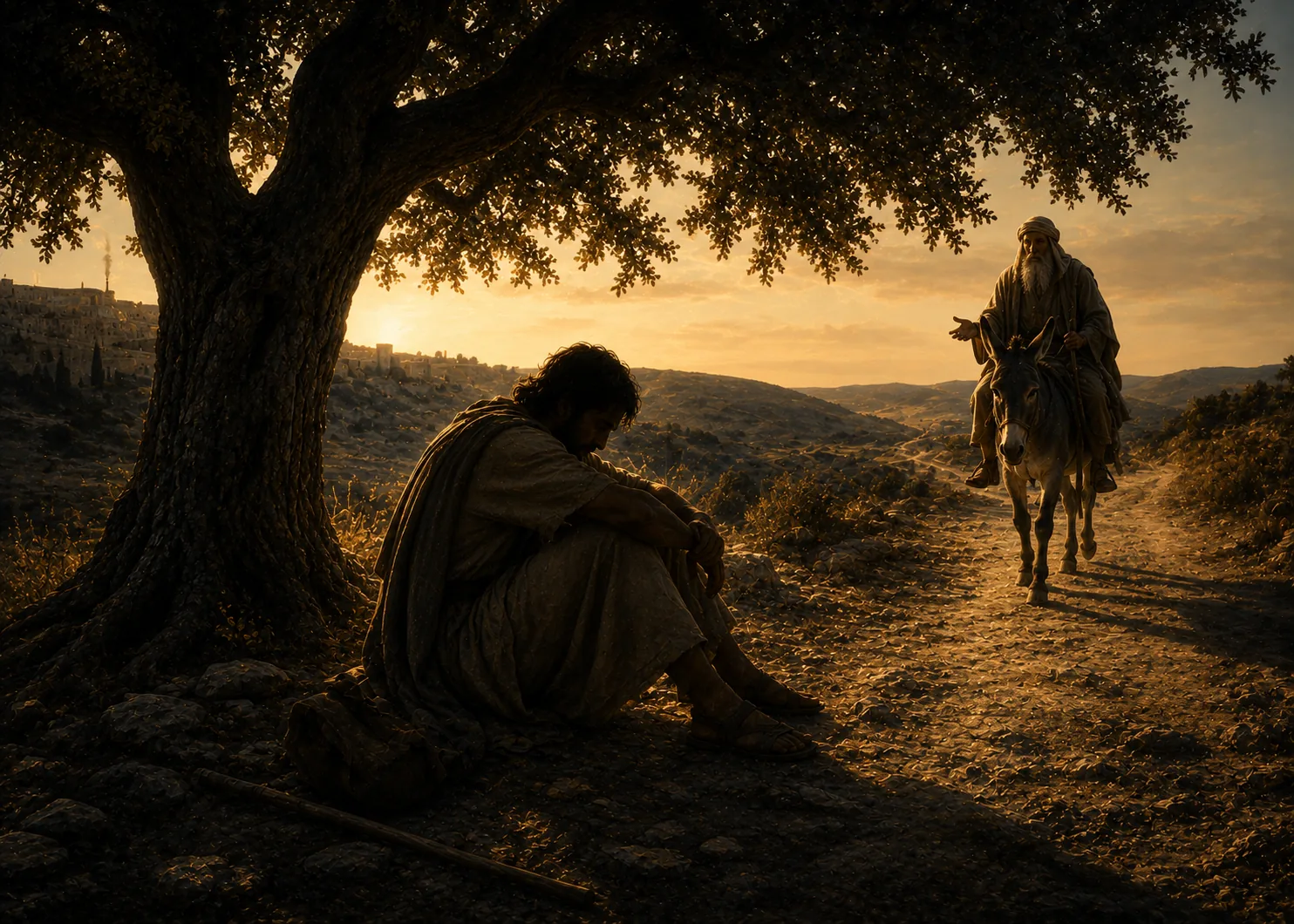
I. Under the oak
A man is sitting under a tree, and he is hungry.
He's hungry on purpose. That morning he was told not to eat, and he has kept it all day, through the hardest hours of his life. He walked out of Judah into Bethel with a word to deliver and delivered it, standing in front of an altar with the king beside it. The king put out his hand and said lay hold on him, and the hand went dead in the air and stayed there. The man prayed for the king who had just tried to arrest him, and the hand came back. Then the king, shaken and grateful and still a king, offered him dinner.
If thou wilt give me half thine house, I will not go in with thee, neither will I eat bread nor drink water in this place.1
Half the house. He turned it down without a pause and gave the reason plainly — so was it charged me by the word of the LORD — and then he did the third thing he'd been told to do, which nobody ever remembers: he went home by a different road. Threat didn't move him. Money didn't move him. He is, by any measure available to us, a man of extraordinary steadiness, and he will be dead before the day is out.
He sits down under an oak, because he's been walking since dawn and hasn't eaten.
And an old man rides up on a donkey and says, Come home with me, and eat bread.
That's it. That's the sentence. Not a threat, not a bribe, not a temptation dressed in anything particularly clever. An invitation to dinner, from a stranger, offered kindly — and the man who refused a king is about to sit at that stranger's table with bread in his hand.
It did not happen the way it gets preached. The story is not about a man who forgot what he was told. He didn't forget; the text is careful to show us that he still had it word for word. It is not about a man who was tempted by comfort and gave in, though he was tired and the comfort was real. It is about something more ordinary than either, and much more common, and much harder to see coming, because it doesn't arrive as a temptation at all. It arrives as a conversation with somebody who knows more than you do.
II. What he was told, and what he was asked
Nobody in this chapter ever weighs anything.
Start with what he was actually given. For so was it charged me by the word of the LORD, saying, Eat no bread, nor drink water, nor turn again by the same way that thou camest. Three parts, and no reason attached to any of them. He isn't told why the bread matters. He isn't told what's wrong with the road he came in on. He gets an instruction sized to the next few hours and nothing else — which is how this kind of thing seems to come, and which the companion essay The Highest Peak argues at length: a lamp for the feet, not a floodlight over the country.
Now the conversation on the road. The old prophet asks whether he's the man from Judah. He says he is. The old prophet says, Come home with me, and eat bread. And the man of God answers by repeating his instructions, accurately, out loud, to the old prophet's face:
I may not return with thee, nor go in with thee: neither will I eat bread nor drink water with thee in this place: for it was said to me by the word of the LORD, Thou shalt eat no bread nor drink water there, nor turn again to go by the way that thou camest.
He has it. All three parts, in order, unmuddled. Whatever undoes him, it isn't ignorance and it isn't a bad memory.
What happens next gets read past. The old prophet does not test the man of God's word. He doesn't weigh it, or measure it against anything, or ask a single question about it. He doesn't say are you sure, or tell me exactly what you heard, or let's take this to somebody. He asks him to drop it, and he offers a credential as the reason.
And notice that testing was never running in that direction anyway. It couldn't have been. A first-hand instruction isn't a claim submitted for adjudication; it's a thing to be done. There is no procedure by which a second party evaluates the command God gave you about your own bread, because the second party wasn't there and has nothing to evaluate. The most he can ever have is your report of it.
So the asymmetry sits there in the middle of the chapter, unremarked. The man of God's word was tested by nobody. The old prophet's word was tested by nobody. The only thing that happened in that conversation was that one of them outranked the other.
There is an objection to all of this and it's the right one: scripture does tell us to test what we hear, and it tells us to do it together, plainly, in at least three places.
III. The credential
The man of God wasn't overruled by evidence; he was overruled by standing.
Here is the whole of the old prophet's argument, and it's one verse:
I am a prophet also as thou art; and an angel spake unto me by the word of the LORD, saying, Bring him back with thee into thine house, that he may eat bread and drink water.
Two moves, and they are the two moves every appeal to authority has ever made.
The first is peerhood. I am a prophet also as thou art. Same office, same line of work — and implicit in the grammar, though he never says it, longer at it. The old prophet of Bethel has a house, and sons, and standing in the town; the man from Judah is passing through and arrived that morning. Nothing in that sentence is false. It's a credential, and it's a real one.
The second move is where it turns. An angel spake unto me by the word of the LORD. Not a contradiction of the original instruction — that's the part worth seeing. He doesn't say God never told you that, which the man of God would have laughed at, because he'd been there and knew what he'd heard. He says God has since said something else. It's an update. And an update is the form that works, because it doesn't ask you to believe you were wrong. It asks you to believe you're out of date, which is a much smaller thing to swallow and leaves your own hearing entirely intact.
It's worth saying that the angel isn't a tell. There's an old reading in which the reference to an angel should have tipped the man of God off, and it hasn't held up; an angel carrying God's message to a prophet is unremarkable in this literature, which is more or less what happens to Elijah six chapters later under a different tree.2 The claim was ordinary. That's what made it usable.
Then the narrator spends five words on all of it.
But he lied unto him.
No motive. No explanation. Nobody has ever settled why the old prophet did this, and the text shows no interest in helping. It puts the fact down, flat, in the middle of the verse, and moves on.
The verse is an inventory: seniority, office, and a warrant from beyond the room. Those are the three things any second opinion has ever run on, and the old prophet had all three — and every one of them was true except the last. He really was a prophet, he really had been at it longer, and his sons really had watched the whole thing happen at the altar that morning and come home and told him about it. The only false thing in the sentence is the one part that couldn't be checked.
The man of God did not lose an argument. He was never given one.
IV. The mouth that lied carries the word
Two verses later, God speaks through the liar.
The two of them go back to the house and eat. And as they sat at the table — mid-meal, minutes after the lie, with the bread of the broken fast still in front of them — the word of the LORD came unto the prophet that brought him back. It's a hard word and a true one, and it's the same mouth.
I don't think we let that land, because it's inconvenient in a specific way. It forecloses the thing most of us are actually doing when we think we're being discerning, which is sorting people. Sound and unsound. Safe and unsafe. The ones you can take a word from and the ones you can't. That picture is enormously comfortable, it's how most of us were taught to handle spiritual authority, and this chapter grades the same man both ways inside of two verses so that you can't run it.
The tradition keeps doing this, and it's never an accident. God speaks through Balaam's donkey, and calls a Persian emperor who doesn't know Them My shepherd.3 I've argued elsewhere, in The Machine You Expect, that this is a standing pattern and not a set of curiosities — that God has always been willing to use instruments that had no idea what they were carrying. The old prophet is that pattern with a worse instrument. Not one who didn't know. One who had just lied.
It also disposes of the taxonomy — the voice of fear, the voice of power, the voice of deception, each with its altar. That framing preaches well, and it quietly installs a second power with a portfolio, which is exactly the belief that The Knowledge of Good and Evil takes apart. Verse eighteen and verse twenty are the same man.
So if the messenger can't be the criterion, the criterion is somewhere else, and the tradition already says where. It says it in the most familiar passage it has on the subject, which is this chapter in miniature:
And when He putteth forth His own sheep, He goeth before them, and the sheep follow Him: for they know His voice. And a stranger will they not follow, but will flee from him: for they know not the voice of strangers.
Not they know a stranger's credentials are irregular — they know the voice, so the stranger has nothing to work with. The essay that owns that passage is In the Name (The Ambassador), and its finding is that in John 10 the knowing runs in both directions and mostly the other way. The negative half is the one that bears here: it names what the man of God had, and what he set down.
V. The objections, at full strength
Four of them. The second one changes the shape of the essay, and the third is the one I have no clever answer to.
The first: scripture commands us to test what we hear, and to do it together. It does. Beloved, believe not every spirit, but try the spirits whether they are of God: because many false prophets are gone out into the world. Despise not prophesyings. Prove all things; hold fast that which is good. Let the prophets speak two or three, and let the other judge.4 Three commands, all plain, none of them optional.
Read the third one in its own paragraph, though. First Corinthians 14 is describing a room. There are people in it, somebody is speaking to them, and Paul is regulating what happens next — take turns, let the others weigh it, and if something comes to a man sitting down, the one on his feet stops talking. Then the line that says where the check actually sits: the spirits of the prophets are subject to the prophets. The one speaking is answerable for what he says.
That is a rule about a word being offered to a room. It has never been a mechanism for revoking a word already given to you. The man of God was not in a room. He was alone on a road with an instruction that concerned nobody but himself, about his own bread, and there was nothing on the table for anyone else to weigh. What he submitted to review wasn't a claim. It was an obedience.
The second: so you're telling me to trust myself and ignore everyone. No. And a careless version of it is genuinely dangerous.
Nothing in this chapter is an argument against counsel, against elders, against people who have walked it longer telling you what they saw, or against a circle of folding chairs on a weekday morning. I've argued the opposite at length: in The Sheep in the Basement I made the case that a room full of people who have stopped pretending is producing the exact thing Jesus asked for, at scale, mostly outside the church. I believe that. I sit in one of those rooms.
The room isn't the problem. The distinction worth holding onto: the room doesn't tell you what God said to you. It puts you where you can hear it. Those are different jobs, and almost everything good about a room comes from the first one being off the table. When you walk into a meeting nobody there is authorized to hand down your next step, and that limitation is not a weakness of the format; it's the whole reason the format works on people who have been damaged by authority.
The failure in 1 Kings 13 is one specific transfer, and it's narrower than it looks. It isn't asking. It isn't listening to somebody. It's treating someone's standing as a reason — letting the fact of a person's seniority function, all by itself, as evidence about the content of what they're saying.
The third: God told me is the most abusable sentence in the language, and you've just armed it. Yes. And I've been on the wrong end of it.
In 2013 I met a man at a yoga studio in Los Angeles who called himself guruji. This was years before Jesus found me; I was somebody who was looking, which is the condition this whole essay is actually about. I started visiting him at his apartment. He talked about his students. He talked about the time he'd spent meditating in caves. He showed me photographs of a beautiful woman who was, he said, his devotee. He gave me things to read. We drank tea, for several weeks.
And I could see it. It was transparently egotistic — the caves, the students, the photographs, the reading list, a man narrating his own advancement to a visitor over tea, week after week. I watched him do it and I read it correctly and I kept going back, because he was further along than I was and I had decided that being further along was the kind of thing that settles a question.
Then he offered to do a chakra balancing, and I said yes. It involved lying on my back while he passed crystals over my body. It ended with him touching me in a way I had not agreed to.
I don't have anything to add to that sentence. The fault is his; a man who arranges weeks of deference and then uses it did the thing he'd been building toward, and there is no version of this where the person on the table failed a test. What I can speak to is my own side of the road, and my own side of the road is that every tell was there and I had already read it.
I'd put the tell this way now, and it's the only thing I'd carry out of that apartment: a dead giveaway of somebody's path is how much they're selling it. Self-aggrandizement is not subtle and it is not rare, and you can usually see it in about a week.
And look at what that's worth on its own. I saw it, and it didn't save me. A tell you can read correctly and still be undone by isn't a procedure. It's a description of how little the reading was worth by itself, next to the one thing I'd handed over without noticing, which was the assumption that a man further along the road gets to say what my next step is.
Two things here are cheap to leave implicit. Frauds turn up wherever there's standing to be had; the fraud in this chapter is a prophet of Israel with a house in Bethel, and I don't get to make this a story about somebody else's tradition. And the rooms of that tradition had already given me something real years earlier, which I've written about in Krishna Is Not Christ and would not take back. One man was a predator. That is a fact about him.
The fourth, and it's the hard one: then how do you know it isn't your own voice? I don't have a method for that, and I'd distrust one. Not because a practice is always a dodge, but because a test for whether a word is true has to be run by somebody, and who is running it is the whole difficulty. The most I've got is on loan from two companions — The Highest Peak, where guidance comes one step at a time and never with the country attached, and The Life Is Not in the Book, where obedience is a hearing word before it's a doing word.
There's one thing this chapter adds, though, and it's small and it holds: whatever the answer is, it can't be a person. The moment your answer to how do I know is somebody else, that somebody has to answer the same question about themselves, and there's nobody left for them to ask.
The chapter does leave one thing lying in the road, and it isn't a test of the voice. It's an observation about what the voice asks for. Every instruction in this story costs him something — no bread, no water, the long way home. Not one of them gives him anything he wanted. A word that only ever tells you what you already wanted is the one to be suspicious of first, and you don't need any standing at all to notice it.
Paul, for what it's worth, ruled out the exact credential the old prophet used, and named it: though we, or an angel from heaven, preach any other gospel unto you than that which we have preached unto you, let him be accursed. He's talking about the gospel there, not about whether a man on a road should eat bread, and the difference is real.5 What survives the difference is still worth having. The tradition already knew that an angel told me is not a trump card, and it knew it from the inside.
VI. The chapter says the fault twice, and not the same way
There is a judgment in this chapter. Forasmuch as thou hast disobeyed the mouth of the LORD, and hast not kept the commandment which the LORD thy God commanded thee — that is spoken by the word of the LORD, and it lands: thy carcase shall not come unto the sepulchre of thy fathers. Then a lion meets him on the road and kills him. And the detail everyone notices is there because the narrator wants it noticed: the lion doesn't eat him, and doesn't touch the donkey, and the donkey and the lion stand there beside the body until travelers come by. That is not what a lion does, and the whole weight of the reading tradition — ancient, medieval, and modern — takes it as the sign that this was God's doing and not an accident.6 I think that reading is right, and anybody who tells you this chapter has no judgment in it hasn't read it.
The chapter states the fault twice. Here it is the first time, in God's own verdict:
thou hast disobeyed the mouth of the LORD, and hast not kept the commandment which the LORD thy God commanded thee.
Second person. Indexed to him. The thing he failed to keep is the thing he was handed, that morning, on a road, about his own bread.
Here it is the second time, out of the old prophet's mouth, when the news comes back to Bethel:
It is the man of God, who was disobedient unto the word of the LORD: therefore the LORD hath delivered him unto the lion.
The personal clause is gone. What's left is disobedience in general — a rule, and a man who broke it. And that second version is the one that got preached. It's the sentence people quote as the moral of the chapter, and it is a line of dialogue, spoken by the man who arranged the disobedience, about the man he arranged it for.
Matthew Henry noticed, three hundred years ago, and interrupted the old prophet mid-sentence to say so: concluded it was the man of God, who was disobedient to his Master (and whose fault was that?) — and then, drily, that it would well have become him to ask why the lion was not sent against him and his house, rather than against the good man whom he had cheated.7 It's a fair question and the chapter never answers it.
One clause is the whole distance between a verdict and a sermon. Take the personal clause out and you have a general moral about obedience, which is a thing people can nod at and file. Leave it in and you have something much narrower and much worse: a man who was given one instruction, who could still recite it correctly at the moment he was asked to break it, and who set it aside because someone with better standing told him it had been superseded.
He didn't lose an argument with God; he handed the question to somebody else, and somebody else answered it.
VII. Lay my bones beside his bones
The last part of the story is the part nobody tells, and I can't work out why, because it's the strangest thing in the chapter.
The old prophet hears what's happened. He saddles his donkey again — the third time somebody saddles a donkey in this chapter, and the first two were going the wrong way — and he rides out and finds the body in the road with the lion still standing over it. He picks up the man he killed, brings him back to town, and puts him in his own grave.
Then he mourns over him. Alas, my brother!
And then he tells his sons: When I am dead, then bury me in the sepulchre wherein the man of God is buried; lay my bones beside his bones.
Three hundred years pass. A king named Josiah comes north to Bethel and pulls down the altar the man of God had cried against on the morning of the day he died, and to defile the place he burns the bones out of every grave on that hillside on top of it — which is, to the word, what the man of God had said would happen. And in the middle of it Josiah looks up and sees one marker still standing.
Then he said, What title is that that I see? And the men of the city told him, It is the sepulchre of the man of God, which came from Judah, and proclaimed these things that thou hast done against the altar of Bethel. And he said, Let him alone; let no man move his bones.
And then the sentence nobody planned:
So they let his bones alone, with the bones of the prophet that came out of Samaria.
The liar's bones were spared because he'd asked to be laid beside the man he killed. On a hill where every other grave was emptied onto a fire, those two were left where they were, together, because of a request made by the guiltier of them out of grief.
I don't know what to do with that, and the chapter doesn't say. It isn't absolution and it isn't a lesson. It's just the last thing that happens, and what it is not is a warning.
I have no method to give you, and I don't think one is missing. The picture this chapter takes down is the one where somebody further along the road can settle a question you were given directly. What's left when it comes down is what the story says: the man had it firsthand, and firsthand is not a thing that can be lent, or borrowed, or delegated to a person with a better title, and there is nobody in the world who can do your hearing for you.
The man was under that oak for a while before the old man rode up. It's the last time in the story he is alone with an instruction he could still keep.
Footnotes
-
1 Kings 13 throughout, KJV. The chapter is short enough to read in one sitting and it repays it; almost everything here is in the plain sense of the text rather than behind it. Quotations here follow the King James, with deity pronouns capitalized per this publication's convention — the King James lowercases them, and the capitals are mine. ↩
-
The reading that the mention of an angel was a signal the man of God missed is Alexander Rofé's, and it has not been widely accepted; Mordechai Cogan's objection is the straightforward one, that an angel doing God's bidding would not have struck anyone in this literature as unusual — compare 1 Kings 19:5–7, where an angel twice wakes Elijah under a juniper tree and tells him to eat. ↩
-
Numbers 22:28–30; Isaiah 44:28 and 45:4–5, where Cyrus is named My shepherd and God says plainly thou hast not known Me. ↩
-
1 John 4:1; 1 Thessalonians 5:20–21; 1 Corinthians 14:29, with verse 32 — the spirits of the prophets are subject to the prophets — which is the clause that locates the check. ↩
-
Galatians 1:8; compare 1:11–12, where Paul grounds his own authority on not having received the gospel from a man. The scope is the gospel itself and a rival version of it, which is a larger and more public thing than the question in front of the man of God. I'm claiming only that the tradition ruled out the appeal to an unverifiable higher messenger, not that Paul was legislating about private guidance. ↩
-
The unnatural restraint of the lion is generally read as the sign of divine agency rather than accident — so Richard Nelson, First and Second Kings (Interpretation, 1987), 88, and Robert L. Cohn, "Literary Technique in the Jeroboam Narrative," ZAW 97 (1985): 23–35, both quoted in Manhee Yoon, A Literary and Theological Reading of 1 Kings 13 (PhD diss., University of Toronto, 2016), 78. Matthew Henry reads the preserved body as a token of mercy inside the judgment rather than a qualification of it. On the narration itself, Keith Bodner's observation is the one this movement rests on: "While the narrator refrains from mentioning any direct causation, the old prophet is quick to interpret the dramatic events as divine judgment" (Jeroboam's Royal Drama, Oxford, 2012, 113, quoted in Yoon, 78). ↩
-
Matthew Henry, Exposition of the Old and New Testament, on 1 Kings 13:23–32. ↩