Son of Joseph
Why the list nobody reads argues against the doctrine printed beside it.
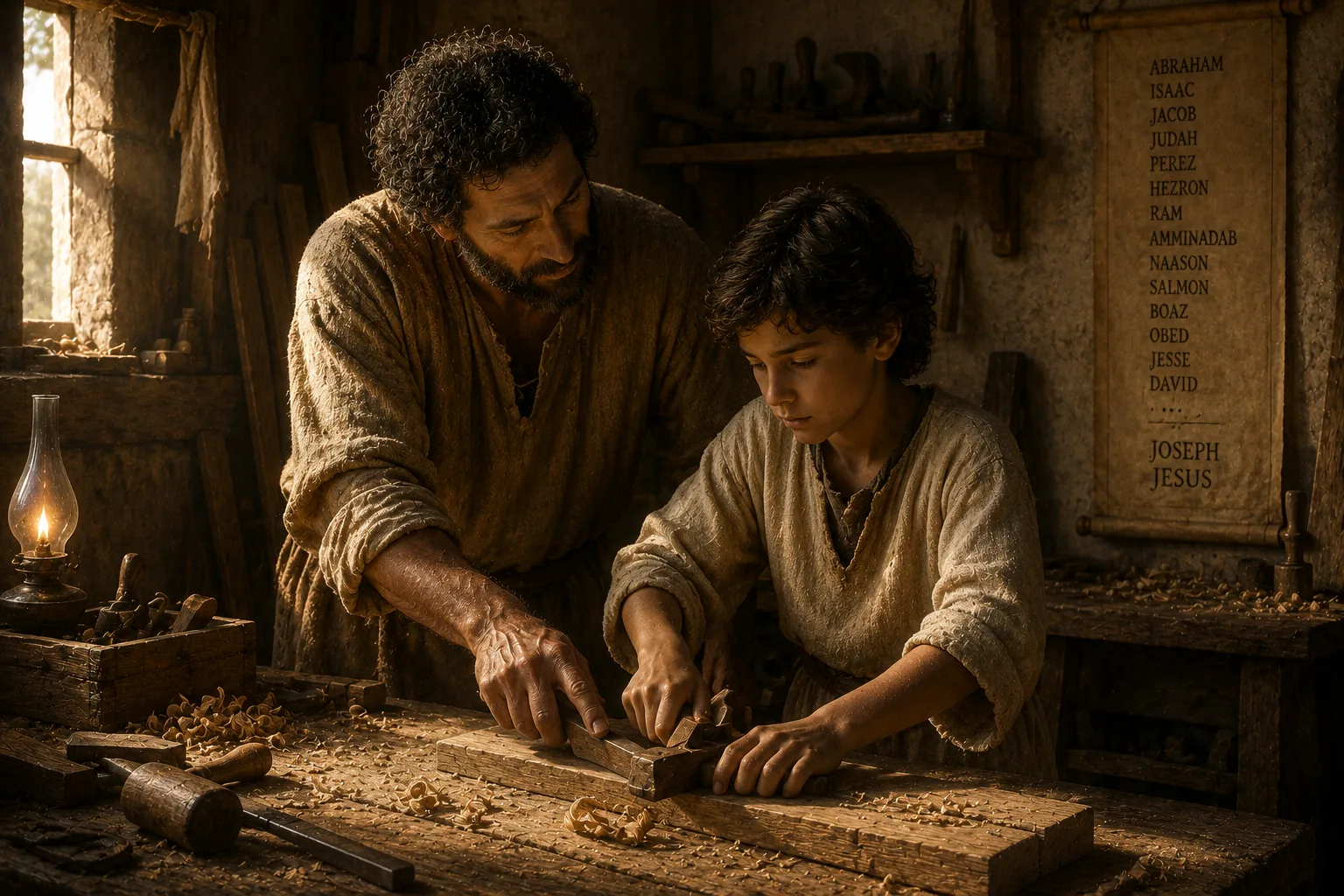
I. The list nobody reads
Open the New Testament and the first thing it does is hand you a list.
Not a scene, not a claim, not a voice crying in the wilderness — a list. Abraham begat Isaac; and Isaac begat Jacob; and Jacob begat Judas and his brethren. Forty-one names, most of them strangers, marching down the page in a formula that does not vary for seventeen verses.1 Nobody reads it. Lectionaries route around it. Study Bibles give it a heading so you know what you are skipping. Every reader I have ever watched open Matthew has done the same thing I did: thumbed past the names to verse 18, where the story starts.
It is not a preamble. It is the argument.
Look at the sentence it opens with: The book of the generation of Jesus Christ, the son of David, the son of Abraham.2 That is the gospel's opening claim, and it is a claim about descent. Everything in the seventeen verses that follow is the evidence for it. And Matthew is not sleepwalking through the material — he has worked on it, arranging the whole line into three sets of fourteen and then telling you he has done so, out loud, in verse 17, the way a man points at the architecture he wants you to notice.3 Stranger still, into a patrilineal register where women do not normally appear at all, he seeds four of them — Tamar, Rahab, Ruth, and her that had been the wife of Urias — every one of them a woman whose place in the line came by an irregular road.4 That is not filler. That is a man building a document he needs to hold weight.
And every link in it runs through a father. That is what the formula is doing, forty-odd times, without variation: a man, and the son he begat, and the son that son begat. The line comes down through Judah and David and the kings and the exile and the obscure generations after it, and it arrives, in verse 16, at a carpenter in Nazareth.5
Then the verb changes.
And Jacob begat Joseph the husband of Mary, of whom was born Jesus, who is called Christ.6
Read it twice. Everyone in this chapter begat. Joseph does not. The chain that has been forged link by link for seventeen verses reaches its final link and does not close. It reaches Joseph and then goes sideways — through his wife, by a passive verb, to a son the sentence declines to say he fathered.
Two paragraphs later, Matthew tells you why. That which is conceived in her is of the Holy Ghost.7
So here is the plainest question about those two pages, asked without the flinch that usually accompanies it. Why would a man spend seventeen verses proving a descent through Joseph, and then, in the next paragraph, remove Joseph from the descent?
I think the genealogy is the older thing, and the truer one. That much is not my invention: the list is widely taken to rest on tradition Matthew inherited rather than composed, and the Davidic claim it carries is demonstrably older than his gospel — Paul already has it in the fifties.8 What I add is the plain reading of what an inherited patrilineal document is evidence of. I think it tells us what the earliest people who followed Jesus believed about where He came from, which is that He came from where you came from. And I think the paragraph after it is an answer supplied later, to a question the genealogy never had — an answer that solved one problem and created a much larger one, which the church has been living inside ever since.
That answer comes down here, and not in order to reduce Him. I am doing it because I have come to think the doctrine of the virgin birth is the single largest obstacle to the thing He actually asked of us, and that what stands behind the picture, once you take the picture down, is better than the picture.
II. What a genealogy is for
A genealogy in that world is not sentiment. It is a legal instrument.
It exists to establish what you are entitled to by virtue of who your father was: your tribe, your land, your standing, and — if you were a priest — your right to serve at all.9 It is evidence, and its evidentiary logic is patrilineal. Descent runs through the father. That is not one feature of the document among several; it is the entire mechanism by which the document proves anything.
And Matthew needs it to prove something specific. The promise he is claiming for Jesus is a promise made to a house: a son of David, on David's throne, out of David's own body.10 That is why the list is there. That is why it runs where it runs. Strip the Davidic descent out of Matthew's opening and you have not damaged a decorative element; you have removed the load-bearing claim of his first sentence.
So here is the difficulty, stated as flatly as I can state it. A patrilineal proof of descent routed through a man the text says is not the father does not prove descent. It proves paperwork.
There is a good answer to that, the one the tradition has always had ready, and it deserves its strongest form — it is not a foolish answer, and I would rather be beaten by it than win against a weak one.
The answer is adoption. Early Judaism had both the concept and the practice of it — Jacob taking Ephraim and Manasseh as his own, levirate marriage, and the evidence of Aramaic papyri and inscriptions — and adoption of that kind transferred lineage, which is precisely the thing at issue.11 Look at what Matthew has the angel tell Joseph: thou shalt call His name Jesus: for He shall save His people from their sins.12 To name a child is to claim him. Joseph takes Mary, and he names the boy, and by naming him he places him inside his house and inside his line — which means the Davidic descent Matthew has just spent seventeen verses documenting passes to Jesus by the strongest legal instrument the culture had. On this reading the genealogy is not embarrassed by verse 18 at all. It is completed by it.
That has real force, and I have little standing to wave it off. Adoption is not a technicality in this tradition or in this publication. I have argued at length, in In the Name (The Ambassador), that the deepest thing the gospel offers is exactly an adoption — a name received rather than earned, a surname conferred at the door of a house you did not build. I am the last person entitled to say that a legally acknowledged son is a son in name only. In that world he isn't one — he is simply a son.
So the answer stands. I leave it standing and set two more things down beside it, and at the end I will ask which explanation is carrying the weight.
But note, before we go on, what the answer is not. It is not Matthew's, and he never makes it. Nowhere does he write and thus by acknowledgment the line passed to Him, which is the one sentence that would have closed the seam and cost him nothing. What he does instead is build a blood argument, break it at the last link, and move on to the star and the wise men without appearing to notice. The repair is one we supply. That is worth holding onto: for two thousand years the defense of the genealogy has been performed by the genealogy's readers rather than by its author.
III. The witnesses
Here is the second thing to set down beside the adoption answer: in the earliest record we have, the virgin birth is thinner than its position in the creed would lead you to expect.
Start with Mark, the earliest of the gospels. Mark has no birth narrative at all. No annunciation, no manger, no star, no Joseph. Mark's gospel opens with a grown man walking out of Nazareth and down to a river to be baptized, and if his were the only gospel we had, no one would know the story existed.13
Then go to the other end. John is the latest and the highest — the gospel that opens In the beginning was the Word, that makes the largest claim about Christ's origin anywhere in the canon. John, of all writers, has every reason to tell you about the conception, and he does not. There is no birth narrative in John either. And twice he lets people call Jesus something he never pauses to correct: Philip, fetching Nathanael, says Jesus of Nazareth, the son of Joseph; and the crowd at Capernaum, scandalized, says Is not this Jesus, the son of Joseph, whose father and mother we know?14
I have to be careful here, out loud. That is an argument from silence, and silence is the weakest evidence there is. John lets a great many misunderstandings stand for literary reasons — misunderstanding is practically his method. I am not claiming John denies the virgin birth. I am claiming only what the silence supports: that the two gospels bracketing the tradition, the earliest and the latest, built their portraits of Jesus without needing it.
Paul is the one that gives me pause the longest, because Paul is earlier than all four gospels, and Paul is precise about origins when it matters to him. What he says is this: God sent forth [Their] Son, made of a woman, made under the law.15 And this: concerning [Their] Son Jesus Christ our LORD, which was made of the seed of David according to the flesh.16
Made of a woman. Not of a virgin — of a woman, which is what every human being is made of. And the Davidic descent, which is the whole reason Matthew's list exists, Paul grounds according to the flesh. Not according to the law, not according to acknowledgment, not by adoption into a house. Flesh. The earliest surviving witness we have says the descent from David runs through the body.
Luke does have the annunciation, and I am not going to pretend otherwise; two of the five carry the story and Luke carries it beautifully. But Luke also supplies a second genealogy that disagrees with Matthew's at nearly every link between David and Joseph — Matthew's Joseph is the son of Jacob, Luke's is the son of Heli — and Luke, at the head of his own list, inserts a hedge Matthew never needed: being, as was supposed, the son of Joseph.17
Add it up honestly and the tally is modest. Not nobody believed it. Just this: of the five earliest witnesses to Jesus, two carry the virgin birth, the earliest of them does not, the highest of them does not, and the two that do cannot agree on the lineage it is attached to.
And there is one witness more, this one from inside Matthew's own transmission. An old Syriac manuscript — the Sinaitic palimpsest, recovered at Saint Catherine's — reads verse 16 the other way. In it Joseph begets Jesus, and the chain closes.18
Handle that carefully. It is an isolated minority witness in a translation, and the critical editions do not print it; I cannot tell you we can recover an earlier Matthew in which the line ran unbroken, and the scholars who could tell you that cannot either. Anyone who hands you this variant as a smoking gun is selling you something. What it shows is smaller and better: the seam was felt, and early. A community reading a chain of begettings that stops begetting at the last link had the same reaction you had two pages ago — in the fourth century, long before anyone had a modern axe to grind.
And the argument does not need it. Keep the received text exactly as the church has always had it, every letter. Matthew still builds a blood argument through seventeen verses and then supplies, in the paragraph immediately after, a reason the blood does not run. You don't have to reconstruct anything. You only have to read the chapter straight through without skipping the part everybody skips.
IV. Almah
The third thing. Matthew does not leave the conception hanging as a bare assertion — he grounds it, the way he grounds everything, in a text. Behold, a virgin shall be with child, and shall bring forth a son, and they shall call his name Emmanuel, quoted from Isaiah, introduced with his signature formula: that it might be fulfilled which was spoken of the LORD by the prophet.19
The word Isaiah wrote is almah. It means a young woman of marriageable age. It does not mean virgin, and Hebrew was not short of ways to say virgin — the word for that is betulah, and Isaiah did not use it.20 The Septuagint, translating into Greek two centuries or so before Matthew, rendered almah as parthenos, which in Greek does carry virginity.21 Matthew, writing in Greek, quotes the Greek.
And there is something else, which I find more decisive than the vocabulary. Read Isaiah 7 in its own chapter. Ahaz is king in Jerusalem and two kings are marching on him and he is terrified — the text says his heart moved like trees in a wind. The sign is given to him, for his own emergency: a child will be born, and before that child is old enough to know to refuse the evil and choose the good, the land of the two kings you are afraid of will be abandoned.22 The child is a clock. The sign is the boy's age. A sign whose whole function is to resolve inside a frightened king's own lifetime is not a prophecy launched seven hundred years downfield to land on a carpenter's wife.
I am aware of exactly whose argument I have just made. This is standard-issue material for people who use it to embarrass Christians, and I have no interest in that at all. So here, immediately, is what I think it costs.
Nothing.
Matthew reads his scriptures the way every writer of his moment read them — searching the text for the present, finding the shape of what has just happened in the language of what was written long before. That is not fraud. It is how the tradition thought, and it is how it still thinks every time a preacher finds you in a psalm. The honest description of what happened is small and unscandalous: a translation choice made in Alexandria, read three centuries later through a habit of reading that found the living present in ancient words, hardened over time into a claim about biology. No one lied. Something got translated, and then it got believed.
V. The temple in India
There is a hole in the story, and holes get filled.
He is twelve years old in the temple, and then He is about thirty at the Jordan.23 Eighteen years, four gospels, nothing. Not a scene, not a sentence. Whatever formed the man who walks out of Nazareth in Mark's first chapter happened inside a silence the tradition never filled.
The most persistent filling is that He went east — that the missing years were spent in India, studying with brahmins and Buddhists, and that He came home carrying practices He had learned there. It is a beautiful story and it has been believed by serious people, and I have wanted it to be true.
Everything in it that is true is conceded, and a fair amount is true. The years really are blank; no one is inventing the gap. And the geography is not absurd. Three centuries before Jesus, Ashoka had sent envoys west and named the Hellenistic kings he sent them to, in an inscription carved into rock.24 Within the same century, ships were running the monsoon route between Egypt and the coast of India as ordinary commerce — though the direct crossing became routine around the middle of it, which is after the years in question.25 The world was not sealed. A Galilean encountering Indian thought is not a physical impossibility, and anyone who tells you the ancient Mediterranean and the ancient East were hermetically separate is wrong.
But the claim, when you meet it, is usually more specific than that. It usually arrives as: there are records. There is a monastery in India that holds the documents.
There are not, and it does not.
The claim traces to one man. In 1894 a Russian traveler named Nicolas Notovitch published a book reporting that at the monastery of Hemis, in Ladakh, he had been shown a manuscript life of Saint Issa — Jesus — covering the missing years.26 Max Müller challenged it almost immediately. In 1895 J. Archibald Douglas traveled to Hemis and put the questions to the abbot directly, who told him that no such manuscript existed and that no European answering Notovitch's description had been there at all.27 The other two pillars are weaker still. Levi Dowling's Aquarian Gospel of Jesus the Christ, which fills the eighteen years in loving detail, is not a discovered record; it is a channeled one, written in 1908 by a man who said he was reading it off the akashic records.28 And the shrine at Roza Bal in Srinagar, offered as His tomb, is a shrine with a tradition attached to it, which is a different kind of object than a piece of evidence.29
I say this flatly because I would rather lose a story I love than defend one that cannot be defended. I have done this before in these pages: in Krishna Is Not Christ I set down the much-loved claim that Krishna and Christ share a root, because it is false, and the essay was stronger for having said so. An argument is only as strong as the weakest thing you ask a reader to swallow.
But the reason I am spending a movement on this is not the evidence. It is what the story is for.
Watch what the India story does. It answers a question — how did He do it? — and the answer it gives is: He learned something we were not taught. He went somewhere we cannot go. He had access.
That is the virgin birth wearing different clothes.
Both stories take the explanation of Jesus and put it out of reach. One locates it in His conception and one in His curriculum, and it makes no difference which, because the function is identical: you get to admire Him from where you are standing, and stay there. A man with an eighteen-year apprenticeship in Kashmir is exactly as unrepeatable as a man with half a divine genome, and both of them can be revered indefinitely without costing you anything.
And here is the part that settles it for me. I do not need the story. Nobody does. If the emptying He accomplished required a curriculum only obtainable four thousand miles from Galilee, then follow Me was addressed to almost no one who has ever lived. The reason to let the India story go is not merely that its evidence collapses under a single visit to Hemis. It is that it does the same damage as the doctrine being taken down, and does it in the same place.
VI. What was left
So what happened in the man?
The answer this publication has been building toward, argued most fully in The Novelist DM, is that Jesus of Nazareth shed the sense of being a separate self — completely, in a way no one before or since has managed to sustain — and that what was left in Him afterward was God, because God is what is left in anyone who does it. Not a hybrid. Not a being made half of one substance and half of another, requiring an unusual conception to fuse them. A man who emptied out and did not fill back up.
I'm not going to re-derive that here; the argument for it lives in that essay and this one is not a repeat of it. What is added here is the removal of the last obstacle standing in front of it, which is the idea that His divinity was a fact about His genetics.
What I do want to put on the page is the evidence that persuades me, which is not philosophical at all. It is a verbal tic that runs through everything He says about His own deeds. He never claims one. Confronted, praised, accused, He hands the credit somewhere else, every time, with a consistency that would be exhausting if it were a pose. I can of Mine own self do nothing.30 The Father that dwelleth in Me, [They do] the works.31 And when a man in the road opens with a compliment, He will not even take that: Why callest thou Me good? none is good, save one, that is, God.32
Sit with that last one. It is a strange sentence for a demigod to say, and an entirely coherent sentence for an emptied man to say. It is also, as it happens, the sentence this whole publication is named after.
The uniqueness claim, stated narrowly — the wide versions of it are false and I have argued against them myself. It is not that He alone loved God; people have loved God magnificently in every tradition and every century, and I came to God through devotional chanting in a language I did not speak. It is not that the God He pointed to was unavailable elsewhere. It is something more particular, and checkable: where He puts the doing. The deflection is not an occasional modesty; it is a habit of speech running through the discourses — the Son can do nothing of Himself, My doctrine is not Mine, I do nothing of Myself, I have not spoken of Myself.33
And I should say what that does not mean, because the obvious objection is a good one. He is not a man who makes no claims. He makes the largest ones anybody has ever made — I am the way, the truth, and the life; before Abraham was, I am.34 So the pattern is not humility in the ordinary sense, and anyone arguing that from these verses is arguing something the verses will not hold. The pattern is stranger than that, and it is the reason I find it evidential: the largest claim and the deflection arrive in the same breath. I am the way is four sentences from the Father that dwelleth in Me, [They do] the works — same room, same evening, same discourse. A man promoting himself does not talk like that. A man with nothing left in him to promote talks exactly like that.
And none of this makes Him less a man with a body. I am emphatic about this, because the argument can be misheard as running in the opposite direction from where it goes. He got tired. He ate. He wept at a grave. He bled, and He died, and I will not have any of that turned into appearance or symbol. The emptying is not a dissolving; it is the reverse of a phantom. It is a real man, solid all the way down, with nothing left inside him standing between the Father and the work.
VII. The line I am denying
I have been circling it for six movements and I should say it in the open.
The Apostles' Creed: conceived by the Holy Ghost, born of the Virgin Mary. The Nicene: incarnate by the Holy Ghost of the Virgin Mary.35 I do not believe that clause. I am not going to pretend I have been doing anything other than removing it, and I am not going to hide the removal inside implication and let a reader discover it later and feel handled.
Two concessions first, and I mean both of them.
The doctrine has done real work. It guarded something that matters: that Jesus did not become God's by promotion — that the divinity was not a prize awarded at the Jordan for exceptional conduct, a good man elevated on merit. Against that reading, the virgin birth is a wall, and the church was not foolish to build a wall there. The thing it was protecting is true and worth protecting.
And it is confessed. Sixteen centuries, in every language, by people whose faith is not mine to condescend to and is in most cases larger than mine. On this clause I am the one out of step, and I know it, and there is no smugness available to me here. I want none.
Now the answer. The frame I am arguing from never located the divinity in the biology, so it does not need a biological exception to protect His origin in God. If God is not a second thing standing outside creation but the life that everything is made of and running on, then how did God get into that man was always the wrong question, and the wall was built across a road nobody was traveling.36 Nothing had to get in. Something had to get out of the way.
And here is what the doctrine costs, which is the reason I am willing to stand where I am standing.
A doctrine's real meaning is what it does inside a person's chest. What this one does — reliably, in reader after reader, whatever the theologians intend — is put a wall between what He did and what you could do. If He could forgive like that because of how He was conceived, then His life is a demonstration, and you can admire a demonstration forever without moving. Every impossible thing He asks of you becomes explicable: of course He could. He wasn't working with what I'm working with.
But He was. That is the whole of it. Follow Me was not said to people who shared His chromosomes; it was said to fishermen, by a man who had the same equipment they did and had simply stopped defending it. I have argued in The Highest Peak that what we were given is a route rather than a rulebook — and a route is only worth having if someone with your legs walked it.
So I am denying a line in the creed, and this is the defense: I am denying it in order to follow Him more faithfully. Not to make Him smaller. To make Him reachable, which is what He said He was.
Go back to the list.
Forty-one names. Kings and nobodies, most of them men you would never have heard of otherwise. Tamar, who had to trick her way into the line. Rahab. Ruth, a foreigner. The woman the text will not name, who was married to Uriah. Adultery in it, and exile, and a great deal of ordinary marriage in ordinary houses over a thousand years. Begat, and begat, and begat — the whole unglamorous human chain, dragging itself down the centuries toward a town nobody thought well of.
And at the end of it, a man.
Not an exception to the list. The last name on it — standing on the road you are standing on, a few steps ahead, already walking.
Footnotes
-
The list yields forty-one names from Abraham to Jesus, while 1:17 claims three sets of fourteen — forty-two. The discrepancy is old and well known, and the usual resolution counts Jechonias twice, once closing the royal line and once opening the line of private men after the exile. I take no position on it and the argument needs none: the essay's case rests on the verb at 1:16, not on the arithmetic at 1:17. Verified. ↩
-
Matthew 1:1 (KJV): "The book of the generation of Jesus Christ, the son of David, the son of Abraham." The genealogy runs 1:1–17. Verified. Scripture throughout is the King James. Deity pronouns are capitalized here and throughout, which the King James does not do; and where the house They/Them is substituted into a quotation rather than only recased, the substitution is bracketed — [Their] Son, [They do] the works — so the word is visibly mine and not the translators'. The pronoun is argued in They/Them. ↩
-
Matthew 1:17 (KJV): "So all the generations from Abraham to David are fourteen generations; and from David until the carrying away into Babylon are fourteen generations; and from the carrying away into Babylon unto Christ are fourteen generations." Verified. That Matthew states the scheme himself is the ground for calling it deliberate; nothing here rests on why he chose fourteen. ↩
-
Tamar (Matthew 1:3, KJV Thamar), Rahab and Ruth (1:5, KJV Rachab), and "her that had been the wife of Urias" (1:6) — Bathsheba, unnamed. I give the three by their familiar English names and the fourth as the King James has her, which is how the text itself leaves her. All four verified. ↩
-
The trade comes from Matthew 13:55 (KJV), where His neighbors ask "Is not this the carpenter's son? is not his mother called Mary?" Verified. Nothing in the argument rests on the occupation; it is there because a document this consequential ending at a working man in a small town is the fact the whole essay is about. ↩
-
Matthew 1:16 (KJV): "And Jacob begat Joseph the husband of Mary, of whom was born Jesus, who is called Christ." Verified. Every preceding link in the chain uses begat; this one does not. ↩
-
Matthew 1:20 (KJV), the angel to Joseph: "that which is conceived in her is of the Holy Ghost." The birth narrative runs 1:18–25. Verified. ↩
-
That Matthew 1:1–17 rests on tradition he received rather than composed is the ordinary position in the critical literature — the genealogy reads as a self-contained unit with its own frame, and the Davidic claim it exists to carry is attested a generation before the gospel, in Romans 1:3. Raymond E. Brown's The Birth of the Messiah is the standard treatment. I lean on the uncontroversial half of that — the list is older than the chapter it sits in — and not on any particular reconstruction of how the infancy material came to join it. ↩
-
The evidentiary function is on display at Ezra 2:61–63 and Nehemiah 7:63–65, where priests who "sought their register among those that were reckoned by genealogy" and could not find it were "as polluted, put from the priesthood." Both verified. A genealogy is what proves a claim; lose the document and you lose the standing. ↩
-
2 Samuel 7:12 (KJV): "I will set up thy seed after thee, which shall proceed out of thy bowels, and I will establish his kingdom"; the promise runs 7:12–16. Jeremiah 23:5: "I will raise unto David a righteous Branch." Both verified. I claim only that Matthew is arguing for Davidic descent, which his first verse says outright — not that first-century Judaism was unanimous about what the Messiah had to be. ↩
-
The strongest scholarly form of the defense is Caleb T. Friedeman, "Jesus' Davidic Lineage and the Case for Jewish Adoption," New Testament Studies 66.2 (2020), 249–67, arguing from Ephraim and Manasseh, levirate marriage, Aramaic papyri, and Jewish inscriptions that early Jews had both the concept and the practice, so no appeal to Roman law is needed. He is answering Yigal Levin, who had argued that adoption was absent from Jewish law. I have deliberately given §II Friedeman's version rather than Levin's, because Friedeman's is the one that hurts my argument, and an essay that reaches for the weaker opponent has not earned anything. Two honest limits, kept here rather than used as a body-level gotcha: what Friedeman establishes is adoption, a transfer of status more formal than a father's bare acknowledgment; and the reason Jewish law has no single adoption procedure at all is the primacy it gives biological kinship in fixing inheritance and tribal status. ↩
-
Matthew 1:21 (KJV): "and thou shalt call his name Jesus: for he shall save his people from their sins" — deity pronouns capitalized in the body as throughout. Verified. Some print editions set JESUS in capitals here; the edition I checked does not, so I have not. ↩
-
Mark 1:1–11 (KJV): the gospel opens with John baptizing in the wilderness and "Jesus came from Nazareth of Galilee, and was baptized of John in Jordan." Verified, including the absence — Mark carries no infancy material anywhere. ↩
-
John 1:45 (KJV), Philip to Nathanael: "Jesus of Nazareth, the son of Joseph"; John 6:42: "Is not this Jesus, the son of Joseph, whose father and mother we know?" Both verified. Luke 4:22 makes the same identification in different words — "Is not this Joseph's son?" — which is why I cite it as a parallel and do not quote it in the body as though it read alike. ↩
-
Galatians 4:4 (KJV): "God sent forth his Son, made of a woman, made under the law" — quoted in the body with the house pronoun bracketed. Verified. The phrase says nothing about the manner of conception in either direction; what it does not say is of a virgin. ↩
-
Romans 1:3 (KJV): "Concerning his Son Jesus Christ our Lord, which was made of the seed of David according to the flesh" — house pronoun bracketed in the body. Verified. This is the load- bearing citation of §III, so its limit belongs here: according to the flesh is a claim about physical descent, and Paul makes it about the Davidic line specifically. He does not there address the conception, and I do not have him addressing it. ↩
-
Luke 3:23 (KJV): "And Jesus himself began to be about thirty years of age, being (as was supposed) the son of Joseph, which was the son of Heli"; Matthew 1:16 has Joseph as the son of Jacob. Both verified. The standard harmonization is that Luke gives Mary's line rather than Joseph's; it is a real proposal and the reader should know it exists, though it leaves as was supposed doing exactly what it does. ↩
-
The Sinaitic Syriac palimpsest (Codex Sinaiticus Syriacus), a late-fourth- or early-fifth-century Syriac gospel manuscript recovered at Saint Catherine's, reads Matthew 1:16, in Agnes Smith Lewis's 1894 translation: "Joseph, to whom was betrothed Mary the Virgin, begat Jesus, who is called the Christ." Verified as to the reading, the manuscript, and its status. Status stated plainly: it is an isolated minority witness in a translation, not a Greek witness and not what the critical editions print; the manuscript does not otherwise rewrite the surrounding narrative to match. §III claims nothing from it beyond that the seam was felt early. ↩
-
Matthew 1:22–23 (KJV): "Now all this was done, that it might be fulfilled which was spoken of the Lord by the prophet, saying, Behold, a virgin shall be with child, and shall bring forth a son, and they shall call his name Emmanuel." Verified. ↩
-
Isaiah 7:14. The Hebrew is ʿalmah; HALOT renders its instances "marriageable girl," "a girl who is able to be married," "young woman." The term whose reference is specifically virginity is betulah, which occurs some fifty times in the Hebrew Bible and is not the word used here. See Hallvard Hagelia (Ansgar College and Theological Seminary, Kristiansand), "'Almah in Isaiah 7:14." The honest limit, which the body keeps: ʿalmah does not exclude virginity, it simply does not assert it. My claim is that the Hebrew does not carry the doctrine, never that it contradicts it. ↩
-
The Septuagint renders ʿalmah at Isaiah 7:14 as parthenos, which does carry the sense of virginity; the standard edition is Rahlfs (1935). The date of the Greek Isaiah is not precisely fixed — estimates run across the last three centuries BCE — so the body says only that it precedes Matthew by a couple of centuries, and I have not manufactured a firmer date than the evidence supports. ↩
-
Isaiah 7 (KJV): Rezin of Syria and Pekah of Israel move on Jerusalem (7:1); Ahaz's heart is moved "as the trees of the wood are moved with the wind" (7:2); and the sign carries its own clock — "before the child shall know to refuse the evil, and choose the good, the land that thou abhorrest shall be forsaken of both her kings" (7:16). All verified. The crisis is the Syro-Ephraimite one, and the sign is given to a specific king in a specific emergency. ↩
-
Luke 2:42 (KJV), "And when he was twelve years old", in the temple episode at 2:41–52; and Luke 3:23, "about thirty years of age." Both verified. ↩
-
Ashoka's Major Rock Edict 13 names the kings to whom he sent envoys: Antiochus (Antiochus II Theos of Syria), and beyond him Ptolemy, Antigonus, Magas, and Alexander — conventionally Ptolemy II Philadelphus of Egypt, Antigonus Gonatas of Macedon, and Magas of Cyrene, with the Alexander disputed between Corinth and Epirus. Verified. Third century BCE, and evidence of deliberate contact westward. ↩
-
The Periplus of the Erythraean Sea, a Greek merchant's handbook of the first century CE, describes the Egypt-to-India run and names Indian ports — Muziris on the Malabar coast, Nelkynda, Barygaza. Verified. The correction the body carries: the direct open-sea monsoon crossing is attributed to Hippalus and conventionally dated to around the middle of the first century CE — which is after the years this movement is about. So the honest claim is that the world was not sealed and that contact ran in both directions, not that a Galilean of the 20s could have taken a routine passage to India. ↩
-
Nicolas Notovitch, La vie inconnue de Jésus-Christ (Paris, 1894), translated as The Unknown Life of Jesus Christ, reporting a manuscript life of Saint Issa shown to him at the Hemis monastery in Ladakh. Verified. Notovitch is sometimes said to have confessed the fabrication outright; that claim is contested and I have not made it — the record I rely on is the investigation below, which is enough. ↩
-
F. Max Müller, "The Alleged Sojourn of Christ in India," The Nineteenth Century 36 (1894), 515–22 — which closes with a letter from an English traveler just back from Hemis: there had been no Russian there, and no such life of Christ. Then J. Archibald Douglas, then professor of English and history at Government College, Agra, who went to the monastery himself in 1895 and published "The Chief Lama of Himis on the Alleged 'Unknown Life of Christ,'" The Nineteenth Century 39 (1896), 667–78, with Müller's postscript at 677–78. The lama told him no such manuscript existed and that no European answering Notovitch's description had been received. Both verified. (Douglas spells the monastery Himis; I use the commoner Hemis.) ↩
-
Levi H. Dowling, The Aquarian Gospel of Jesus the Christ (1908), which fills the missing years with travels through India, Tibet, Persia, Greece, and Egypt, and which Dowling presented as transcribed from the akashic records rather than as a documentary source. Verified. ↩
-
The shrine at Roza Bal, Srinagar, identified as the tomb of Jesus in a modern tradition that reaches the West chiefly through the Ahmadiyya movement and its founder Ghulam Ahmad, and popularized in Holger Kersten, Jesus Lived in India: His Unknown Life Before and After Crucifixion (1986). Verified, including that Kersten's thesis has no support in mainstream scholarship. ↩
-
John 5:30 (KJV): "I can of mine own self do nothing" — deity pronouns capitalized as throughout, and LORD set in capitals wherever the word names God. Verified. The verse continues: "because I seek not mine own will, but the will of the Father which hath sent me." ↩
-
John 14:10 (KJV): "the Father that dwelleth in me, he doeth the works" — rendered in the body as "the Father that dwelleth in Me, [They do] the works," the house pronoun bracketed and the verb brought into agreement inside the bracket. Verified. ↩
-
Luke 18:19 (KJV): "Why callest thou me good? none is good, save one, that is, God." Verified. The parallel at Mark 10:18 says the same thing in different words — "there is none good but one, that is, God" — and a reader who checks it should hear the difference here first. ↩
-
John 5:19 (KJV): "The Son can do nothing of Himself, but what He seeth the Father do." John 7:16: "My doctrine is not Mine, but His that sent Me." John 8:28: "I do nothing of Myself; but as My Father hath taught Me, I speak these things." John 12:49: "I have not spoken of Myself; but the Father which sent Me, [They gave] Me a commandment." All verified; deity pronouns capitalized as throughout, and the house pronoun bracketed at 12:49 where the referent is the Father. The pattern is heaviest in John, which is worth saying out loud rather than leaving for a reader to notice: I am describing how the Fourth Gospel has Him speak, with Luke 18:19 and Mark 10:18 as the Synoptic witness to the same reflex. ↩
-
John 14:6 (KJV): "I am the way, the truth, and the life: no man cometh unto the Father, but by Me." John 8:58: "Before Abraham was, I am." Both verified. 14:6 and 14:10 stand four verses apart in one discourse, which is the point the body makes of them. ↩
-
The Apostles' Creed: "conceived by the Holy Ghost, born of the Virgin Mary." The Nicene Creed in its traditional English form: "was incarnate by the Holy Ghost of the Virgin Mary." Both verified. Modern liturgical revisions render the Nicene line differently — "was incarnate from the Holy Spirit and the Virgin Mary" — and I quote the traditional wording because it is the one most readers will have said aloud. Nothing in the argument turns on which English form is used; the clause is the same clause. ↩
-
The same no second is the ground of a companion essay, The Author Is Not a Character, approached from the other side: there it is Islam's denial of a begotten Son — He begetteth not — that turns out, read closely, to be guarding it. ↩