The Distance That Love Needs
Why we are separate enough to love God.
I. The wish that would end the thing it wants
Anyone who has been in love has felt the wish, and it does not feel dangerous. You are lying next to the person, close as two people get, and some part of you wants to close even that — to stop being two, to pour yourself across the last inch of distance and be, finally, one thing with them, no gap anywhere, nothing held back or held apart. We have a whole vocabulary for it. You complete me. We're two halves of one whole. I don't know where I end and you begin. The wish is for the distance to go to zero. It is one of the sweetest wishes a person gets to have.
It is also, taken literally, a wish for the love to end. Because if it were granted — if you truly became one person, one self, one undivided thing — there would be no one left across from you to love, and no one left in you to do the loving. Love is not something one thing does. It is something that happens between two. Every I love you ever spoken was spoken across a gap, from a someone to a someone else, and the gap is not the enemy of the sentence. The gap is what the sentence is for. Close it all the way and you have not perfected the love; you have abolished one of the two people it needed.
That paradox is worth sitting inside: it is a small window onto the largest fact of our lives — the one so constant we stop seeing it as a fact at all. We experience ourselves as separate. Separate from each other, and, underneath that, separate from God: a single self, sealed in a single skin, looking out through two eyes at an immensity that is not us. Nearly every spiritual tradition has treated that separateness as the wound — the thing to be healed, dissolved, seen through, woken up from. I have argued exactly that myself, in other essays, and I meant it. But the wish that would end the thing it wants has made me go back and look again. Because there is a version of closing the distance to God that would do to our love of God precisely what merging does to two lovers: consummate it by erasing one of the two it was running between. And I have come to think that the distance we feel from God is not, at its root, the wound at all. I think it is the standing-room of a love that could not otherwise have existed. I think we were made separate enough to love Them.
II. The problem I have to answer first
The strongest form of the opposite case comes first, before I lay a finger on it, and the strongest form is one I built.
I have argued it at length — most fully in The Knowledge of Good and Evil and in The Novelist DM — that the separate self is the whole of the trouble: that the wall each of us feels around the self is a mistake, an artifact of standing where we stand, and that behind it there is not a crowd of separate souls but one undivided life, looking out through every face. I still think that is true, and I am not here to unsay it. The mystics of every tradition have climbed to that summit and sent back the same report, and the report is not a delusion. Press the words all-powerful and all-present hard enough and they leave no room for a second thing standing outside God on its own ground; whatever we are, we are happening inside the only life there is, made of it, running on its power. That much I will defend anywhere.
But watch what happens when you take that road all the way to its end, and ask it to keep the one thing the whole tradition insists is the point. God is love, says the confession at the very heart of the faith.1 Not God is powerful, though They are; not God is one, though They are; God is love — and the first and greatest thing ever asked of a human being is to love God back, with the whole of the heart and soul and mind and strength.2 Love is the beginning and the end of it. Now run the merger picture to completion against that. If the destination is the drop slipping back into the sea, the wave lying down into the water, the self dissolving until only the One remains — then at the exact instant of arrival there is no longer anyone there to love God, and no longer a beloved standing off to be loved. The love is not fulfilled at the summit. It is retired. The two that it needed have become one, and one thing, alone, in a room by itself, cannot love. It can only be.
So something is wrong with the picture, or at least unfinished, and finding what's wrong is the whole of it. The wrongness is not in the oneness. It is in a word I have been letting do two different jobs — a word that means, on one page, the wound, and on the next page, the design.
III. Distinction is not separation
Here is the distinction the whole argument turns on, and it is a distinction between two things we have been calling by one name.
There is separation, and separation is the wall. It is the self mistaking itself for its own source — sealed, defended, sure the boundary it feels is the edge of the world. It is the posture that sorts everyone else onto the far side of a line, that meets the other as a rival or a resource, that goes out into the world with a lack in its hands trying to get. That is the thing the mystics are right to want gone. It is the thing I have spent essays taking down, and I would take it down again tonight. Separation is real, and it is the whole architecture of our loneliness, and there is nothing to be said for it.
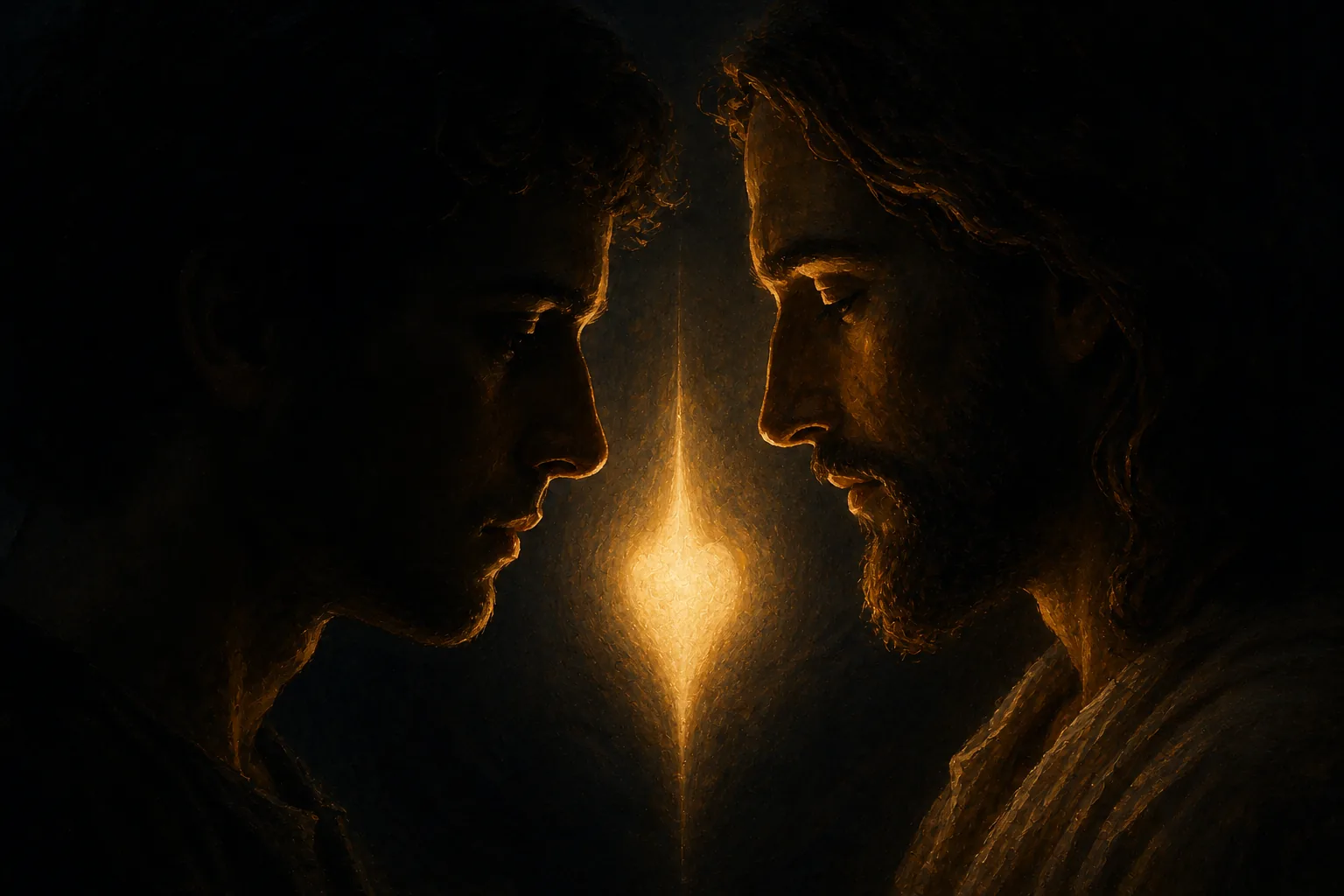
And there is distinction, which is not the wall at all. Distinction is simply the fact that a lover and a beloved are two — that there is a face here and a face there, and a space between them across which something can be given. Distinction is not a barrier; it is the condition of an approach. You cannot cross a distance that isn't there. You cannot give a gift to yourself and have it be a gift. You cannot say You to a mirror. Where separation walls the two off from each other, distinction is the only reason there are two to be near in the first place.
We have collapsed these into one word — separateness — and then, understandably, tried to abolish the whole of it, and in doing so we keep reaching to tear out the very thing love is built on along with the thing love dies of. The fall was never that we became distinct. The fall was that distinction curdled into separation: the You hardened into a them, the beloved standing across from us became a rival across a line, the gift we were held in became a thing we had to grab. Eden is the story of that curdling — eyes opening onto a split world, and then shame, and hiding, and blame, three walls thrown up in three verses.3 But read what stood before the wall went up. Two who were naked and not ashamed; a creature and its Maker walking together in the cool of the day. That is not the absence of distinction. It is distinction without separation — two, and near, and no wall yet. The wall is the wound. The twoness was the design, and the design was good.
So the work is not to abolish the two. It is to bring the wall down while the two remain. And that turns out to be a far stranger and more demanding thing than dissolving into the light — because the wall and the twoness feel, from the inside, like the same fact, and almost every attempt to lose the one has lost the other with it.
IV. Union is not merger
The oldest and best image for the thing I am refusing is the drop and the sea, taken one careful step back from where the mystics usually leave it.
The drop of water, the teaching goes, imagines itself a separate thing, a little private life with its own edge — and the whole of wisdom is to see through that, to let the edge go and fall home into the ocean it was always made of. And there is a truth in it I would not touch: the drop's pretense, its conviction that it is its own water, cut off and self-owning — that has to go, and its going is the end of the loneliness. But notice the two ways the sentence can end. The drop can vanish into the sea — become the sea so completely that there is no drop anymore, nothing left that could turn and regard the water it has joined. Or the drop can come so close to the sea, be so wholly of it, hold nothing back from it, that it is all sea — and still, somehow, a drop, a place where the ocean has a face and can be loved by what it holds. The first is merger. The second is union. And they are not the same, and everything is in the difference.
Merger makes one and loses the beloved. Union makes the two one and keeps them two. This is not my invention; it is the hardest-won doctrine of one of the most sophisticated traditions of the love of God the species has produced — the bhakti insistence, almost untranslatable, on an oneness-and-difference held together past the reach of reason: that the soul is at once one with God and forever distinct from God, because without the distinction there is no love.4 A drop that becomes the ocean cannot love the ocean; it is gone. The whole art, that tradition says, is to come close enough to burn and stay a self who can adore. I spent years on the floor of a yoga studio learning that motion — the years I've written about in Krishna Is Not Christ — before I had any idea Who it was for, and the thing it was teaching my heart was not how to disappear. It was how to draw near without ceasing to be the one drawing near.
Our own scripture says the same thing in its plainest human image and we mostly read past it. Man and wife, it says, shall be one flesh.5 One flesh — and still two people. Not one person; the sentence would be a horror if it meant one person. The two do not merge into a single self that has swallowed the other; they are joined into a union that needs both of them to go on existing to be a union at all. That is the shape of the thing. Union is not the erasure of the distance. It is the distance filled with love instead of wall.
V. Love was never lonely in God
Now the objection every careful reader is already holding, and it is the right one. If God needs a beloved in order to be love — if love requires two — then was God, alone, before creation, not yet love? Did They need us to become what They are? That would make God incomplete, a solitary power waiting on a creation to finish it, and the tradition will not have that, and neither will I.
The answer the tradition actually gives is stranger and better than the objection expects: God was never solitary. God is love is spoken of God as God is in Themselves, before there is any world to love — which can only be true if love had, eternally, somewhere to go inside the divine life. And it did. The tradition confesses a God who is not a lonely one but a communion: the Father and the Son, of whom the Son says both I and My Father are one and — in the garden — not My will, but Thine.6 Look hard at those two sentences held together, because they are the whole of it. One — no wall, no second God, no rivalry, the undivided life the mystics were right about. And yet a distinction real enough that there is a My will and a Thy will, a giver and a receiver, a someone who can turn and hand Himself over to a someone. That is not a contradiction to be managed. It is the eternal fact that lets the oldest sentence be true. Love was never lonely in God, because God was never merely one. God is a distinction held inside a unity — which is the exact shape love has, and the reason God is love is a sentence about what God is and not only about what God does.
I will not pretend to have measured this; no one has, and the essays that claim to have counted the persons of God to the decimal have always seemed to me to be staring at the finger and missing the moon. It is enough for the argument to see the shape. The One we come from is not a bare, featureless unity with no room in it for love until a creature arrives to be loved. It is, in its own depth, a nearness — a We — and it was love before the first star. Even the way these essays have learned to name Them says so: They, for the Father who will not shrink into a single picture, and He, for the Son who took one face; the pronoun itself refusing to let the divine settle into a lonely it. God is not a lonely one. God is a love. And a love, by its nature, does the one thing a solitude can never do. Love overflows.
VI. Why, then, us
So here, at last, is the answer to the question I started under — why we are here at all, feeling ourselves at this ache of distance from a God we are made of and cannot see.
Not because God was lonely and needed us to fill a lack; we just refused that. Because love overflows. A love complete in itself does not sit still and admire its own completeness — it gives itself away, and in giving itself away it makes more of the ones it can be given to. Creation is not God repairing a solitude. It is God widening the communion — making new faces to be loved, and, the astonishing part, new faces that can love back. And there is only one way to make a beloved who can love you back rather than a mirror that can only show you your own face. You have to make something that can stand off from you far enough to turn around, on its own, and freely say You. A distinct self. An other, in the only sense of other that love has any use for — not other than God in substance, for there is nothing that is, but a real place where the one life has been given a face of its own and a vantage of its own and the standing-room to turn and adore the source it came from.
Which means the distance you feel from God is not your exile from love. It is the room love needed to happen in. We are separate — I would now say distinct — because a beloved has to be a someone, and a someone has to be enough of its own thing to say You and mean it. Scripture puts this at the very start, in the first thing in the whole creation that God calls not good: not the dark, not the deep, but the aloneness of the one creature. It is not good that the man should be alone.7 And the remedy God reaches for is not to merge the man back into Himself, not to dissolve the ache into a featureless peace. The remedy is to make another — to take one and, at the cost of a wound in his side, make two, so that there can be love where there was only a self.8 The first thing heaven does about loneliness is not to abolish the distance. It is to put someone on the other side of it.
This is why a room of mechanical adorers — the sunflowers turning to the light with no choice in the turning, the dolls with their arms out — is not loveless merely because it is unfree. It is loveless first because there is no one there. Freedom is love's second requirement: a beloved who could not have said no cannot be said to have said yes — which is the argument of a companion essay, The Freedom to Walk Away, that God did not make us prisoners and call the captivity love. But distinction is the first, and the deeper: before there can be a yes or a no, there has to be a someone standing far enough off to say either. God did not want to be adored by Their own reflection. A reflection cannot love you; it can only agree. So the mirror was given a face of its own, and a little distance to stand in, and — this is the whole risk and the whole point — the freedom to use the distance for love or against it.
VII. The distance we made a wall of
I am not going to spiritualize what we did with the distance, because the horror of it is exactly what the wall is made of, and a pretty account here would be its own kind of lie.
The same standing-room that lets a creature turn and love its Maker is the standing-room in which a creature can turn away and love only itself. The gift and the wound are cut from one cloth. Handed a distinctness whose entire purpose was love — a face of our own so that there could be a You between us and God — we took it and did the thing distinctness makes possible and love never intends: we mistook the standing-room for a fortress and moved in. We took the little distance that was there so we could reach across it and we sealed it, and called the seal a self. The You we were given for God we spent, most of it, on me. And out of that one substitution comes the whole catalogue — every wall between a person and their neighbor, every line drawn to put someone on the far side of our concern, every cruelty, which is only ever a distinct will treating another distinct will as a thing outside its circle. The tradition has a heavy word for the whole condition, and the word does not name a list of forbidden acts. It names this: a self curved so far in on its own separateness that it has forgotten the distance was ever for anything but defense.
This is not to be solved too fast: the two errors stand on either side of the narrow truth and both are always waiting. On the one side is the wall — separation dressed as selfhood, the ego sure it is its own god, and this is the error I have spent essays against, and it is real, and it is most of hell. But on the other side is the correction that overcorrects: the flight into a oneness so total that the two disappear, the drop diving for the sea to be rid of the loneliness by being rid of the self — and this buys peace at the price of the beloved, and quietly abolishes the very love it set out to perfect. The truth runs between them, and it is harder than either. Bring the wall down; keep the two. Be so wholly God's that nothing is held back, and remain a someone who can be held. Close enough to burn; still a self who can adore. Neither the fortress nor the featureless sea — a face, at last, turned fully toward the Face it was made to love, with the wall gone and the two remaining.
That is not a state I can hand you a technique for, and I distrust anyone who says otherwise, myself included on my worse days. I can only say what shape the mending has.
VIII. Face to face
Notice that the tradition's own picture of the end is not the drop vanishing into the sea. It is stranger, and it keeps the two.
When Paul reaches for the best thing he can say about where all of this is going, he does not say we shall be dissolved. He says: now we see through a glass, darkly; but then face to face.9 Face to face. A face requires two — a seer and a seen, one who beholds and one beheld — and the whole promise is not that the two collapse into one but that the glass between them clears. Now, in part, through a smeared and darkened window; then, fully, with nothing in between and no one abolished — then shall I know even as also I am known. Known. There is still an I there to do the knowing, and a You there to be known and to do the knowing back. The end of the story is not the erasure of the distance. It is the distance with the wall taken out of it — nearness without a barrier, and without a vanishing.
The last book of the tradition makes the same refusal in the loudest image it has. When it wants to show the consummation of everything — the healing of the whole long wound between God and what God made — it does not reach for an ocean absorbing a drop. It reaches for a wedding: a marriage, a bride and the One she is given to, two made one and staying two, because a marriage of a thing to itself is not a marriage at all.10 That same confession — God is love — has held out, all the way to the end of the book, for the only thing it was ever able to run on, which is two who have become one and remained, gloriously, two.
So I will hand the question back the way I found it, changed only by having been looked at. We asked why we feel ourselves separate from God, and the honest first answer is that much of what we feel is the wall, and the wall is ours, and it is the whole of our loneliness and it has to come down. But underneath the wall, holding it up, there is something that is not the wall and must not come down with it: the plain fact that we are each a someone, with a face of our own, standing at a little distance from the God who gave us the face — a distance that was never a punishment and never finally an illusion, but the room a love needed so that there could be a We where otherwise there would only ever have been the loneliest thing imaginable, which is a love with no one to love, adoring itself in a mirror in an empty room. We were made separate enough to say You. The mending of the world is not the unsaying of that word. It is the day we get to say it, at last, with nothing in the way.
Footnotes
-
"God is love" — 1 John 4:8, 16 (KJV). ↩
-
"Thou shalt love the Lord thy God with all thy heart, and with all thy soul, and with all thy mind, and with all thy strength" — Mark 12:30 (KJV; Jesus quoting the Shema, Deuteronomy 6:5). ↩
-
The eyes opened, the nakedness known with shame, the hiding, and the blame passed from the man to the woman to the serpent: Genesis 3:7–13 (KJV). The reading of these as the walls thrown up at the fall — self against body, self against God, self against neighbor — is carried in full by The Knowledge of Good and Evil; pointed to here, not re-argued. ↩
-
Achintya-bheda-abheda — "inconceivable oneness-and-difference" — the signature doctrine of the Gaudiya Vaishnava (bhakti) tradition: the soul is at once one with God and forever distinct from God, because without the distinction there is no love. The doctrine, and the image of the drop that cannot love the ocean it has become, are borrowed here with thanks and not re-run (the essay linked above is where I make the fuller case). ↩
-
"Therefore shall a man leave his father and his mother, and shall cleave unto his wife: and they shall be one flesh" — Genesis 2:24 (KJV). The union that makes two one and requires both to remain. ↩
-
"I and my Father are one" — John 10:30; and, in the garden, "not my will, but thine, be done" — Luke 22:42 (KJV, quoted exactly). The body takes the house capital on deity pronouns and this note does not, so the verse stays checkable against the King James. The two sentences held together — perfect unity, and a real distinction of wills within it — are read here as the eternal shape of love within the divine life, not as a metaphysical claim I can demonstrate. The Gethsemane surrender is taken up in The Novelist DM and The Freedom to Walk Away; here it serves only for the distinction-within-union it shows. ↩
-
"And the LORD God said, It is not good that the man should be alone; I will make him an help meet for him" — Genesis 2:18 (KJV). The first thing in creation called not good is a creature's aloneness; the remedy is the making of another, not a merging back. ↩
-
Genesis 2:21–22 (KJV) — the woman made from the man's side, one becoming two so that there can be love where there was a single self. Read here for its shape, not pressed as biology; the "wound in his side" is the text's own image (the taken rib), and no more is claimed of it. ↩
-
"For now we see through a glass, darkly; but then face to face: now I know in part; but then shall I know even as also I am known" — 1 Corinthians 13:12 (KJV), from the chapter on love. ↩
-
The consummation of the story as a marriage — "the marriage of the Lamb is come, and His wife hath made herself ready" (Revelation 19:7); "the bride, the Lamb's wife" (Revelation 21:9) — the union of two who remain two, not the absorption of one into the other. KJV; verbatim pronouns kept and capitalized per the house note. ↩