The Freedom to Walk Away
God didn't make us prisoners and call it love.
I. The question, put at its sharpest
Here is the question in its strongest form, not the soft version a believer can answer in their sleep.
God is said to be all-loving, all-knowing, and all-powerful. Sin exists. Pick any two of the three attributes and the third seems to break. If God is all-knowing, They saw sin coming. If God is all-powerful, They could have made a world without it. If God is all-loving, They would have wanted to. So either God wanted sin, and is not all-loving; or couldn't prevent it, and is not all-powerful; or never saw it arrive, and is not all-knowing. The atheist I used to be thought this was checkmate, and I no longer think he was being lazy. It is a real question. It deserves a real answer and not a dodge, and most of what gets offered in reply is a dodge — a hand waved at mystery, a quick pivot to how sin is really our fault, an appeal to some greater good kept offstage where it can't be examined.
The answer begins by refusing the question's first hidden assumption: that sin is a thing God made.
II. God did not create sin the way They created trees
Run back through the list of what God is said to have created. Light. Water. Dry land. The green things that grow, the fish in the sea and the birds in the air. A man, and then a woman. Every item on that list has the same grammar: it is a thing, an object, some piece of what there is, spoken into being and standing there afterward with an existence of its own.
Sin is not on that list, and it is not the kind of item that could be. Sin is not a substance. There is no shelf in creation where the sin was kept, no material God stirred into the mix. Sin is not a thing at all; it is a use — a direction a will can take, a bending of something good toward something it was not for. Cruelty is not a created object; it is love's machinery turned to the opposite purpose. A lie is not a thing; it is the faculty of speech, which is good, aimed at concealment. Evil, the tradition has said for a very long time and in more careful language than I'm using, has no substance of its own. It is a privation, a swerve, a good thing spent wrongly.1
So when we ask why God created sin, we have already smuggled in a false picture — sin as one more item on the manufacturing list, sitting between the oceans and the animals. God did not create sin. What God created was something far stranger and far more dangerous than any object: God created beings with wills of their own.
A will is not a thing either. It is a capacity to originate — to be, in some real and frightening sense, a genuine source of what happens next, and not merely a channel through which prior causes run. That is what it is to give a creature a will and mean it. And here is the part there is no way around: to make a will that can genuinely say yes is to make a will that can genuinely say no. You cannot make the first without making the second, because they are not two powers but one. The capacity to choose is the capacity to choose wrongly. God did not author the wrong choice. God authored the capacity — and the capacity, by its nature, held the wrong choice inside it as a possibility from the first day.
The claim is not that God made sin. The claim is that God made freedom, and that sin is what freedom looks like when it is used against the One who gave it. The possibility was created. The act was ours.
III. The tree was a real no
The garden makes this concrete, which is what the garden is for.
God plants a tree and gives a single command about it: of every other tree, eat freely; of this one, do not eat.2 Read as a trap, it is a strange and petty thing — a forbidden object dangled in front of creatures who were bound to want it, a setup with a punchline already written. But it is not a trap. It is the opposite of a trap. It is the one place in a garden full of yes where a no is available. It is freedom given an address.
Think about what a command actually is. A command you are incapable of breaking is not a command; it is a description. If I "command" a stone to fall when I let go of it, I have not issued an order, I have stated a law of nature. An order is only an order where disobedience is possible. So the moment God gives Adam a real command — a thou shalt not that his hand is fully able to reach past — God has done something with enormous consequences: They have made the man free. The tree is not the thing that ruins the garden. The tree is the proof that the garden was ever a place where love, and not mere mechanism, could happen.
What the fruit is said to do — what the knowledge of good and evil is, and why coming to possess it reads in scripture less like an upgrade than like an exile — is another argument, made elsewhere.3 Here the tree matters for one reason only: it is a choice that can go the other way. Take that away and you have not made the garden safer. You have made it a diorama.
IV. "But They knew"
Now the real objection arrives, and it is not the cartoon version. It is sharp, and if you have felt the force of the question at all you have felt this.
Fine — a will that can say no. But God is all-knowing. God knew, before the man's hand moved, exactly where it would go. God knew Adam would eat. So the freedom was a formality. Why hand a creature a choice whose outcome you have already read? Why give the hands at all, if you have already watched them reach? A test whose result is known in advance is not a test; it is a performance with a foregone ending, and a cruel one, since the failure was scheduled and the punishment real. That is the objection, and it is a good one. Its factual premise is conceded whole. Yes. God knew.
But look hard at the move the objection makes in its middle, because that is where it goes wrong. It slides from God knew what the man would do to God made the man do it, and those are not the same, and the distance between them is the entire matter. Knowing is not causing. I can know my friend well enough to tell you, with something close to certainty, what he'll order at the restaurant before he opens the menu. My knowing does not reach into him and place the order. He still chooses it; I have simply seen truly. Foreknowledge of a free act is knowledge of a free act — the freedom is inside the thing known, not erased by the knowing of it. An infinite mind seeing the whole of what a creature will freely do takes nothing from the creature; it only means the seeing is complete.4
And there is a second, deeper thing the objection misses, which is this. The objection assumes that foreknowing the bad outcome obligates God to prevent it — that if you can see the no coming and you love, you close off the road to it. But closing off the road to the no is closing off the road to the yes. They are the same road. To reach in and guarantee the outcome — to make sure the hand could not reach the tree — is to unmake the freedom, and with it everything the freedom was for. God did not prevent it, not because God is indifferent to the cost, and not because God failed to see it, but because preventing it, at the only price at which it could be prevented, would have cost the very thing the whole arrangement exists to make possible.
V. The lock, from the inside
I know this part from the inside.
There was a relationship I left. I am not going to narrate my way through another person's heart, and I am not going to make anyone the villain of an argument about God — the person is real, this is only ever my side of it, and the last thing I want is to win a point about love by spending someone I once loved. Only the part that was mine to feel, then — and it is the whole reason this is not just tidy to me but true. What I could not, in the end, talk myself out of was this: a love you are not free to leave slowly stops being able to feel like love. Not because there is too little of it. Because there is no door in it — and a devotion with no door in it does something to itself over time. The holding becomes the whole substance, and the thing being held quietly goes out of the room. I stayed a long while before I understood that staying, past a certain point, was not the loving thing it looked like from outside. Then I left, and it was among the hardest things I have done, and I do not get to tell it as a man who came out of it clean. Leaving is not innocent. I only know that I could no longer call it love while I could not leave it — and that the leaving, which looked from every angle like the failure of love, was the first thing in a long time that had any freedom in it.
I tell you that not to litigate my own history in the footnotes of a theology, but because it taught me, from the wrong side of the door, exactly what God will not do.
For love to be given freely there has to be a giver — someone standing there genuinely able to say yes. And a someone genuinely able to say yes is, in the same breath and by the same power, someone able to say no. You cannot have the one without the other. The yes and the no are cut from a single cloth. A yes with no no available to it is not a yes at all; it is the click of a mechanism, the fall of the stone when the hand opens. It carries no love because there was no self behind it free to withhold.
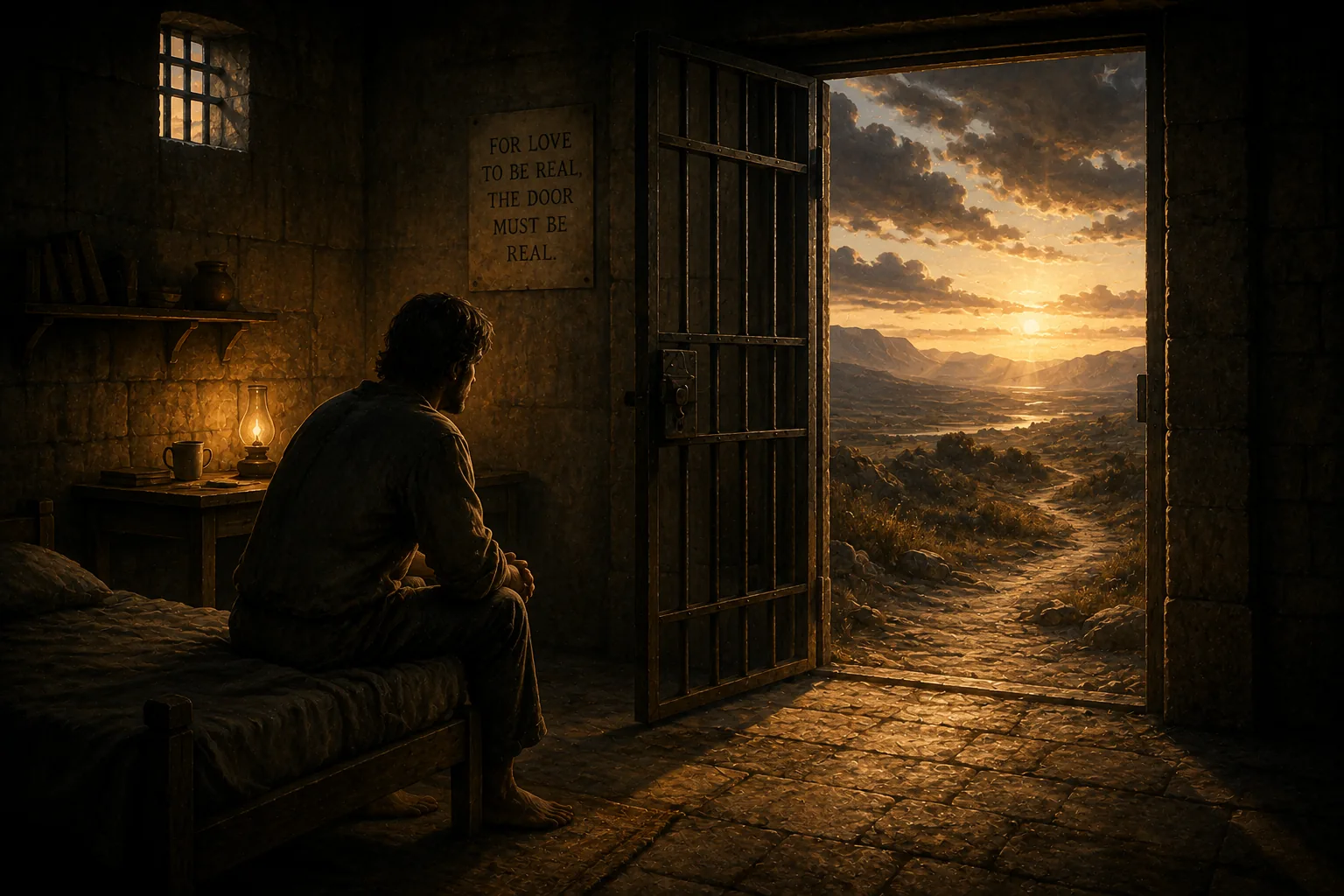
God could have made that. This is the part I find almost unbearable to sit with. God could have made a house full of creatures who mechanically adore Them — who turn toward Their maker the way a sunflower tracks the light, with no more choice in it and no more meaning. A room of dolls with their arms out. Perfect, unbroken, unanimous obedience, and not one grain of it worth anything, because obedience that cannot be withheld is not the same as being chosen. God did not want that. God did not want a house of prisoners calling their captivity love. So God did the one thing that makes love possible and makes everything that follows from it possible too. God built the door, and left it unlocked.
Freedom, in other words, is not a flaw in the design of love that God tolerated for the sake of some other good. Freedom is the design. It is not the risk love runs; it is the condition under which there is any such thing as love to run a risk at all.
VI. The horror, named plainly
I am not going to spiritualize what that unlocked door has meant. Here, of all places, that would be a lie.
The same freedom that makes it possible for me to love God freely makes it possible for me to do the other thing, and the other thing has a history, and the history is not abstract. The freedom that lets a person choose their maker is the identical freedom by which people have chosen the camp, the auction block, the child's body, the mass grave. It is one capacity. There is no version of it that comes with a governor installed, that permits the yes and forbids the atrocity, because the moment you install the governor you are back to the sunflower and the doll. We can hurt each other, without limit and without end, for the same reason and by the same power that we can love each other at all. That is the terrible arithmetic of the thing, and I will not pretend the sum comes out small.
So I am not going to tell you God is innocent of it. That is the sentimental move and it is false. God is not innocent of the freedom's cost. God knew. That is the whole force of the objection, and it stands — God knew what the freedom would cost, saw the mass graves from before the foundation, and made us free anyway. There is a version of God who kept everyone safe by keeping everyone locked, and that God does not exist, and the reason that God does not exist is that a locked safety is not love and God would not counterfeit love even to spare us. Over Jerusalem, at the end, the note is not triumph. It is grief with the door still open: how often would I have gathered thy children together, and ye would not.5 And ye would not. That is God, all-powerful, declining to make the gathering happen by force, and grieving the refusal instead of overriding it.
Hold that. Don't resolve it too fast. The honest thing to say is not that the cost is acceptable — I don't know what scale that word would even be weighed on — but that the cost is the price of the only thing that could ever have been worth paying it, and that God paid in first and paid the most. Which is what makes this a specifically Christian answer and not just a philosopher's.
VII. He came looking
Every version of the free-will answer I have given so far, an honest atheist can follow right up to its edge and then stop, unmoved, and say: all right. Suppose all of that. Suppose freedom is the price of love and God paid it by letting us loose. That only makes God the One who opened the cage. We are still the ones bleeding in it. So God set the terms and walked away — the deist's clockmaker, admirable, distant, and no comfort to anyone actually inside the wreck the freedom made.
And this is exactly where Christianity says something that no other answer to the question says, something that changes what kind of answer it is.
The story does not end at fine. It does not end with you chose yourself, so you're on your own now. Go back to the garden, to the very first moment after the very first no. God does not arrive with a sentence prepared. The first thing out of God's mouth, in the ruined afternoon, is a question, and the question is a search: Where art thou?6 Not how dare you — where are you. And of course They know where we are; omniscience does not misplace anybody, and the question was never a request for information. It is the way a parent says now where could she be? to a child hiding under a blanket with both feet sticking out — not because they cannot see her, but because the looking is the love, and being found is the whole point of the hiding. The maker walking the garden in the cool of the day, calling for a creature They can see perfectly well, asking anyway, so that the one who is crouched there in the leaves can hear that they are wanted and not hunted. That is the note struck at the beginning, and the whole rest of the book is that note getting louder.
Because God, having authored the freedom and foreseen to the last grave what we would do with it, did not stay outside the wreck. God came into it. Not as a rescuer lowering a rope from a safe height, but the other way — all the way down, into a particular body, at a particular address, under an occupying army. Christ enters the thing itself. Temptation: He was tried at every point we are tried.7 Humiliation: He emptied Himself and took the form of a servant and was mocked and stripped.8 Death: the state killed Him slowly and in public. He goes into suffering, into the exact machinery our freedom built, and — this is the hinge — He remains faithful in it where we did not. Where the first freedom said no, His freedom, in the same kind of body, under worse pressure, says yes. Not a forced yes. A yes that had every road to no wide open in front of it, in a garden of its own, at night, with the cup right there.9
So no. I do not think God created sin because They wanted us to suffer. I think God created creatures who could genuinely choose Them, and a genuine yes means something for the one reason that it could have been a no. God did not make us prisoners and call the captivity love. God made us free — free enough to walk out the unlocked door, which is exactly what we did — and then, rather than let the walking out be the end of it, came after us. Still comes. The book ends not with a lock but with a knock: Behold, I stand at the door.10 Notice which side the handle is on. He does not break it down. He came all this way, into all of it, and He is standing outside a door that opens from the inside, waiting to be let in by the same freedom that let Him out.
Which means the question I started with has quietly turned into a different one. Not why would God create sin — God didn't. The question that's left is the one standing at your door with a hand already raised, and it was always going to come down to what you do with a thing that can, genuinely, go either way.
Footnotes
-
The reading of evil as privatio boni — not a substance but a privation, a good thing lacking or misdirected — is Augustine's, developed against the Manichaean picture of evil as a rival stuff co-eternal with good (Confessions VII; Enchiridion 11). Nothing in the argument depends on the technical apparatus; the plain point is that cruelty and the lie have no material of their own — they are goods (love's machinery, the faculty of speech) turned. ↩
-
"Of every tree of the garden thou mayest freely eat: but of the tree of the knowledge of good and evil, thou shalt not eat of it" (Genesis 2:16–17, KJV). ↩
-
What the knowledge of good and evil is — and why acquiring it reads as separation rather than ascent — is the argument of a companion essay, The Knowledge of Good and Evil; it is deliberately not re-run here. The tree in this piece is doing one job: being a real, refusable command. ↩
-
The distinction between foreknowing a free act and causing it is old (Boethius, Consolation V, holds that God sees all times at once, as present, so that divine knowing no more compels the act than your seeing a man walk compels his walking). How an infinite mind might hold the whole of a free future at once is taken up on its own terms in The Highest Peak; here I need only the narrow claim — knowing is not causing. ↩
-
"O Jerusalem, Jerusalem … how often would I have gathered thy children together, even as a hen gathereth her chickens under her wings, and ye would not!" (Matthew 23:37, KJV). The grief is the Son's, over a city that was free to refuse the gathering and did. (The hen of the simile keeps her own lowercase pronoun.) ↩
-
"And the LORD God called unto Adam, and said unto him, Where art thou?" (Genesis 3:9, KJV). The first divine speech after the fall is not an indictment but a search. ↩
-
"But was in all points tempted like as we are, yet without sin" (Hebrews 4:15, KJV). ↩
-
"made himself of no reputation, and took upon him the form of a servant … he humbled himself, and became obedient unto death, even the death of the cross" (Philippians 2:7–8, KJV, quoted exactly; the body takes the house capitals). The kenosis — the self-emptying — is developed at length in The Novelist DM; here it is named, not re-argued. ↩
-
The garden of Gethsemane deliberately rhymes with the garden of Eden: a second garden, a second freedom, a second night with a real choice in it — not my will, but thine, be done (Luke 22:42, KJV exactly) — where the first said the opposite. ↩
-
"Behold, I stand at the door, and knock: if any man hear my voice, and open the door, I will come in to him" (Revelation 3:20, KJV, quoted exactly). The body takes the house capital (My voice); the King James lowercases it, and this note keeps the King James so the verse stays checkable. The latch is on the inside; the knock does not force it. ↩