The Highest Peak
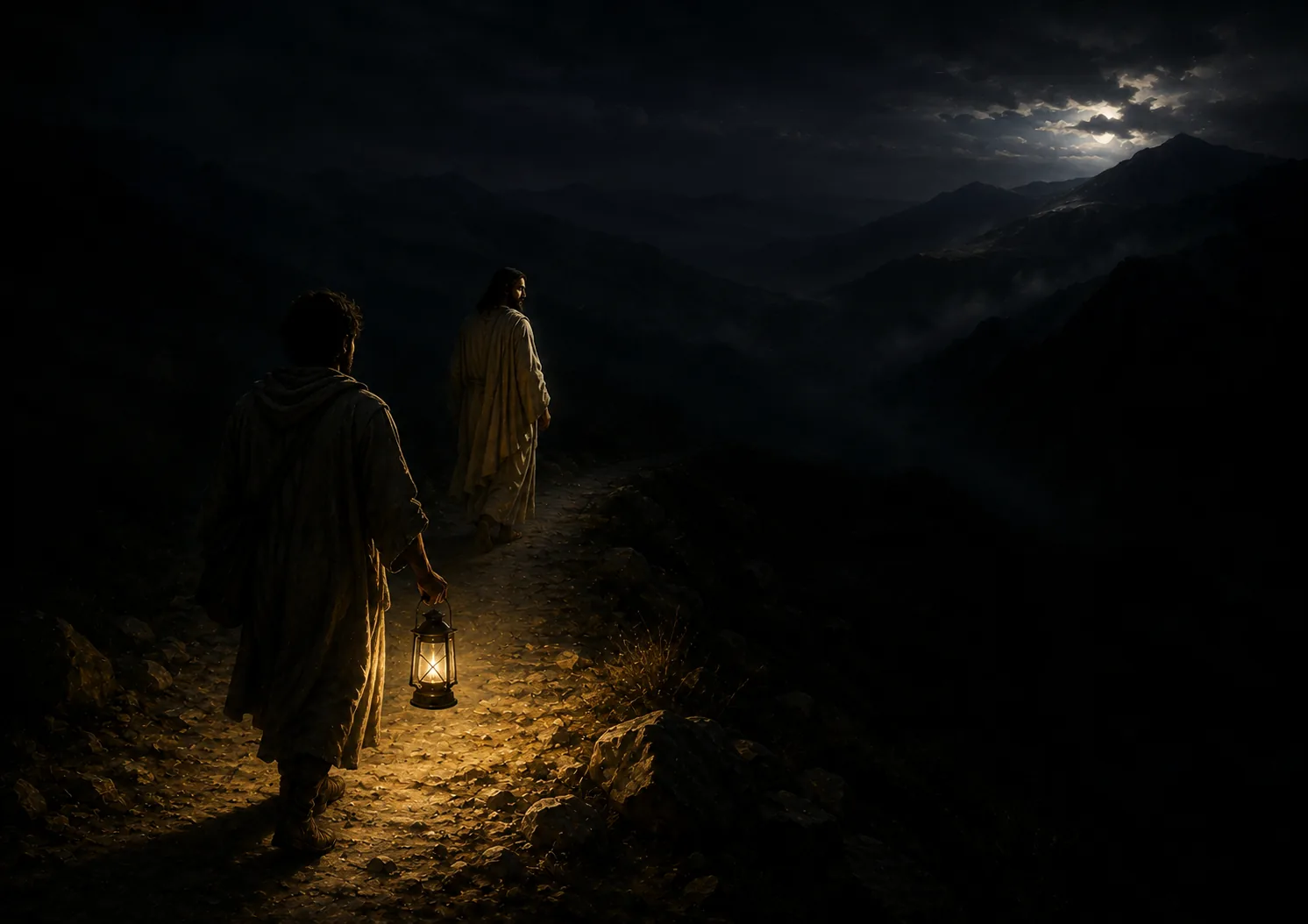
There is one road, and there is Someone on it.
I. The Range in the Dark
Start here, because everything that follows is a consequence of it.
You are standing on a mountain range at night. Not looking at one — standing on it, at one spot, in a body. There are other people out there. You can hear some of them; a few are close enough to touch. There are whole crowds on the far side you will never meet.
Everyone wants the same thing, and it is not complicated: the top of the highest mountain in the range. Not a high place — the highest peak. That is the arrangement everyone would choose if everyone could see, and nobody objects to it. I am going to keep calling it that, because the essay turns on the difference between the highest peak and the highest one I have personally been able to make out.
But it is dark. What you have, and all you have, is the slope under your own two feet — which way is up, right here, within the length of your body. Everyone else has exactly that, at their own spot.
The first thing that goes wrong is so natural it doesn't feel like an assumption: we take it that if we are all going to the same summit, we must all be walking the same way. That is false in the plainest geometric sense. Two people on opposite shoulders of the same mountain must walk in opposite directions to reach the same top. Someone heading east and someone heading west are not necessarily disagreeing. They may be doing exactly the same thing.
And then it gets worse, and this is where the picture stops being a landscape and starts being the world.
The range is not holding still. Every step anyone takes changes the heights. Not metaphorically — that is what it is to live among other people whose lives are made of each other. A summit rises because someone on the far side did something generous at four in the morning; another settles because of a decision in a room you will never enter. The peak that was to your east an hour ago may now be to your west, and it was moved by strangers.
And there is one more turn of the screw, and it is the one that should take the wind out of anybody. The peak you have been climbing toward may never have been the highest. Not because you were careless. Because it was the highest you knew of — the tallest thing within earshot of your own life — and the range is very large, and it is dark.
Now ask the question the whole essay lives inside.
How could everyone possibly arrive?
Not one clever person. Everyone. On a shifting, coupled range, in the dark, from every starting point at once, with local slope as the only instrument any of us has. There is no answer to that available from inside the problem. That is not pessimism; §V is the careful version of the same sentence.
There is exactly one arrangement I can think of in which it works out, and it is a great deal more demanding than it first sounds. Seeing the whole range would not be enough. The heights move when people move, so anyone guiding us would have to know not only where everything stands but how the entire sequence of movements will unfold — across every step that every person could take, including all the steps we are not going to take. Every route offered to me has to still work after everyone else has answered, and after everyone else has answered that, out to the end. A step that is right for me and wrong for the range has simply moved the problem somewhere I cannot see.
So: somebody who holds the whole unfolding — every branch of it — and who walks a few steps ahead of each of us, saying follow me.
And it is worth finishing the picture, because the end of it is the part nobody paints. Say it worked. Everyone arrives. What happens then is not a freeze and not a reward ceremony: they like it there, and they stay — not because leaving is forbidden but because there is nowhere better and, at last, everyone can see that. The country stops heaving. The heights hold still, the maps stop going stale, and the whole thing — for the first time since anybody started walking — settles.
Which is, as it happens, precisely what is on offer.
There is a man a few steps ahead of you on the road. Not far ahead — close enough that you could reach Him in three strides; far enough that you have to keep moving to keep Him in view. He does not hand you a map, which by now you know is a mercy rather than a withholding. He does not tell you where this ends, or how long it takes, or what it will cost. He does not ask what you believe about Him. He looks back over His shoulder, often enough that you never quite lose Him, and He says the same two words He has been saying since the beginning.
Follow me.
The man is Jesus. He is the way shower, and He shows a way the only way anybody ever shows one — by walking it in front of you. The two words are the ones He opened with, and they are worth hearing for what they are not: not believe this about Me first, not understand this before you move. Follow. A verb about your feet.
And then He keeps walking, which is the part people forget. He is not standing at a signpost gesturing down a road He has no intention of taking. He is on it. Whatever is up ahead, He gets there first.
Three things are true about that, and the argument leans on all three.
The first: there is a route, and He knows the whole of it — the range, the far side of it, the way the heights are moving while we argue about them, and every way they would move under every step any of us might take instead.
The second: you are shown almost none of it. A person three strides ahead is not a rendering of the country; He is exactly one turn of information, refreshed continuously, forever. You cannot read the plot off the back of His head. You cannot tell, from where He is standing now, whether this is going toward the thing you want.
The third: you are entirely free to go another way, and He will not stop you. There is no invisible wall. Nothing seizes up. You can turn off this road for a better-looking one and nothing whatsoever will prevent you, and — this matters, and most religious writing lies about it — the other road is frequently wonderful.
And then there is a fourth thing, which is stranger than the other three and is the reason this image and not some other one.
When you go the other way, He comes with you.
He does not stay at the junction with His arms folded, waiting for you to see sense. He does not vanish, to reappear when you have been sufficiently punished. He turns and walks into it beside you — the detour, the wrong town, the years — and He keeps saying the same two words the entire time, pointed back toward the road you left. Sometimes so quietly that you can tell yourself, honestly, that you did not hear anything. Sometimes at a volume that empties your life out on the floor.
Which is where it gets genuinely difficult to see straight, and where the argument actually starts. Because a man walking next to you while you do a thing looks a great deal like a man who thinks you should be doing it. His presence is not His endorsement. He is not there because you chose well. He is there because He does not leave.
And notice what the picture has done. He started a few steps ahead, which is where a way shower belongs — far enough in front to be followed. On the detour He is not ahead of you at all. He is beside you, on a road He did not choose and would not have picked, for no reason except that you are walking it.
There is one more thing to say about Him now, and it will have to be paid for later.
He will lead you down. There are stretches of this where the ground falls away for a long time and the only honest description of what is happening is that you are getting further from every summit you can feel. He will not explain that. Ask Him why this valley and you will not get a reason; you will get the same two words. What He will do — and this is the part I have come to believe and cannot demonstrate — is take account of what you are able to bear, and make it as smooth as a thing like that can be made.1
Which does not make it easy. I want that on the page early, in the plainest available words, because a great deal of writing in this territory quietly promises otherwise and then leaves the reader holding the difference. The way through is smoothed. It is not easy, and He never said it was; the one time He described the road He called it narrow, and hard, and said hardly anybody finds it.
So the question is not can I see Him — you usually can, if you are honest about it. The question is the one that never asks itself:
Which way am I going, and how loud does He have to get?
Hold that. What follows is an argument that this is the structure of a life, and that the One a few steps ahead is not a metaphor. I am going to make that case from inside the tradition that already believes it, using its own words, and I am going to borrow one piece of grammar from somewhere else to say a thing the tradition has always meant and has never had a clean way to put.
II. The Will of God Is a Route, Not a Rulebook
Here is the first claim, and it is smaller than it sounds: when scripture talks about the will of God, it talks about it far more often as a road than as a list.
We do not hear it that way. Ask most people — including most believers, and including the ones who were handed a fear-based version of this and are still carrying the bruise — what "the will of God" means, and you will get something legislative: a set of requirements, things He forbids, a standard you are being measured against. The phrase arrives in the ear as a rulebook, and the weather that comes with it is the weather of an examination.
Now go and read the actual lines.
A man's heart deviseth his way: but the LORD directeth his steps.2 That is not a statute; it is a hand on the shoulder mid-stride. He leadeth me in the paths of righteousness.3 Paths. And thine ears shall hear a word behind thee, saying, This is the way, walk ye in it.4 Not these are the rules, keep them — this is the way, walk ye in it. Enter ye in at the strait gate… strait is the gate, and narrow is the way, which leadeth unto life, and few there be that find it.5 A gate and a road, and the trouble with the road is not that it is strict but that it is hard to find. And at the end of the line of them, the strangest of the set, in which the road stops being a road at all: I am the way.6
The tradition's vocabulary for what God wants is overwhelmingly the vocabulary of navigation — way, path, steps, gate, walk, follow, lead. The legal language is the flourish; the road is the fact.
Because here is what a rulebook is. A rulebook is what a route looks like to somebody who cannot see the terrain.
If you know the whole country and I know none of it, you will not hand me the country. You will hand me instructions — general enough to survive my ignorance, blunt enough to work when I am tired and frightened and cannot see thirty feet. Keep the river on your left. Don't cross after dark. Those instructions are true. They are also a compression — a lossy summary of something actually particular, actually continuous, and already known in full by Someone who is not me. The commandments do not stop being commandments under this reading. They stop being the whole of what is meant, and start being the part that fits in a form a walker can hold.
And if that is right, then the tradition's most uncomfortable claim about God's knowledge stops sounding like a threat and starts sounding like a description of the man on the road: Declaring the end from the beginning, and from ancient times the things that are not yet done, saying, My counsel shall stand.7 That is a sentence spoken from outside the sequence. It is the voice of Someone who is not walking.
III. The Ones Who Did Not Know Where He Was
Second claim, and it is the one with the widest reach: if the will of God is a route rather than a rulebook, then what puts a person on it is that the One ahead of them is a Person they have met — and the direction of their feet is how that shows.
That is not a dramatic sentence, and it is not meant to be. It is what He says happens when the whole thing is finally sorted out.
Take the scene the tradition itself uses for the sorting. The nations are gathered and divided as a shepherd divides sheep from goats, and the criterion turns out to be embarrassingly concrete: food, water, clothes, a welcome, a visit to a prison. And then the detail that almost nobody preaches, and that decides how the rest of the scene reads. Both groups know exactly who is speaking to them. The ones who are welcomed are not modest about it; they are confused — but read what they actually say. LORD, when saw we Thee an hungred, and fed Thee?8 They call Him LORD. So do the others, seven verses later, in the same words.9 Not one person in that courtroom is in any doubt about whose voice it is. Which settles less than it looks and more than nothing. They are standing in front of Him, so of course they can name Him there, and the parable says nothing either way about what they knew on the Tuesdays when they were doing the feeding. What it does settle is narrower and worth having: the scene never says the sheep were strangers to Him. A reader who wants them ignorant has to bring that with them; it does not come out of the text.
What they did not know is where He had been. The surprise is not who are You; it is You were in the prison, and nobody told us. They are not being told they passed a test they studied for. They are being told that the back they had been following was in the cell the whole time.
That is not a marginal text. It is the last thing He teaches before the arrest, in the gospel most concerned with judgment, and what it puts out of reach is the ledger — the idea that this was ever the kind of sorting a person could study for. He does not ask the sheep to recite what they believed about Him. He tells them where He had been standing while they worked, and the information arrives after the verdict, as news.
And it is not an isolated verse, which is what would make it easy to wave off. The same claim is made, in different keys, all over the same gospel.
Not every one that saith unto Me, LORD, LORD, shall enter into the kingdom of heaven; but he that doeth the will of My Father which is in heaven.10 That is as flat a statement as exists on the subject, and it is aimed squarely at people who have the vocabulary right. Read what it says and no more than what it says: saying the name is not enough. It is not a claim that the name is dispensable, and it never was one.
Then the two sons: one is told to go and work, says I will not, and goes; the other says I go, sir, and doesn't. Whether of them twain did the will of his father?11 Notice the phrase — the will of his father, which is the subject of this entire essay — and notice that the son who did it is the one who said no.
And when His own people complain about an outsider doing the work, notice what the complaint concedes before it even begins. Master, we saw one casting out devils in Thy name, and he followeth not us. The man has the name. He is using it, out loud, and it is working. What he does not have is membership — and that, not the name, is the entire content of the objection. The answer is forbid him not, and he that is not against us is on our part.12 That is the objection this section raises, raised first by His friends, and answered by Him before anyone had a church to be outside of.
Now the turn, because there is a real objection and it deserves better than a footnote.
You have just made Christ optional. Have I? Look again at the scene. He is not absent from the sorting; He is the criterion. It is Him in the prison, Him hungry, Him in the stranger — the whole force of the passage is that the least of these and the Son of Man are not two subjects. He is more central in that story than in any doctrine of membership, not less. What the passage removes is not Christ, and it is not the name either. It removes the idea that the name is enough — that having said it settles the matter and everything after is administration.
Then the objection from the other side, which is the one I would raise. So you have put a toll booth back on the road. No, and the difference is not a technicality. A toll booth is a fee, collected by a clerk, from someone whose actual business is somewhere past him. What I am describing is not a fee; it is the thing itself. You cannot walk behind someone you have never met. You cannot hand your will over to a Person you could not pick out of a room. That is not a charge levied at the entrance — it is what following is, and there is no version of it that happens at a distance, to a stranger, by accident.
And §II's own verse holds, unbent. I am the way is exclusive: it says there is no route apart from Him, and it means the Person and not the principle. A person who says the name every Sunday can be walking the other way, and the gospel says so in the plainest words it owns. Which should be frightening and freeing in about equal measure, and to the same people.
Two limits, so this claim stays the size it actually is. It is not universalism — nothing here says everyone arrives, and the scene Matthew is describing has two groups in it, not one. And it is not the flattening that says all roads are the same road; the whole argument is that there is one road, and that it has a person on it. The claim is narrower and stranger than either: the road is open, the One walking it ahead of you is somebody you can actually come to know, and what was never waiting at the end of it was a clerk checking your pronunciation.
IV. A Minimizing, Maximizing Purpose
Third claim, and this is the one the machinery hangs from: if God is infinite and good, then what They will is not a preference. It is a solution.
Take the tradition at its word for a moment about what God wants. They are not willing that any should perish.13 They work all things together for good.14 They are, in the one line the New Testament allows itself as a definition, love.15 Every one of those is a statement about everything at once — every creature that will ever be capable of being harmed or blessed, across the whole run of time, held together. Not a wish about my afternoon. A disposition toward the entire arrangement.
And a will over the entire arrangement is a categorically different kind of object from a will over my afternoon. It is not bigger. It is different in kind — the way a photograph of a crowd is not a larger photograph of a face. What an infinite mind wills, if it wills the good of everything, is the best available arrangement of everything, worked out whole, with every trade-off already made. There is a name for that in the disciplines that spend their days on such things. It is a solution to an optimization problem: the configuration that does the most good and the least harm, out of all the configurations there could be.
Set beside it the most exact description of what it would be like to see from there that I know of, which was not written by a theologian and was not trying to help me.
In Ted Chiang's Story of Your Life, a linguist named Louise Banks learns the written language of an alien species and, in learning it, begins to acquire the mode of consciousness that produced it. Chiang's account of the difference between their minds and ours is the cleanest statement of the whole problem, and it is two sentences long:
Humans had developed a sequential mode of awareness, while heptapods had developed a simultaneous mode of awareness. We experienced events in an order, and perceived their relationship as cause and effect. They experienced all events at once, and perceived a purpose underlying them all. A minimizing, maximizing purpose.16
That is what the view from oneness would be. Not a bigger version of our view. A different mode: no before and after to walk through, no chain of causes to trace, the whole thing present at once — and, seen that way, not a chain at all but a purpose. A minimizing, maximizing purpose.
The physics under it is not decoration; it is the reason the story is about optimization and not clairvoyance. A ray of light passing from air into water bends. You can explain the bend the way we normally do — a different index of refraction, one damn thing after another — or you can explain it the way Fermat did, by noticing that of all the paths the light could have taken between those two points, the one it takes is the fastest.17 Not fastest by luck. Fastest as the principle: the path is fixed by the whole journey taken as a whole, which means that to say the light "chose" the quickest route is to describe it as having, in some sense that makes physicists uncomfortable at parties, already known where it was going.
And then Chiang has his physicist correct himself, which is the part worth quoting rather than paraphrasing. Least time is misleading; in some situations light takes a path longer than the alternatives. What is true is that it always follows an extreme path — one that minimizes the time or one that maximizes it — so Fermat's is not a minimal principle at all but a variational one. And then the line that ought to stop a theologian in his tracks: almost every physical law we have can be restated this way.18
Take that correction for exactly what it is worth. It does not tell us anything about suffering — an extremum in a physicist's sense is a mathematical property of a functional, not a synonym for extreme in the sense of harsh, and an essay that let those two words shake hands would be winning by a pun. What it buys is narrower and better: a whole route can be fixed by a condition on the whole, and the tidy story where a path is the sum of its little local steps is not the only story physics knows how to tell.
Now the limits, because this is exactly where an argument like mine goes wrong.
I'm not proposing that God is a utility maximizer, and I'm not going to tell you what the objective is. I do not know what the good is, in the sense that would let anyone compute with it, and neither does anyone else, and an essay that quietly slipped a number in where the tradition has always had a mystery would be doing the thing this voice exists to refuse. The claim is narrower and, I think, unembarrassing: whatever the good is, an infinite mind wills all of it, for everyone, at once — and a will of that shape is a solved whole and not a sequence of decisions. The optimization language is a borrowed grammar for an old confession. It is not a replacement for it.
Nor am I claiming that physics proves providence. It doesn't, and Chiang isn't arguing that it does. What his story establishes — and it is the smaller, more durable point — is that the teleological reading is not disqualifiable. Every physical event, he writes, is an utterance that can be parsed two entirely different ways, one causal and one teleological, both valid, neither one ruled out no matter how much context you have.19 That is all I need. Not that the purposive reading is forced. That it is available, and that it has never been closed off, and that the people who told us it was closed off were overstating their hand.
V. Why No Part of It Can Find the Way from Inside
Fourth claim, and it is the one that turns the whole thing from a comfort into a problem: granting that the solution exists changes nothing about our position. We still cannot find it from where we stand. Not because we are lazy or wicked. Because of the shape of the problem.
§I put you on the range in the dark. This is the careful statement of why that predicament is structural and not a failure of effort — and it is worth saying first that the range was not my invention. The mountain of the LORD's house shall be established in the top of the mountains, and shall be exalted above the hills.20 Not a mountain. The one above the others. Whatever else that vision is doing, it is describing a range with a highest point in it.
Three properties, and each one on its own would be enough to sink us.
First: it is not one mountain. If the range were a single smooth peak, local information would be sufficient — up-here would always point at the summit, and you would arrive from anywhere you started, every time. Mathematicians call that shape convex, and its whole virtue is that what is true under your feet is true about the world.21
We are not on one mountain. That isn't a metaphor I'm choosing; it is the plain condition of a world with more than one creature in it. Every direction that improves my afternoon can cost my decade. Every direction that improves my decade can cost somebody I will never meet. What is good for this town is what closes that one. Goods are not stacked in a tidy cone with everyone's interests pointing the same way up, and any account of the world that says otherwise has quietly deleted somebody. Non-convex is the technical word. The English is: up-here is not reliable information about up.
And now the geometry says a thing I did not put there and cannot get around. If you are standing on a foothill, every direction is down. To reach the mountain you actually want, you have to leave the one you are standing on — which means the first stretch of the only route that goes anywhere is spent losing altitude you have already paid for. No local signal will ever tell you to do that. Everything under your feet says stay.
And it is worse than a step down off a rise, because the mountains that matter do not sit side by side on level ground. The base of the highest one is reached through the valley between — and the valley is deeper than any ground you have stood on, and there is a stretch in the middle of it where you are lower than you have ever been and the summit is not even in view. That is not the route failing. That is the route. There is no path from here to there that does not go down first, and go down farthest just before it turns.
This is not a devotional flourish I have smuggled into the mathematics; it is the mathematics. It is also, in its shape, the oldest counsel the tradition has about how anyone gets anywhere.22
Second: it does not hold still, and we are the reason. The heights are a function of what everyone does, so every step anybody takes reshapes the country for everybody else. The best available arrangement is therefore not a fixed point on a fixed map — it moves, it moves because of us, and it moves fastest where the most life is happening. A local method chasing a stationary target at least has a target. Ours is being carried.
Which is why the maps go stale, and why that is nobody's fault. A map is a record of where the heights stood when a careful person was standing somewhere else, some time ago, and no degree of rigor immunizes it against the movement of people its author never heard of. That does not make the maps worthless; the ones we have were made at cost by people who were not fools. It licenses one thing only — the map is not the guide.
Third: the trap is not what you think. The vivid version of this is slightly wrong, and I have watched the wrong version do damage. The usual picture is a trap — a little summit you get stranded on, a local maximum, everyone's favorite metaphor for a rut. In a range of very high dimension, which is the only kind a real life is, that is rarely what happens. There are so many directions available that a true peak — a place where every single direction is down — is vanishingly unlikely. What you get instead, and get constantly, is a plateau: a wide flat shoulder where nothing rises, no direction helps, and there is no signal at all telling you which way to move.23
Which is a far better description of a hard year than a summit ever was. Not stranded on a peak. Stopped on a shoulder. Nothing is dramatically wrong; nothing is improving; no direction announces itself; the slope under your feet, which has been the only instrument you have ever had, has gone flat. Every tradition that takes the inner life seriously has a name for that place, and ours calls it a wilderness, and it is not an accident that the wilderness stories are about being led through country in which one's own judgment has stopped producing a reading.
I have spent a good part of my working life watching processes climb surfaces like this — something with far more patience and far better instruments than I have feeling its way up a range it could not see, and coming to rest, confidently, on a rise that was not the mountain. It does not feel like failure from the inside of the climb. It feels like arrival. That is the part worth carrying into a discussion of the will of God: the local view cannot tell the difference between the summit and a high place.
The large version of the claim is false, and I do not need it. I'm not saying the problem is unsolvable — I'm saying the opposite; §IV said the opposite. I'm not saying God has a hard time. I am saying that a local method has no access to global structure, and that when the structure is also moving, and moving because of the other local methods, the gap does not close with effort. The slope at your feet is real information and it is not the map, and no amount of feeling it more carefully will turn one into the other.
Which is also what the geometry makes of our disagreements. A great deal of what we take for opposition is the east-and-west of §I — the geometry of standing somewhere else. That is not an argument for thinking nothing matters. It is a very good reason to be slower than we are with the word lost.
And the tradition has been saying exactly this the whole time, in its own vocabulary, without the apparatus:
For my thoughts are not your thoughts, neither are your ways my ways, saith the LORD. For as the heavens are higher than the earth, so are my ways higher than your ways, and my thoughts than your thoughts.24
That is usually read as a rebuke, and it is usually deployed as one. Read it again as a structural statement, and notice that it is not reaching for a metaphor either — it says higher, twice, and it says it about ways. It is not telling you God is smarter than you and you should be quiet. It is describing the difference between a view from inside the range and a view of the range.
And then, three thousand years before anyone had a word for it, the thing itself:
There is a way which seemeth right unto a man, but the end thereof are the ways of death.25
Seemeth right. Not is wrong. A way that presents, locally, to a sincere and careful climber, as the correct direction — up, plainly up, every step of it — and tops out somewhere else entirely. There is no better one-line description of a local optimum in any literature I know of, and it was written by somebody who had never seen a mountain rendered as a function.
VI. A Lamp for the Feet
Fifth claim, and it follows from the fourth the way a consequence follows: since we cannot see the range, guidance can only take one form. The next step. No explanation.
This is not how anyone wants it. What we want is the map — the whole route, the reasons, an itinerary we can check ourselves against and, more to the point, evaluate. What we get, if the reports of the people who claim to have gotten anything are worth reading at all, is consistently something much smaller and much stranger: a pull toward one specific next thing, whose purpose is not disclosed and frequently never will be.
Donnie Darko renders this better than any devotional book I have read, and it renders it without a word of religion in it. Donnie sees paths come out of people's chests — thick liquid ropes traveling away from them through the air, unmistakably for the person they belong to: a direction, an intention, and no explanation whatever. One of them is his own. He follows it, into his parents' bedroom.
And here is the part I would not have invented, and the reason the scene is worth having. Asked afterwards what he found there, he says: nothing.26
That is what being led actually looks like from the inside, and it is nothing like being handed a plan. A pull toward one specific next thing; a room; no reason offered; no visible payoff. If the following turns out to have mattered — and in his case it does, at the far end of the film, in a way that has stopped being a reason by the time it arrives — the mattering is not available to him at the moment he is asked to move. The sequence is the whole point: obedience first, comprehension later, if ever. Very often the honest answer to what did you find is the one he gives.
Which is precisely the tradition's own account of what its light does.
Thy word is a lamp unto my feet, and a light unto my path.27
We quote that line as a comfort and hear it as a floodlight — the sense that with scripture in hand the country ahead is illuminated. Look at what it actually promises. A lamp. Unto the feet. The instrument named is the one a person carries at night on a road, and its whole function is to show you the next few feet of ground so that you do not turn an ankle. It does not show you the country. It was never advertised as showing you the country. It is a step-sized instrument, and the psalmist, who had walked at night, knew exactly what he was promising.
And the voice in Isaiah, when it comes, does not come as an itinerary either. Go back and notice where in the sentence it arrives: thine ears shall hear a word behind thee, saying, This is the way, walk ye in it — when ye turn to the right hand, and when ye turn to the left.28 The word comes behind you, and it comes at the moment of deviation. That is not an instruction manual. That is a correction signal — and it is exactly how the voice of someone walking with you behaves. He is not narrating the itinerary while you are on the road. He speaks when you turn.
Which is the place to say what §I only gestured at. The word that comes at the turn does not come at one volume. Sometimes it is so quiet that it is indistinguishable, in the moment, from your own second thoughts — and can be dismissed as such, and usually is. Sometimes it is not quiet at all. Lewis wrote that God "whispers to us in our pleasures, speaks in our conscience, but shouts in our pain: it is His megaphone to rouse a deaf world" — a line that has comforted a great many people and cost a great many others.29 The volume is not the message. A thing said at a scream is the same two words that were said at a whisper, and it is never a verdict on the one hearing it. §VIII refuses that reading at length, because it is the way this entire picture turns cruel.
This is the point at which this kind of writing usually goes bad.
I'm not going to tell you how to discern the will of God. Not because it would be immodest, but because the attempt is self-defeating in a way the argument has already diagnosed. A technique for reading Him is a claim to have gotten above the range. It is the local view promoting itself to the global one. Every method I have ever been offered for working out God's will has had, at its bottom, the assumption that with the right procedure I could evaluate the route — which is precisely the capacity §V says a part does not have with respect to the whole. I can say what guidance is shaped like. I can't hand anyone an instrument for auditing it, and I have come to think that the people selling one are selling the disease as the cure.
VII. The Sidequest
Sixth claim, and it is two that have to arrive together or the first is a lie: the freedom to leave the road is completely real — and the one who leaves is never the only one who pays for it.
Take the freedom first, and take it seriously, because a great deal of bad religious writing gets its energy from pretending the freedom is fake. It is not fake. Nothing stops you. There is no invisible wall, no scolding, no interruption of service. The detour is not forbidden and it is not even discouraged; some of the best years of a life are spent on one. I will borrow the word the games have given us and call it a sidequest, because it is exact: a real story, often a beautiful one, that is simply not the one you were being led into. Any account of the will of God that cannot say plainly that the sidequest is available and often wonderful is describing a cage and calling it a road.
And here is what the tradition says He does about it, which is the thing I could not get from any object made of light. He goes after you. The shepherd does not stand on the hill counting the ninety and nine; he leaves them and goes out into the country after the one, and the story does not end with a reprimand — it ends with the animal on his shoulders and a party.30 That is the fourth fact from §I, told by someone who was not making a point about optimization.
Now the second half, and here the tradition does something I did not expect when I went looking. It does not make the argument I would have made. The wanderer suffers, certainly — the book I am about to use will put its man in the sea and then in the dark for three days, and it will not spare him a thing. But that is not what it reaches for first. It reaches for something much more uncomfortable, and it puts it in the opening scene of the book everybody thinks is about a fish.
Jonah is told to go to Nineveh. He goes to Joppa instead, and pays the fare, and gets on a boat pointed the opposite way.31 And then:
But the LORD sent out a great wind into the sea, and there was a mighty tempest in the sea, so that the ship was like to be broken. Then the mariners were afraid, and cried every man unto his god, and cast forth the wares that were in the ship into the sea, to lighten it of them.32
Read who is in that scene. The storm does not fall on Jonah in a private room. It falls on a crew of working sailors who have never heard of Nineveh, who are throwing their own cargo — their wages, their livelihood, the thing they came out here for — over the side, in the dark, in terror, because of a detour that was not theirs and that they were not consulted about. Jonah, meanwhile, is asleep below deck. That is the whole claim of this section, staged better than I could stage it: the wake of a deviation lands on people who did not take it. He will pay too, and shortly, and the text is unsparing about it. He is simply not the first to be handed the invoice, and he is nowhere near the only name on it.
And the plateau, when a people gets on one, is measured in bodies. There is a parenthesis early in Deuteronomy that I think is one of the quietest devastating sentences in scripture, because it is doing nothing but stating a distance: There are eleven days' journey from Horeb by the way of mount Seir unto Kadesh-barnea.33 Eleven days. It took forty years. The text does not editorialize; it just lays the two numbers next to each other and lets you do the arithmetic, and the arithmetic includes a generation that died in the flat country between them.
So: is wandering the sin? No — and getting this wrong is how the doctrine turns cruel.
Not knowing is not the sin. We have established that not knowing is the condition: a part cannot see the whole, and no amount of virtue converts a local view into a global one. And wandering as such is not the sin either, or the desert fathers wasted their lives and half of Genesis is a rap sheet.
The sin is smaller and more specific and much more familiar. It is the will appointing itself the navigator. It is the moment — and it is a moment, and it happens in all of us several times a day — when the part decides it can see the range, chooses its own road, and then takes the company of the one who followed it there as confirmation that the choosing was right. Not I don't know the way, which is simply true, but I do — climbing whatever looks like up from here, with a confidence that has nothing underneath it but the slope at one's own feet, and reading a faithfulness that would have followed us anywhere as a verdict in our favor.
And when that produces suffering, which it does, nothing is being imposed. This matters enormously in a publication written partly for people who were handed a fear-based faith and are still flinching. Be not deceived; God is not mocked: for whatsoever a man soweth, that shall he also reap.34 That is not a threat of retaliation. It is a description of terrain. You end up standing where your steps took you; that is not a verdict, it is arithmetic. The wages of self-navigation are not a sentence handed down by an offended authority. They are the country you end up standing in.
VIII. But My Child Died, and I Never Left the Path
Now the objections, and there are three, and the first one is not really an objection. It is the thing this entire essay could be turned into by anyone who wanted a weapon, and I would rather hand over the weapon myself and break it in front of you.
It goes like this. If leaving the path causes suffering, then my suffering proves I left the path. And its second, worse form, the one that gets said out loud in hospital corridors by people who mean well: if their suffering is that bad, what did they do?
That does not follow. Deviation causes suffering does not entail suffering implies deviation. One is a claim about a road; the other is a verdict on a person; and the second is not contained in the first by any rule of inference anyone has ever had. Suffering has many sources. Straying is one of them. Somebody else's straying is another — that was §VII's whole point, and the sailors were innocent. And a great deal of it has no traceable source at all, which is a fact about the world and not a gap in someone's righteousness.
The tradition I am arguing from does not merely leave room for this correction. It stages the correction twice, at maximum volume, at two of its most conspicuous moments.
The book of Job is a long argument between a suffering man and three friends who hold exactly the inference I just refused. That is all they hold. Their entire case, elaborated over dozens of chapters with real eloquence and real concern, is that the world is legible: that Job's catastrophe can be read backwards into Job's conduct, because that is how a just world would work. They are not villains. They came and sat with him for seven days first. They are the most sympathetic wrong people in scripture, and the verdict at the end is delivered on them, not on him: ye have not spoken of me the thing that is right.35
And when the disciples walk past a man born blind, they ask the question in its purest form — Master, who did sin, this man, or his parents, that he was born blind? — and the answer they get is one word before it is anything else. Neither.36
And this is where I owe §VI its debt, because the image I have been using can be turned into the same weapon with one twist of the wrist. If He sometimes has to raise His voice, and if a life can be emptied onto the floor, then it is a very short step to your catastrophe was addressed to you — and from there to reading a stranger's ruin as correspondence you are entitled to interpret. The volume is not the message. A thing said at a scream is the same two words that were said at a whisper; it is never a different instruction, and it is never a verdict on the one hearing it. And the fact that a person is in a hard place is not evidence that they were shouted at, any more than it is evidence that they strayed.
Nothing here permits you to look at a suffering person and read their route off their pain. Not their route, not their obedience, not their standing, and not what God is supposedly saying to them. The inference is unavailable to us, and the two places our own scripture puts it in someone's mouth are the two places it is condemned. If you take one thing from this piece, I would rather it were this than the physics.
The second objection is the prosperity one, and it is the mirror of the first: if I am on the optimal path, shouldn't things go well for me?
Here is where §V comes due, and it needs no mathematics at all. The valley is on the route. Not beside it, not instead of it. Every step of that low stretch is a step in the right direction, and none of it feels like one.
That is the whole answer to the prosperity question, and anyone who has walked in mountains already has it in their body. A route that is best for the whole arrangement, across all of time can run directly through the worst night of a particular life without anything having gone wrong. Nothing in "best for everyone, forever" contains a promise that it will be pleasant for me, this year, in the ways I can currently perceive. The objective was never my comfort; it was never even, particularly, my outcome.
And the psalm the road came from does not stop at the road. He leadeth me in the paths of righteousness — and then, in the very next breath, yea, though I walk through the valley of the shadow of death, I will fear no evil: for thou art with me.37 Notice what is not offered. Not a way around the valley. Not an explanation of it. Not even a promise that it will be short. What is offered is company, and the verb is walk through — which is what you do to a valley that is on your way somewhere.
And the Christian version of that sentence is the hardest one available, so I will just say it. No one has ever been more precisely on the path than the man in Gethsemane. No one has suffered more for being on it. Father, if Thou be willing, remove this cup from Me: nevertheless not My will, but Thine, be done.38 Notice the order of events, because it is the whole thing: He asks for the cup to be taken away, He is not given that, and then He says the sentence. Thy will be done is not spoken by someone whose path had turned out pleasant. It is spoken by someone who has just been told no.
I have written elsewhere about what happens to work when a person stops deliberating — when the weighing goes quiet and the thing comes out through the hands faster than anyone could argue their way to it.39 The obvious reconciliation is the wrong one, and I have watched it do damage: that frictionlessness is the signature of being on the path, and grinding the signature of being off it. That is false in both directions. The path can be unbearable — that is the garden, and it is the whole reason §IV kept Chiang's correction about extrema. And a road can be entirely frictionless, feel wonderful the whole way, and come out somewhere terrible.
Which is §VIII(a) again in different clothes. There I refused the inference from suffering back to straying; here I refuse the same one run forward, from how a road came out back to whether you were being led down it. Neither direction holds. A locked room can be on the route. So can a pew. Being unable to read the one off the other is not a defect in the account — it is the account.
And the third objection I am going to decline to answer.
Fine — then why this? Why this particular wound, this child, this diagnosis, this year?
I don't know, and I am not going to build you a reason. The claim is a shape, not a content: that a solution exists, that it is held whole by Someone who is not walking, and that a part inside it cannot see the shape from where it stands. Every one of those claims is about structure. None of them entitles me to stand over a specific grief and explain what it was for, and the fact that my framework could be used to generate such an explanation is not a license to generate one. It is a reason for restraint. The demand that the range justify itself in terms a walker can audit is, one more time, the local view claiming a global privilege — and I would rather leave it empty than fill it with something comforting and made up.
What I can do is end the section where Chiang ends his story, because he arrives at the same edge and does not step over it either.
Louise, by the end, knows. She knows the whole shape of the life she is about to walk into — including a daughter, and including that daughter's death at twenty-five. And when the man who will be that daughter's father asks the question that begins it, she says yes. Not in resignation. Not because she has been shown that it is worth it. She says yes, and then she asks the only honest question there is from inside a route you did not design:
From the beginning I knew my destination, and I chose my route accordingly. But am I working toward an extreme of joy, or of pain? Will I achieve a minimum, or a maximum?40
She does not know. She walks it anyway, and holds out her hands.
IX. Then Say It, and Mean It
One objection left, and it is the one that has been standing at the back of the room since §IV with its hand up.
If the route is already solved — if Someone is holding the whole thing at once and knows where this goes — then what exactly am I doing? Are my choices theater?
Chiang's answer is the best short one I know, and I will report it honestly, including its limits. Freedom, he writes, "isn't an illusion; it's perfectly real in the context of sequential consciousness"; and within the simultaneous mode, freedom is not meaningful, but neither is coercion — it is simply a different context, no more and no less valid than the other. He compares it to the drawing that is either an elegant young woman or an old crone: both readings are correct, and you cannot see both at once.41
That is not a proof and I am not going to dress it up as one. It is a novelist's image. But it is the right shape, and it is worth noticing that it is also, structurally, what the tradition has been doing for two thousand years — holding divine foreknowledge and human freedom together, refusing to collapse either into the other, and being accused by every passing century of muddle for it. It may not be muddle. It may be that these are two parsings of one utterance, and that the demand to pick one is a demand made from inside the sequence by someone who can only read one at a time.
But the answer that actually satisfies me is not that one. It is a different thing Chiang noticed, and it is his best gift to a Christian essay, and I do not think he knew he was handing it over.
For the heptapods, he writes, all language is performative. They do not use language to inform; they use it to actualize. Saying equals doing. They already know how every conversation goes — and the conversation still has to happen, because their knowing is true only if the event occurs. They speak not to transmit information but to enact the thing.42
Read the Lord's Prayer with that in your hand.
Thy will be done.43
We say it as a request, or as a resignation, and both readings are wrong in the same direction: both treat the sentence as being about the will of God, a message sent toward it from outside. It is not about it. It is a performative. It does not report the route and it does not petition for information about the route. It is the act by which a part stops setting its own quest — the way a vow does not describe a marriage but makes one, the way I promise is not a statement about a promise but the promise itself. You do not say it to find out what happens. You say it to do it. That is the entire operation, and it is available to anyone, anywhere in the range, including — especially — the flat shoulders where nothing is rising and there is no slope left to read.
Which is the point at which I should put the apparatus down.
Everything I have used here — the range, the valley, the slope underfoot, the highest peak, the solved problem — is a borrowed grammar, and grammar is not the thing it describes. The kingdom of heaven is not a mountaintop. The will of God is not a number, the world is not a search, and if you have come this far and what you are left holding is an image of an optimizer running the universe, then I have handed you a worse idol than the rulebook I took away in §II, and with more math on it. Take it down. I am not going to put anything in the space where it was. That is the discipline this voice is under, and this is one of the places it costs something, because the emptied space is genuinely less satisfying than the machine.
What survives the taking-down is smaller, and older, and harder to hold. You cannot see the range. You get one step of lamp. And the way, when the tradition finally stops calling it a way, turns out never to have been a route at all — which is why every image here had to come down and He did not. I am the way is not a man claiming to know the road. It is a man saying there isn't one, apart from Him.
So: the road, and the man a few steps ahead on it.
He is still there. He has been there through the whole argument, including the parts of it that were wrong. He did not stay at the junction, and He has not once said anything other than the same two words — at whatever volume the day required, in the valley as readily as on the ridge, and never as a verdict on the one hearing it.
Follow me.
He is not pointing at the mountaintop. He is walking there.
And He is still looking back over His shoulder to see whether you are coming.
Footnotes
-
The claim that the route is fitted to what the walker can carry is the tradition's, not a comfort I am adding: God is faithful, who will not suffer you to be tempted above that ye are able; but will with the temptation also make a way to escape, that ye may be able to bear it (1 Corinthians 10:13, KJV). Two strains worth owning rather than hiding. The Greek peirasmos covers both "temptation" and "trial," so English translations diverge on how wide the promise is; and the immediate context is idolatry in Corinth, not suffering in general, so the verse is routinely stretched further than it reaches. I use it for its shape — a route fitted to a walker — rather than as a proof, and §VIII's refusal of tidy theodicy stands over it. ↩
-
Proverbs 16:9 (KJV). Verbatim quotations keep their source wording throughout, including its pronouns for God; where this essay speaks in its own voice it uses the publication's They/Them. Commentators split on whether the proverb asserts providence or observes, more modestly, the limits of human planning. The argument here needs only the weaker reading, and takes it. ↩
-
Psalm 23:3. ↩
-
Isaiah 30:21. The full verse is worth having: And thine ears shall hear a word behind thee, saying, This is the way, walk ye in it, when ye turn to the right hand, and when ye turn to the left. Note where the voice arrives — §VI returns to it. ↩
-
Matthew 7:13–14. ↩
-
John 14:6. ↩
-
Isaiah 46:10. ↩
-
Matthew 25:31–46 (KJV); the question quoted is at 25:37. The identity of the least of these my brethren is genuinely contested: many read it as the poor and suffering generally, while a substantial line of interpretation restricts it to Christian missionaries or the persecuted church — and that narrower reading would blunt the use I am making of the passage. I have not resolved it and do not need to. The detail that carries this is that neither group knew where He had been, and that survives either reading. ↩
-
Matthew 25:44 (KJV): Then shall they also answer Him, saying, LORD, when saw we Thee an hungred, or athirst, or a stranger, or naked, or sick, or in prison, and did not minister unto Thee? — the same address, in the same words, from the group that is turned away. Both halves of the scene know who is speaking. What separates them is what they did, and what neither of them knew is the same thing: where He had been standing. ↩
-
Matthew 7:21. (The Son's pronouns are capitalized here per house convention; the King James lowercases them. Casing is not substitution and is not bracketed.) ↩
-
Matthew 21:28–31. ↩
-
Mark 9:38–40 (KJV); cf. Luke 9:49–50. The same shape appears outside the gospels — Peter, at Acts 10:34–35, concluding that in every nation he that feareth him, and worketh righteousness, is accepted with him; and Paul, at Romans 2:14–15, on those who have not the law and do by nature the things contained in it. I have kept those out of the body because the argument stands on the gospel material alone and the voice cuts a name that is not carrying a sentence. ↩
-
2 Peter 3:9. ↩
-
Romans 8:28. The textual question here is real and the argument leans on the verse, so it should be visible: some early witnesses read ho theos synergei — "God works all things together for good" — rather than the KJV's "all things work together for good," which moves the agent from the things to God. Modern translations split accordingly. Either reading serves the argument, which needs only that the whole is being worked toward good, not who is grammatical subject of the working. ↩
-
1 John 4:8. ↩
-
Ted Chiang, "Story of Your Life," in Stories of Your Life and Others (Vintage), p. 134. Page references throughout are to the Vintage Books edition (Penguin Random House, New York) and were checked against the text. ↩
-
Ted Chiang, "Story of Your Life," p. 118: "the route that the light ray takes is always the fastest possible one. That's Fermat's principle of least time." ↩
-
Chiang, p. 119. The correction in his physicist's mouth: light "always follows an extreme path, either one that minimizes the time taken or one that maximizes it," so Fermat's "isn't a minimal principle; instead it's what's known as a 'variational' principle" — and "almost every physical law can be restated as a variational principle." ↩
-
Chiang, p. 133. Chiang is not a theist and would not, so far as I know, endorse the use I am making of his story; he is cited here as a novelist who rendered a perception, not as a witness for the thesis. ↩
-
Isaiah 2:2 (KJV); the same vision appears, almost word for word, at Micah 4:1. Which prophet is quoting which — or whether both are drawing on an older oracle — is a long-running and unresolved scholarly question. The argument here needs only that the image belongs to the tradition rather than to this essay, which is true on any answer. ↩
-
Convexity, glossed loosely here and deliberately: the property that makes local information sufficient to find the global answer. Nothing in the argument turns on the formal definition. ↩
-
I have argued the theological version of this at length elsewhere — that the route home runs downward, through the giving up of height rather than the gaining of it, and that this is the one direction no instinct recommends. The Way Home Is Down (Being Good, 2026). The direction of the debt matters: the geometry does not prove the doctrine. A model that produced the opposite result would not have refuted anything, and I would have kept the doctrine and dropped the model. What is worth noticing is only that the descent is not an ascetic flourish laid on top of an otherwise sensible account of how to get somewhere — it falls out of what the terrain is like. ↩
-
The high-dimensional picture is argued in Yann Dauphin, Razvan Pascanu, Caglar Gulcehre, Kyunghyun Cho, Surya Ganguli and Yoshua Bengio, "Identifying and attacking the saddle point problem in high-dimensional non-convex optimization" (2014), whose case is that "a deeper and more profound difficulty originates from the proliferation of saddle points, not local minima" — saddle points surrounded by flat, high-error plateaus, which impede progress while wearing the appearance of a floor. It is a claim about the terrain such problems tend to have, not a theorem about all of them, and I am borrowing its picture rather than its mathematics. The essay's own claim stays smaller still: that local information does not determine the global solution — not that the problem is provably intractable, which is a different and stronger assertion I do not need. ↩
-
Isaiah 55:8–9. ↩
-
Proverbs 14:12. ↩
-
Donnie Darko (2001), dir. Richard Kelly. Donnie's own account of following the path, given to his therapist, is that it led into his parents' bedroom and that he found nothing there. I have deliberately not built anything on the film's internal machinery — the tangent universe, the artifacts, what the paths are supposed to be — which its own audience has argued about for two decades. The image is what the argument needs: a person shown one direction, with no reason given, and no visible payoff at the time. ↩
-
Psalm 119:105. ↩
-
Isaiah 30:21, again — the whole verse this time. ↩
-
C. S. Lewis, The Problem of Pain (1940), ch. 6, "Human Pain": "God whispers to us in our pleasures, speaks in our conscience, but shouts in our pain: it is His megaphone to rouse a deaf world." I use it for one narrow purpose — the volume of a call — and decline the use it is most often put to. Read as a general account of what suffering means, it licenses exactly the inference §VIII(a) refuses. Lewis is not proposing that, but the sentence has been made to carry it, and an essay in this territory should say so rather than borrow the line's warmth and leave the trouble unmarked. ↩
-
Luke 15:3–7 (KJV); cf. Matthew 18:12–14, where the same parable is told with a different emphasis — Matthew's turns on not despising "one of these little ones," Luke's on joy over one that repents. I am using Luke's. The shepherd is a parable figure and stays He — a dramatis persona, not God-as-God. ↩
-
Jonah 1:3. ↩
-
Jonah 1:4–5. ↩
-
Deuteronomy 1:2 (KJV). The verse is a parenthesis giving the length of the direct route from Horeb to Kadesh-barnea by way of mount Seir; the forty years come from the narrative that follows, not from this verse. I am relying on nothing more than the juxtaposition the text itself sets up by stating the short distance where it does. ↩
-
Galatians 6:7. ↩
-
Job 42:7. ↩
-
John 9:2–3 (KJV). The second half of the answer — but that the works of God should be made manifest in him — is a live translation question: the Greek carries no punctuation, and where the sentence is divided changes whether the blindness is being given a purpose at all. Some renderings make God the author of it, which I do not want and do not need. The argument here rests on the first word, and only on it: Neither. ↩
-
Psalm 23:4 (KJV), the verse immediately after the one §II leaned on (23:3). The order is the psalm's, not mine: leading, then the valley, then the presence. On the Hebrew tsalmaveth: the traditional "shadow of death" is contested, and many modern translators prefer "deep darkness." Nothing in the argument turns on the darker reading, and it does not lean on it. ↩
-
Luke 22:42; cf. Matthew 26:39. ↩
-
Flow (Being Good, 2026) — a witness account of that state from inside a life rather than from a mountain, including what it cost when there was nothing above it. ↩
-
Chiang, p. 145. ↩
-
Chiang, p. 137. ↩
-
Chiang, p. 138. ↩
-
Matthew 6:10. ↩