The Kingdom That Isn't
What Jesus actually does with a demon.
I. The Accusation
People accused Jesus of working for the other side more than once, and mostly it was an insult thrown in an argument — thou hast a devil, said the way you would say you are out of your mind. Once, though, the charge arrived with a mechanism attached, and that is the one He answered with an argument instead of a shrug.
A man is brought to Him who cannot see and cannot speak, and he leaves able to do both. The crowd is doing what crowds do — amazed, asking out loud whether this is the son of David — and some of the religious professionals standing at the edge of it supply the explanation. This fellow doth not cast out devils, but by Beelzebub the prince of the devils.1
Those men are Jewish, and so is He. What follows is several thousand words of hard sayings, and every one of them is a Jewish teacher arguing with other Jewish teachers about an inheritance they hold in common. His disciples are Jewish. The tradition all of them are fighting over is Jewish. What has been done with these arguments since — lifting them out of a family and turning them into a verdict on a people — is the worst thing this material has ever been made to do. When the fiercest of them turns up later, that is the room it was said in.
Sit with what that charge assumes, because the assumption is the subject here. It assumes a board with two sides on it. It assumes there is a dark power with a name and a rank — prince — and a payroll, and that the interesting question about any given miracle is which of the two offices authorized it. The accusers aren't skeptics; they believe something happened. Having watched a man who could not speak begin speaking, they didn't dispute it for a second — they filed it under the other jurisdiction.
Now the answer, which most of us have never actually heard. He does not say no, I am on the good side. He does not produce credentials. He says this:
Every kingdom divided against itself is brought to desolation; and every city or house divided against itself shall not stand.2
And then, one sentence later, the question everything after this lives inside:
If Satan cast out Satan, he is divided against himself; how shall then his kingdom stand?
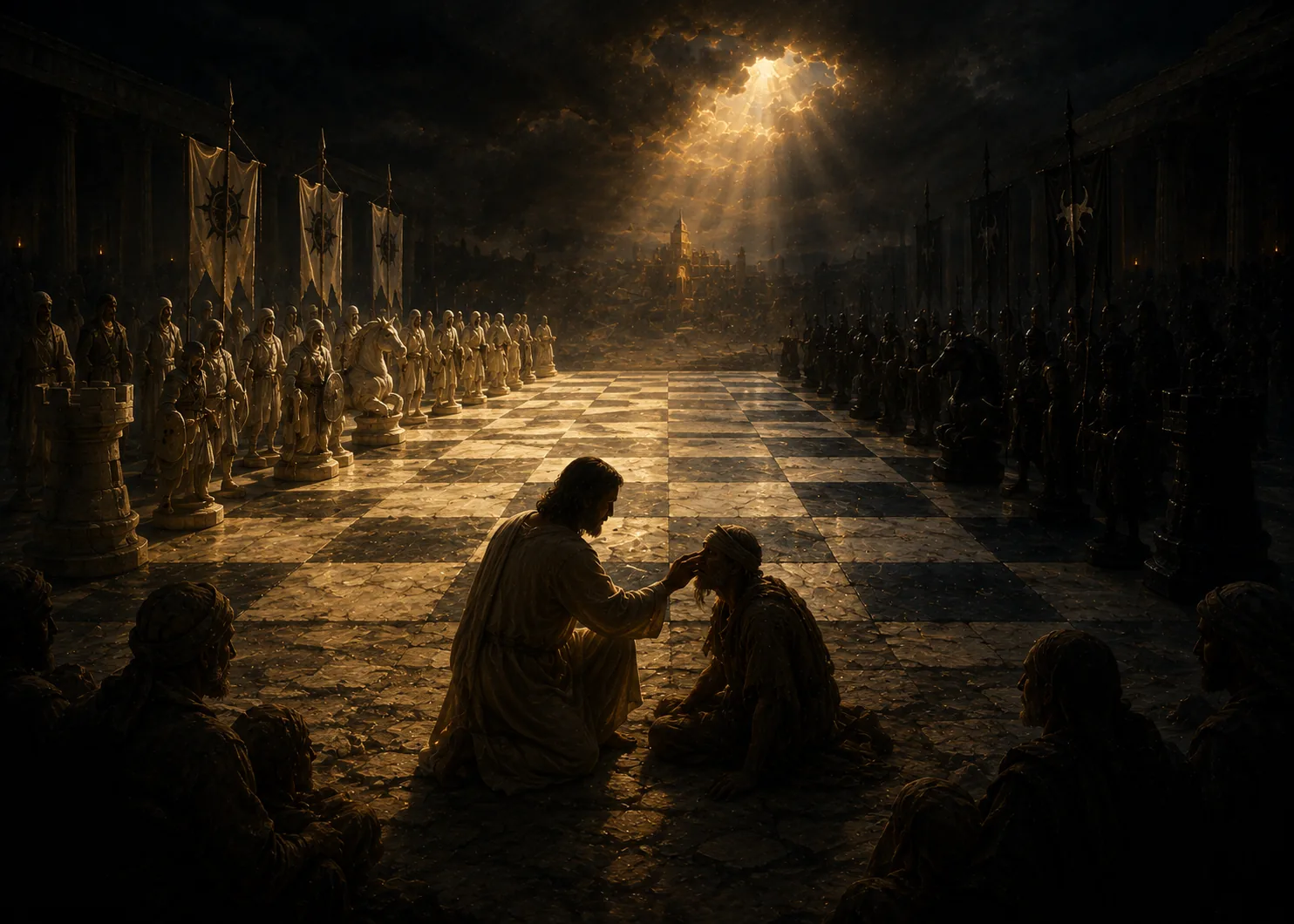
He was handed a two-sided board and He would not sit down at it. He did not claim the light square. He asked what happens to a kingdom that fights itself, and left the men who had drawn the board holding it.
That deserves to be taken seriously, because I have argued three times now, in print, that there is no second power anywhere in reality — and I have never once put the claim in front of the evidence that most obviously contradicts it.
II. The Room There Isn't
The claim I have made three times is that the God the tradition actually confesses leaves no space for a rival, and that the space we imagine for one is the space we invented at a tree.
Those arguments are made and published, and a fourth telling would be a reprise rather than an essay. In one paragraph each:
The first is arithmetic, and it belongs to the schoolmen rather than to me. There cannot be two infinites. Two would have to differ, and to differ is for one of them to have something the other lacks — a place where one stops and the other keeps going. That place is a limit, and a limited infinite is not one. Aquinas runs the argument straight off the infinity of the divine perfection, and the same reasoning is the spine of tawhid in Islam and of the Shema in Judaism.3 I spent a movement of Jealous of a Calf on it, in order to say that a jealous God was never jealous of another infinite, because there is not one to be jealous of.
The second is the two words the tradition has repeated so long they have gone smooth. All-powerful and all-present. Take them at full weight and they do not describe a very large being standing beside a world; they describe a reality with no beside. If God's power is total then there is no power that is not God's, and the moment you grant one thing a single native watt of its own you have made God large and no longer all-powerful. If there is nowhere God is not, then there is no empty shelf to set a not-God on. That is the argument of The Novelist DM, and it's why I can't have a second power without giving up a word I say every week.
The third is the oldest and the strangest. The Knowledge of Good and Evil argues that the fruit at the center of the garden was not wickedness but a worldview — that the knowledge of good and evil is the knowledge of two powers, the conviction that reality is split down the middle into a good force and a bad one with each of us enlisted at birth. On that reading the belief in a cosmic adversary is not our defense against the fall. It is the fall, still running.
Three arguments, three directions, one conclusion. And there is an obvious objection to all three, which I have answered exactly once, in a single sentence, and only out of the Hebrew Bible: that the adversary in Job is not an independent kingdom but a member of the divine court, on a leash.4
That sentence is true and it isn't enough, because the objection isn't really about Job. The objection is that the man at the center of this whole tradition spent His public life casting demons out of people, talked about the devil in what sounds like operational detail, and told a story about binding a strong man before you can rob his house. If there is no second power, somebody has to account for that.
So let us count it.
III. What Counting Can and Cannot Do
Here is the instrument, and I'd rather hand it over with its defects showing than present a number and hope.
I took the four gospels in a text that marks the words of Jesus and tags every word with its Greek lemma, and I counted by lemma rather than by English word — which matters more than it sounds like it does, because the King James renders three different Greek words as hell, and a count run on the English cannot see that. The body here quotes the King James, which is the house translation; the counting ran on the tagged text.5
The figures. Jesus speaks about thirty-nine thousand words across the four gospels, in a little under two thousand verses. The vocabulary of demons — daimonion, Beelzeboul, unclean spirit — appears in seventeen of them. Satan and the devil appear in sixteen. The entire vocabulary of hell — gehenna, hades, the punishment, the worm, the weeping and gnashing of teeth — appears in twenty-four, or twenty-seven if you're generous about what counts as a furnace. Against that, the words He actually spends His time on: kingdom in a hundred verses, Father in nearly two hundred, and the whole warm end of the vocabulary — love, kingdom, Father, forgiveness, mercy, life, blessed — in something over four hundred. Call it eighteen to one.
Four things a count like this cannot do.
Red letter is an editorial judgment, not a manuscript fact. No Greek manuscript marks the words of Jesus. Where a gospel's narration blends into His speech, careful editors disagree — the seams in the third chapter of John are the standing example — and my count inherits somebody else's calls about where the quotation marks go.
A verse is not a unit of weight. The judgment of the sheep and the goats is one row in my tally and a whole scene on the page. The rich man and Lazarus is one row and an entire parable. Nobody reads by the verse and nothing important was ever settled by counting them.
Rarity is not unimportance, and this is the one that could sink the essay if I let it pass. Jesus never once says God is love. That sentence is in the first letter of John, and no honest person concludes from its absence that He did not mean it. A doctrine's weight is not its word frequency, and anyone who tells you otherwise is selling you a trick.
And a count like this can be wrong where nobody can see it. Miss one word — one of the two or three the gospels use for the same thing — and a figure comes out short while looking exactly as confident as a right one. There's no defense against that except leaving the workings open, so the text, the terms and the arithmetic are all recoverable, and anybody who runs it again and gets a different number is owed a hearing.
So what is a count good for, if not for weighing? This: it can tell you what a word was used for. Not how much it mattered — what job it was doing in the sentence, and who was standing there when it was said. That is a question about aim, and aim is checkable.
IV. What He Actually Does With a Demon
Seventeen verses, and the argument is in how they sort.
Six of them are Jesus rebutting the charge that He is demon-powered — the scene we opened on, in its three tellings. Two more report that people said the same thing about John the Baptist, who neither ate nor drank, and they say, He hath a devil.6 One is Jesus flatly denying it of Himself: I have not a devil; but I honour My Father.7 Three commission the work or report it as done. One announces a girl released, to her mother, in a sentence with no metaphysics in it at all: the devil is gone out of thy daughter.8 One is a command, addressed to the spirit and not about it. Two are a single saying told in two gospels. And one — the strangest of the seventeen — is the scene where people who cast out demons in His name are the ones He does not recognize.9
Add them up by what the sentences are doing and a shape appears. More than half of the demon-talk in the mouth of Jesus is defensive. It is Him, or somebody He loves, being accused of demonic power and saying no. The gospels' demonology, in His own words, is mostly a man batting away a slander.
And then the part that is not defensive is not a warning either. Not one of the seventeen tells anybody to be afraid of a demon. Not one describes their organization, their ranks, their methods, or their aims. There is no verse where He briefs the disciples on the enemy. The two that carry a positive claim carry the same one, and it is not about the demon:
But if I with the finger of God cast out devils, no doubt the kingdom of God is come upon you.10
The demon is not the subject of that sentence. The demon is the occasion — the thing whose removal is evidence of something else, and the something else is the whole message. He isn't saying look what I can do to them. He is saying look what has arrived.
The hinge of the whole argument is four verses long.
He sends out seventy people, and they come back thrilled — thrilled about exactly what you'd expect: LORD, even the devils are subject unto us through Thy name. They've been out in the field and they have won. He answers them first with the widest promise anybody makes in the gospels — nothing shall by any means hurt you — and then, in the very next breath, He takes the victory away from them as a thing to care about:
Notwithstanding in this rejoice not, that the spirits are subject unto you; but rather rejoice, because your names are written in heaven.11
So: they came back having won the war, and He told them the war isn't the thing.
There's a version of that sentence that is merely modest — don't get a big head about it — and that reading is available and I can't refute it from the Greek. But look at the shape. Every element of a two-powers cosmology is on the table in that scene: authority, an enemy, a campaign, a victory report. And the answer redirects off all of it, onto something with no adversary in it at all. If you were building a movement around a cosmic war, this is the moment you consolidate. He does the opposite.
I argued in The Knowledge of Good and Evil that a man in recovery did not beat his demons — he stopped granting them the war. That was Luke's sentence before it was mine.
One saying cuts against me and I would rather raise it than be caught with it. When an unclean spirit goes out of a man, the story runs, it wanders through dry places, finds no rest, and comes back to find the house swept and garnished and empty — so it fetches seven worse than itself and moves in, and the last state of that man is worse than the first.12 That is a warning, and pretending otherwise would cost me the essay. But notice what it warns about: not a menacing spirit lying in wait, but an emptied house that nobody ever filled. The danger in the sentence is the vacancy. And notice who is standing there when He says it — Matthew appends even so shall it be also unto this wicked generation, which is to say, the audience that had just demanded a sign from Him.
So the claim I will defend is narrower than the one I wanted, and it is still the one that matters: He never tells anybody to be afraid of a demon. Not once, in seventeen verses.
V. The Kingdom That Isn't
Sixteen verses for Satan and the devil, and the one everybody quotes has been read backwards for a very long time.
If you have ever heard that Satan has a kingdom, this is where it comes from:
If Satan cast out Satan, he is divided against himself; how shall then his kingdom stand?
That is a conditional — the second half of a reductio whose first half is if — and the grammar is worth being exact about, because a great deal rides on it. This is what grammarians call a first-class conditional — if plus the indicative — and it is often glossed since, which is very likely how the flat reading got manufactured in the first place. But the gloss is a convenience rather than a rule: the construction grants its premise for the sake of the argument, and whether the speaker believes it is settled by context, not by the grammar.13 The context here is not in doubt, because the very next verse runs the identical construction on a premise Jesus certainly does not hold — if I by Beelzebub cast out devils, by whom do your children cast them out? Nobody reads that one as a confession. It is the same if.
So: Jesus is not telling His audience that there is a dark realm with a throne in it. He is taking the premise the accusation requires, running it forward, and handing it back broken: your charge, believed, destroys the thing it needs. The sentence is an argument against the men who made it. The only reason it sounds like a doctrine is that we have spent centuries lifting the second clause out of a conditional and reading it flat.
And Mark, who is always the plainest, finishes the thought in a phrase I cannot get a two-powers cosmology to absorb: if Satan rise up against himself, and be divided, he cannot stand, but hath an end.14 An end. Whatever else the adversary is in this book, he isn't one of two balanced forces locked in a long war; he is a thing that is finishing.
Set the rest of the sixteen beside that and they stop matching the picture almost entirely. Luke has Him saying I beheld Satan as lightning fall from heaven — which is a report of a defeat, delivered as an aside, to people who had not asked. Luke also has Him naming Satan for one purpose only: to justify untying a woman who had been bent double for eighteen years, on a sabbath, over the objections of the man who ran the synagogue. Ought not this woman, being a daughter of Abraham, whom Satan hath bound, lo, these eighteen years, be loosed from this bond on the sabbath day?15 The adversary is invoked in that sentence as the reason to break a rule in somebody's favor. I do not want to explain that verse away in either direction: it says the binding was real and it says the untying could not wait, and the person it is aimed at is the rule-keeper.
Then the wilderness, where you would expect the doctrine if it were anywhere. Across the entire temptation Jesus says three things to Satan, and all three of them are quotations from Deuteronomy.16 He does not explain him. He does not rank him. He does not describe his kingdom, his origin, his angels, or his methods. He quotes Deuteronomy and He leaves. If we wanted an account of the enemy from the one person who had just spent forty days alone with him, we had our chance, and what we got was three verses of Torah and a closed door.
And then the sentence that undoes the picture by itself, which is that the harshest thing Jesus ever calls anybody by that name, He calls Peter.
Peter has just heard that Jesus is going to Jerusalem to be killed, and he does what a friend does — takes Him aside and tells Him it isn't going to happen. Be it far from Thee, LORD: this shall not be unto Thee. And the answer is Get thee behind me, Satan — followed by the actual charge, which is not possession and not allegiance: thou savourest not the things that be of God, but those that be of men.17
Read that as a two-powers sentence and it makes no sense at all. Peter is not an agent of a rival kingdom. Peter is a man who loves Him and would like Him not to die, and in that moment the love is pointed at the wrong thing. If the name marked a separate being with a separate throne, it could not land on a friend mid-kindness. It lands there easily.
The strong man, which is the real objection
There is a saying that cuts against all of this.
No man can enter into a strong man's house, and spoil his goods, except he will first bind the strong man; and then he will spoil his house.18
That is combat imagery and there is no reading it away. Luke's version is harder still, and I will quote the hard one rather than the easy one: when a strong man armed keepeth his palace, his goods are in peace: but when a stronger than he shall come upon him, and overcome him, he taketh from him all his armour wherein he trusted, and divideth his spoils. A palace. Armour. An overcoming. Spoils, divided. Anybody who wants a cosmic war can have this verse, and they should have it at full size.
What I will say is smaller than a refutation, and I think it is what the picture actually shows. Look at the tense of it. In none of the three tellings is there a fight in progress. The strong man is bound first, in a subordinate clause, and the whole action of the sentence is the carrying out of goods from a house whose owner is already tied up. In Luke the stronger one simply comes upon him, and overcomes him — one clause, no struggle in it, no outcome in doubt. The armour is named only as the thing he had trusted — the past tense of a man who doesn't have it any more.
This is an image of an aftermath. It grants a strong man; it does not grant a second power. And the difference between those two is the whole difference between a world at war and a world being quietly emptied of something that used to hold it.
The saying is combat language and it stays combat language. What it isn't is a description of two thrones.
VI. And What About Hell
The same pattern is in the other vocabulary, and it's the vocabulary most people actually mean when they say the gospels are frightening. So: twenty-four verses, and I read every one of them for the only question worth asking of them. Who is standing there?
The scribes and the Pharisees, twice, by name.19 The children of the kingdom — the insiders — cast out into the dark.20 Capernaum, which is not a wicked city on a plain somewhere but the town that had actually watched Him work, brought down.21 The people who presume on Abraham and find themselves outside.22 The servant given his portion with the hypocrites.23 Then a long run of verses that are not about anybody else at all: your right eye, your right hand, your foot, and the man you called a fool.24 And then a rich man who ate well while a beggar lay at his gate,25 and a crowd at the end of everything who did not feed, clothe, or visit anyone — and who, the passage is at pains to say, had no idea.26
I have now read all twenty-four several times, and of the ones that are warnings at all, I can't find one aimed at an outsider. Not at a pagan, not at a foreigner, not at a heretic, and — the one almost anybody would bet on — not at anybody for failing to believe something. The warnings in the gospels run consistently toward the middle of the room — landing on the religiously confident, on the hearer's own hand, and on the man who stepped over somebody on his way in.
There is one more, and it runs backwards from all the others. The gates of hell shall not prevail.27 It's the only place in the four gospels where hell is the subject of a sentence with a verb, and what the verb reports is a failure. Gates do not besiege anybody. Gates are what you have when something is coming for you.
And the structure is the same one the seventy walked into. Luke's only mention of gehenna sits at the fifth verse of the twelfth chapter — inside a speech that says be not afraid at the fourth verse, says it again at the seventh with the sparrows and the numbered hairs, and says it a third time at the thirty-second: Fear not, little flock; for it is your Father's good pleasure to give you the kingdom.28 Matthew's version of the same speech has the identical shape. The most frightening sentence He is on record as saying is a subordinate clause inside His most comforting speech, and its grammatical job is to move fear off the people who could actually hurt you.
For what it is worth: verses in which He tells people not to be afraid, counted strictly, come to nineteen; count take no thought as well and it is twenty-six. Against twenty-four to twenty-seven for hell. The ranges overlap, and the honest statement is the dull one. They are the same order of magnitude, and they occur in the same speeches.
John's gospel does attach condemnation to unbelief, and does it sharply — which is where the objections begin.
VII. Objections, at Full Strength
The first is the one that could take the whole thing down.
If there is no evil power, is nothing evil? No, and I need to be exact, because the sloppy version of what I am arguing is genuinely dangerous. Denying two cosmic powers is not denying that a cruel act and a kind one differ. It is not saying that the harm done to a child is anything less than harm. What dissolves is not the difference between good and evil acts; it is the sorting of persons into good and evil kinds, the filing of a human being onto the far side of a line so that we can stop owing him anything. I argued that at length in The Knowledge of Good and Evil and I'm not going to re-argue it, but I won't let what follows be read without it. And there is a companion claim holding the same seam from the other side: The Freedom to Walk Away argues that God did not create sin, because sin is not a created object but a use of a created freedom. A real wrong with no rival deity behind it is exactly the thing that essay was written to describe.
And no part of this says a suffering is unreal. That's the trapdoor under every argument of this shape, and I'd rather nail it shut than step around it. That a thing has no independent power behind it has never once meant it does not cut.29
"You are attacking a caricature." Fair. Jesus did talk about the devil — sixteen separate verses of it — and the argument here has never been that the verses are absent. So take the passages the picture actually stands on, at their strongest.
The wilderness is the first of them, offered as proof that the adversary has power enough to bargain with the Son of God. But one of the three verses usually brought forward is thou shalt not tempt the LORD thy God, which does not mention him at all. It is a sentence about God, quoted out of Deuteronomy to somebody who had just misquoted a psalm.
Then the demoniac among the tombs, where the sentence most often quoted — what have I to do with thee, Jesus, thou Son of the most high God? I adjure thee by God, that thou torment me not — is spoken by the demon. His own words in that scene are a command to the spirit to come out of the man, and nothing else. And the episode does not end where it is usually left off. It ends with the man sitting, and clothed, and in his right mind, and sent home to tell his friends how great things the LORD has done for him.30
Then the seventy, back from the field with the demons subject to them, quoted to the end of the promise — nothing shall by any means hurt you — and stopped there, one verse short of in this rejoice not.
And the everlasting fire of Matthew 25, read as Satan's kingdom, where the text says it was prepared for the devil and his angels: something made ready for him, which is the opposite of a realm he rules.
It is the same lift every time. A phrase is carried out of its sentence and stood up on its own, and the sentence it came out of is doing something else.
None of that needs anybody to be arguing in bad faith. It is what all of us do with a text — fill the gaps from the picture we were handed long before we ever opened the book. The picture is the subject here. The people holding it are not.
"The Church teaches this, and you don't." This is the objection with the most weight behind it, and it ought to end the argument. The Catechism defines hell as a "definitive self-exclusion from communion with God," arrived at "by our own free choice" — a door held shut from the inside rather than a sentence handed down — and then says flatly that "God predestines no one to go to hell." The same article affirms hell's existence and its eternity and calls its chief punishment eternal separation from God; that stands, and I've no interest in trimming it.31
It also describes an adversary, and quoting only the paragraphs that suit me would be a cheat. It has him a created angel who went wrong by his own choice — which is the freedom argument and not the dualist one. And then it says the thing this argument has been walking toward, in words I can't improve: the power of Satan is not infinite. He is "only a creature."32 The church that gave us the fresco denies the second power in its own catechism, and has done all along.
John 3:18. He that believeth not is condemned already, because he hath not believed in the name of the only begotten Son of God. That is condemnation attached to unbelief in the plainest words available, and the distinction between condemnation-language and hell-language does not get me out of it cleanly. What that verse means turns entirely on what the name is, and I have spent a whole essay on that question already; In the Name (The Ambassador) argues that to do a thing in someone's name is to do their will, so that the name you are asked to believe in is not a word to say but a will to come under. I will let it carry this, and note only that John's own next verse gives the criterion in his own voice, and it is not a vocabulary test: men loved darkness rather than light, because their deeds were evil.33
John 8:44, the fiercest verse in this territory. Ye are of your father the devil. The room is the one described at the start, and the detail that keeps it a family fight rather than a verdict sits eight verses upstream: the people He is addressing are introduced as those Jews which believed on him.34 The framing that did the damage — speaking to a group of Jews — flattens exactly that. Having said it: this is the one place He uses the name to build a genealogy of a disposition, and it belongs on the honest side of my ledger.
"You have made it comfortable." This is the objection I would make, and it is wrong in a specific way that is worth naming. A world with one power is not a softer world. It is a world with nothing left to blame. The two-powers picture has a great consolation in it that nobody admits to: if there is an enemy, then the wrong in me arrived from outside, and the war explains me. Take the second power away and the explanation goes with it. Add the finding about aim — that the warnings run toward the middle of the room — and the reader most exposed here is the one who was sure he was fine. That includes the man writing it, who has now published a dozen essays about how other people read their tradition wrong.
VIII. The Picture Was Painted
Here's what I think happened, and it isn't a conspiracy. It's just how pictures work.
Almost everything you can describe about the enemy, you didn't get from the sixteen verses. Say the word and see what arrives: horns, a tail, a pitchfork, a cloven hoof, red. None of that is in the gospels. As far as I can find, none of it is anywhere in the Bible at all. It came from somewhere else, and the somewhere else is traceable. The horns and the cloven hooves are Pan's — lifted off a goat-legged fertility god by way of the satyrs that Jerome had already identified with demons. The pitchfork is a trident, and the earliest one anybody has found in Christian hands is carved on a stone cross at Monasterboice, in Ireland, around the tenth century, possibly the ninth. By about then the whole costume was conventional.35 The rest came from a poet who supplied the architecture and the nine descending circles, and from the doom paintings on the west wall where the congregation could see them right through the sermon, and from the tympanum carved over the door — so that for most people in most centuries the picture of the last judgment was literally the thing you walked under on your way in.
Translation did some of the work too. English collapses gehenna — a valley outside Jerusalem that you could walk to in an afternoon — and hades, the realm of the dead, into one word, and the word arrives in your ear already furnished. A place became a cosmology partly because two words became one.
I have done this several times now, and by now I know the shape. They/Them took down the picture of God made of grammar and pigment; The Life Is Not in the Book took down the one made of paper; Son of Joseph took down the one made of biology. This one is made of paint.
And the rule I have followed every time is the one that matters most here, because this is the piece most tempted to break it: when you take a picture down you do not hang another one in the gap. So I'm not going to finish by telling you there is no devil. I don't know that, and this essay hasn't shown it, and a confident denial would be the same furniture rearranged. The strong man stays where he is, bound in his own house, in a sentence I cannot explain away. So does the everlasting fire in Matthew 25, and the last state of that man, worse than the first.
What I think the counting shows is narrower and, I have come to think, harder to live with. In the words we have from Him, the darkness is never given a throne, never given a briefing, never given a war, and never given to us to be afraid of. It gets a subordinate clause. It gets an aside about lightning. It gets three lines of Deuteronomy and a closed door. And when the people He sent came back from the field with a victory to report, He told them to rejoice about something else.
The men who started all this handed Him a board with two sides and asked which one He was on. He asked them how long a house lasts when it is fighting itself, and He went back to the crowd, and He kept healing people.
Footnotes
-
Matthew 12:22–24 (KJV); parallels at Mark 3:22 and Luke 11:14–15. The three accounts differ in who brings the charge: Matthew has the Pharisees, Mark has scribes come down from Jerusalem, Luke only "some of them." The man in Matthew is blind and dumb; in Luke, dumb alone. ↩
-
Matthew 12:25–26 (KJV); Mark 3:24–26; Luke 11:17–18. ↩
-
Thomas Aquinas, Summa Theologiae I.11.3, which gives three arguments for the unity of God; this is the second, and it runs off the infinite perfection of the divine being — if there were many they would have to differ, and the difference would be either a privation or a perfection, so one of them would lack something either way. The first argument runs from simplicity and the third from the unity of the world; neither is used here. ↩
-
Job 1–2; Zechariah 3. In every occurrence in both books the Hebrew is ha-satan — "the satan" — with the definite article, which makes it a role rather than a proper name: the accuser, a functionary of the divine court. English versions almost universally print "Satan," as though it were a name, and the King James is among them; the article is the thing that disappears in translation. ↩
-
The count ran on the Berean Standard Bible in USX, enriched with words-of-Jesus markup and Strong's numbers. The King James renders geenna, hadēs and (outside the gospels) tartaroō alike as hell: hadēs is hell at Matthew 11:23 and 16:18, Luke 10:15 and 16:23 and elsewhere, the notable exception being 1 Corinthians 15:55, where it has grave. ↩
-
Matthew 11:18; Luke 7:33 (KJV). ↩
-
John 8:49 (KJV). The verb honour is the King James's spelling and stands as the translation has it. ↩
-
Mark 7:29 (KJV). ↩
-
Matthew 7:22–23. The criterion in that scene belongs to The Sheep in the Basement and to In the Name (The Ambassador), which argue it at length; it is touched here only for the oddity that exorcism appears on the résumé of the rejected. ↩
-
Luke 11:20 (KJV); Matthew 12:28 has by the Spirit of God where Luke has with the finger of God. ↩
-
Luke 10:17–20 (KJV): the report at 17, the lightning at 18, the promise at 19, the redirection at 20. ↩
-
Matthew 12:43–45; Luke 11:24–26 (KJV). Luke ends at the last state of that man is worse than the first and lacks Matthew's closing application, Even so shall it be also unto this wicked generation — so the audience-directed edge of the saying is Matthew's alone. ↩
-
The construction at Matthew 12:26 and Luke 11:18 is the first-class conditional — ei with the indicative, about three hundred instances in the New Testament. Daniel B. Wallace, Greek Grammar Beyond the Basics (Zondervan, 1996), in the chapter on conditional sentences, gives its force as the assumption of truth for the sake of argument: if — and let us assume this is true for the sake of argument — then. Matthew 12:26 is among the standard examples. The popular gloss since overstates it, and Matthew 12:27 is the control in the same paragraph: the identical construction, on a premise the speaker plainly rejects. ↩
-
Mark 3:26 (KJV). The phrase is Mark's alone — Matthew 12:26 and Luke 11:18 both end at how shall then his kingdom stand?, and neither carries but hath an end. ↩
-
Luke 13:16 (KJV); the episode runs 13:10–17. Luke 10:18 for the lightning. ↩
-
Matthew 4:1–11; the three replies quote Deuteronomy 8:3, 6:16 and 6:13. Luke 4:1–13 has the second and third in the reverse order — kingdoms before temple — and the three replies are otherwise the same. One wrinkle worth stating rather than smoothing: Deuteronomy 6:13 in the Hebrew, and so in the King James, reads thou shalt fear the LORD thy God, and serve him. The gospels' thou shalt worship follows the Greek of the Septuagint. The reply is a quotation of that verse; it is not a quotation of the King James's rendering of it. ↩
-
Matthew 16:22–23; Mark 8:33 (KJV). Mark lacks Matthew's thou art an offence unto me and has Jesus turning to look at the disciples before He speaks; the rebuke and its stated ground are otherwise identical in both. ↩
-
Mark 3:27; Matthew 12:29; Luke 11:21–22 (KJV). Luke's is the fuller and more martial version — the palace, the armour, the divided spoils — where Mark and Matthew have only the house, the binding and the goods. ↩
-
Matthew 23:15, 23:33. ↩
-
Matthew 8:12. ↩
-
Matthew 11:23; Luke 10:15. ↩
-
Luke 13:28. ↩
-
Matthew 24:51. ↩
-
Matthew 5:22, 5:29–30, 18:8–9; Mark 9:43–48. ↩
-
Luke 16:19–31, at 16:23 and 16:28. ↩
-
Matthew 25:31–46, at 25:41 and 25:46. That neither group recognizes what it has done — the welcomed are as surprised as the refused — is argued at length in The Highest Peak. ↩
-
Matthew 16:18. ↩
-
Luke 12:4–7 and 12:32; cf. Matthew 10:26–31, where the same speech runs fear them not at 26, the hell saying at 28, and fear ye not therefore at 31. ↩
-
The point is made at length in The Novelist DM: made of mind is not the same as make-believe, and no frame is ever permitted to tell a suffering person that this is not happening. ↩
-
Mark 5:1–20; the demon speaks at 5:7, Jesus at 5:8, and the man is sitting, and clothed, and in his right mind at 5:15 and sent home at 5:19 — tell them how great things the Lord hath done for thee, and hath had compassion on thee. ↩
-
Catechism of the Catholic Church §§1033, 1035, 1037. 1033 defines hell as "this state of definitive self-exclusion from communion with God and the blessed," entered by "our own free choice"; 1035 affirms its existence and eternity and names its chief punishment as "eternal separation from God"; 1037 states that "God predestines no one to go to hell." Quoted from the Vatican text. ↩
-
Catechism of the Catholic Church §§391, 392, 395, quoted from the Vatican text. 391 has the devil and the other demons "created naturally good by God" but become "evil by their own doing"; 392 makes the fall a free and irrevocable choice by created spirits. 395 in full: "The power of Satan is, nonetheless, not infinite. He is only a creature, powerful from the fact that he is pure spirit, but still a creature. He cannot prevent the building up of God's reign." ↩
-
John 3:18–19 (KJV). ↩
-
John 8:30–31. Whether the group addressed at 8:44 is continuous with the believers of 8:31 is genuinely contested — the dispute sharpens across the chapter and some readers take the audience to shift — so the claim here is only that the chapter opens its argument with people described as those Jews which believed on him, which is enough to establish the register as a dispute among insiders rather than an address to outsiders. ↩
-
Scripture nowhere describes Satan's appearance, which is why the iconography had to be invented at all; the horns, hooves, tail and pitchfork become conventional in Christian art from about the ninth century. The horns and cloven hooves are commonly traced to Pan and the satyrs — Jerome had already identified satyrs and fauns with demons — and the pitchfork to the classical trident. The earliest surviving depiction of a demon holding one is generally given as the Last Judgement panel on Muiredach's High Cross at Monasterboice, County Louth, where lost souls are driven off by a figure with a trident; the cross is dated tenth century, possibly ninth. These derivations are the standard accounts of where the costume came from, and are less secure than the plain fact that none of it is in either testament. ↩