The Mask Comes Off Last
No test tells you whether a word is God's. One tells you where you would be acting from, and the rest is known only afterward.
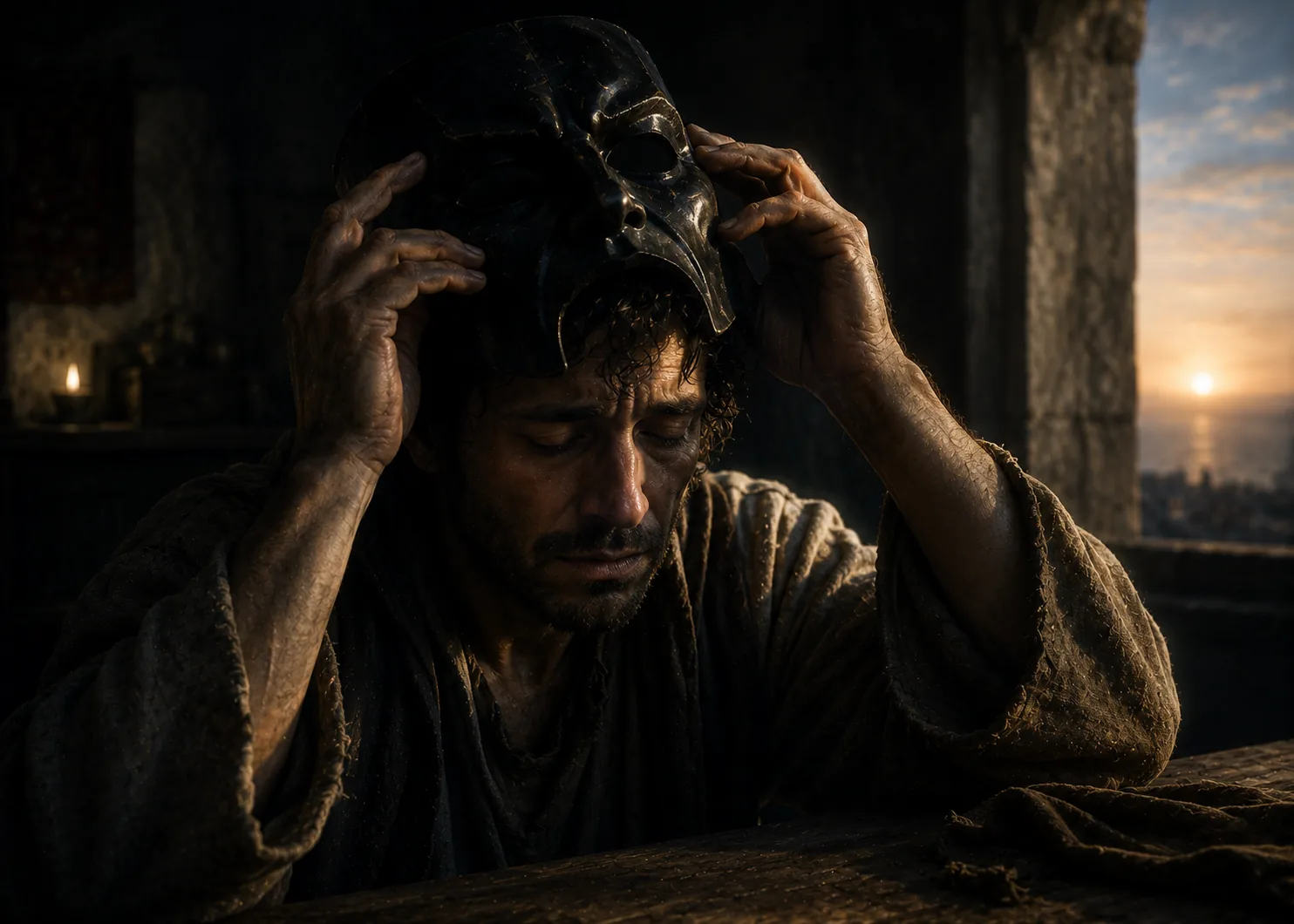
I. A Thousand Faces, One Villain
Every story has a different hero and the same villain.
That isn't quite how Joseph Campbell put it. The book was about the hero — The Hero with a Thousand Faces, 1949 — and its claim was that the hero of every people's stories is one figure wearing a thousand masks, who leaves, goes down, wins something, and comes back. You've met the claim whether or not you've met his name, and folklorists have complained for decades that any story can be fitted to it if you push.1 What gets less attention is the figure standing across from the hero, because Campbell never gave the villain the title, and they are the more uniform of the two. Achilles and Frodo have almost nothing in common. Put their enemies side by side and the resemblance is immediate.
Campbell named the type; he called it Holdfast — the tyrant-monster, the keeper of the past, the hoarder of the general benefit, a figure avid, in his phrase, for the rights of my and mine.2 Read the list of what Holdfast holds and it's the same list in every story: the throne, the ring, the hoard, the daughter, the town, the kingdom that must not change. The dragon in the old tales sleeps on gold that will never be spent. That is the genre's portrait of a particular way of being a self — one that has drawn a line around what is its own and will burn the country before it lets the line move.
And the one across from Holdfast is not a different kind of creature. Campbell's second stage, right after the call, is the refusal of it — essentially, he says, a refusal to give up what one takes to be one's own interest.3 The hero and the villain sit in the same seat. The story is the account of whether the one in it will stand up.
Nobody has written the seat from the inside better than Milton, who gave the villain of the oldest story in the tradition its best lines. Satan, on the burning lake, having just lost:
The mind is its own place, and in itself Can make a Heaven of Hell, a Hell of Heaven.4
And nine lines on, the creed:
Better to reign in Hell than serve in Heaven.
For more than three centuries readers have found those lines magnificent, and some — Blake, Shelley — concluded that Milton was on Satan's side without knowing it. The lines are magnificent because they are exact, and what they describe is not a rival power. It's a position: a self that would rather be sovereign over nothing than be part of something. The Knowledge of Good and Evil makes the case that the fall is exactly that change of perspective, and the case stands there. What is worth noticing here is smaller and stranger: the stories already knew. Fiction has always drawn the villain as the one person in the room who believes there are two powers, and cast them as the second.
What the stories cannot draw is the same figure from inside, which is where everybody actually meets them. From outside the villain is someone on a throne with something to hold, and unmistakable. From inside the villain is a voice, and it doesn't announce itself as a villain. It sounds like good sense about what I stand to lose.
So the question is how you tell — in your own head, with no camera to seat you — which voice you are hearing. The honest answer has two halves, and they are usually run together. There is no test for the word: nothing about a prompting, at the moment it arrives, tells you whether it is true or whether it is God's, and every mark proposed for it can be counterfeited by the faculty doing the checking. But there is a test for the seat. The posture you would be acting from has a shape, the shape can be derived from a single sentence, and it can be read before you move — not by how you feel, which can be faked, but by what you would do. The seat is knowable now. The word is knowable only afterward, in what it became.
II. Holdfast, Derived
A portrait of the separate self is easy to draw and useless to have, because a portrait fits whoever you already dislike. What's worth having is a derivation: one premise, and everything else forced from it, so the shape can be checked rather than recognized. Grant one sentence, and grant it in the first person, because the first person is the only one it is safe in:
I am a bounded thing, and what is inside the boundary is finite.
Nothing else is assumed, and six things follow, each forced by that one sentence.
First, a line exists — inside and outside. That is the sentence itself, and it is already the mistake. The rest is consequence.
Second, the supply is depletable. What's inside can be spent, taken, or lost, and nothing replaces it from within. So loss becomes possible — and not as one event among others, but as the event every other event is measured against.
Third, time becomes a threat. The future is the only place the line can move against me, so the future is where I have to look. A self that has granted the first sentence is not anxious by temperament. It is anxious by logic.
Fourth, others become variables. Everyone outside the line either adds to what is inside it or subtracts from it, and there is no third thing for them to do. Nobody is simply themselves.
Fifth, the world fills with graspers. Campbell saw this one, in the sentence after he names the tyrant: the aggressions Holdfast stands ready to battle back are primarily the reflections of the uncontrollable impulses to acquisition within himself.5 A self that knows itself to be holding assumes that everyone is holding, and reads its own posture off every face in the room. It is why the separate self is so often right about other people's motives — it is an expert in the one motive it has — and wrong about them anyway.
Sixth, the past becomes the safe configuration. Every change is a change from the state in which I still have it, so the last arrangement is the good one. Hence keeper of the past; hence the monster of the status quo. Hence the name. Hold.
Six steps, and none of them added anything the first sentence didn't contain; take the premise away and every step falls. And the things a person wants when they want something badly are each one of the six wearing a different object. Getting is acquisition forward; defending is acquisition backward. Being right is the line drawn around the mind; reputation is the line drawn around the self as other people hold it. Controlling is managing the variables, persuading is control conducted in language, and secrecy is the line kept where nobody can see it. All of them are holding a line. Campbell named the figure better than he knew.
Three things follow that the ordinary portrait of a villain misses.
The hoard is unusable by definition. The dragon sleeps on gold it will never spend, because spending is losing. So the separate self turns everything it holds into something dead: a held relationship stops moving, a held role becomes a fortress, a held certainty stops being a belief you could learn from and becomes a wall you defend. This is exact rather than figurative. To keep a living thing you have to hold it loosely enough for it to move, and Holdfast can't. What it holds, it kills — and it doesn't notice, because a dead thing is very easy to keep.
The hoard is not always gold. Nothing in the six steps says the thing inside the line has to be base. Holdfast can hold a virtue — a doctrine, a discipline, a reputation for gentleness, a self-image as the honest one or the one who has let go. The crude form is what a story draws because a camera needs something to see, and a sophisticated reader is in no danger from it. The sophisticated form is the only one such a reader is in danger from, and it derives from the same sentence in the same six steps.
Holdfast cannot be told. If other people are variables and the line must not move, then a correction is an incursion: it comes from outside, and it moves the line. So a self in this posture cannot receive a gift without converting it to a debt, cannot be surprised without being threatened, cannot be argued with, and cannot be told that it is Holdfast. That is the closed loop, and it is why the stories have to show the figure from outside. It also yields the one check on this whole picture that doesn't depend on my own report, when everything else here is read by the instrument under suspicion. The check is not whether I feel separate. It is whether, right now, I can be told anything. Other people can answer that and I can't, which is what makes it worth having.
There is no matching derivation for the other seat, and the absence is not a gap. Remove the premise and nothing is forced. No line, so nothing can move against me. No finite supply, so no loss to stand watch for. Nothing held, so nothing dies of being held. That is the description, and every sentence of it is a subtraction.
What the derivation buys is a reading you can take before you act. Three questions; they read intention, and none of them grades the word.
Is there an object, and is the object a state of me? The first half isn't the tell. Pulling a child out of the road has an object, a deadline, and one acceptable outcome, and there is nothing of Holdfast in it; teaching has an object by definition, and so does asking someone to stop hurting you. The tell is the second half: when the thing to be secured is a state of myself — my being right, my not looking foolish, my not losing this — the line has been drawn and the derivation is running.
If they say no, does anything in me object? This is the sharpest of the three, because it has a fast answer that is hard to fake to yourself. The separate self wants an outcome from a person. The other seat makes an offer and is, in fact, fine either way — not resigned, not managing its disappointment; fine. You can find out which you are in one imagined no.
Does it survive an hour? Nothing from the vacated seat loses anything by waiting. Urgency isn't always wrong — the child in the road again — but a prompting that cannot bear delay has said where it comes from, because what is held is the one thing time can take.
Put the three together and the intention has a shape. The separate self's intention is closed in time — the thing must be secured now — and closed in outcome — there is one acceptable ending. What is there when the position is vacated holds neither closure. That is what letting people go their own way actually consists of: not a warmth toward them, but the absence of a required ending.
All three questions read the seat. None reads the word. A word from a clean seat can be wrong; a word from a grasping one can be right. A clean seat is what licenses acting. It does not certify the act, and nothing before the act ever will. Notice, too, what kind of questions they are. None asks how I feel, because a feeling can be counterfeited by the very wanting that produces it. Each asks what I would do — if they said no, in an hour — or whether anyone can tell me anything, and a posture shows in conduct where a feeling can be faked. The last of the three is not even mine to answer.
Six steps from one sentence is also a superb instrument for diagnosing everyone you know, and pointed that way it is worthless. The stories knew this too, and they built the safety in.
III. The Seat You Are Given
You never watch as the villain.
The camera puts you with the hero, and it does this so reliably that you stop noticing it is a choice. From that seat the villain's perspective is something you're shown from outside — and outside is the only place it can be seen from. Both Ends of the Leash made the point about the frightened self that, from inside, everything it does looks like sound policy: grant the premise that you are alone in the universe with a finite supply and nobody coming, and getting and defending is not a vice but competence. The villain never experiences themselves as the villain, for exactly that reason. What a story does is deny you the first line. It seats you where you can watch someone reason perfectly from a wrong premise and lets you feel, for two hours, the whole shape of the error without once being inside it. A theater full of people rooting against one figure is a room practicing the one recognition none of them will manage from inside their own week: what the grip looks like from outside when it's yours.
And the practice is safe, and the safety is not incidental. A villain can't be harmed by your getting them wrong. You can misread them, hate them, cheer when they fall, and no one is hurt, because they're made of ink. That is not true of anyone you actually know. A habit of reading the separate self in other people is a license to dismiss them, and the readers most confident in it are reliably the ones most in need of it. Stories let you learn the shape on a figure who can bear it. The only person the shape is safe to read on, outside a story, is the one doing the reading.
For most of my life I sat in that seat with the wrong people in the frame. I was raised anti-theist, in an anti-theist city, and the believers were the simpletons of the story I was in; I've told that in The Way Home Is Down, and the sentence there is that the verdict felt like intelligence. Whose seat it was, that essay didn't say. It was Holdfast's — a self that had drawn its line around being the smart one and would have burned a good deal to keep it there. No one in that seat feels like the villain. That is what the seat is for.
IV. What Campbell Thought It Meant
Campbell believed the stories were true, and he believed it in a way that a follower of Jesus has to answer. The dying and rising god is everywhere — older than the gospels by millennia and wider than the Mediterranean — and the conclusion Campbell draws, openly, from his first pages on, is that the pattern is the psyche's, myth the depersonalized dream, and that the crucifixion and the resurrection are one more telling of it, the Christian face among the thousand.6 Concede everything that's true in that, because most of it is. The pattern is real. It is older than the church. A reading of the gospels that pretended the resurrection had no cousins would lose every reader who has opened a second book, and it should.
The disagreement is about what a pattern is evidence for. Campbell's own metaphysics leans harder than his psychology does — past Jung to Schopenhauer and the Vedanta, to the world as a dream and the dreamer as the one Self behind every mask.7 Take him at his word there, and one step further than he took it, and the conclusion turns over. If consciousness is primary — if the world is the dreaming of One, of whom every finite self is a forgetting — then a shape that recurs in every culture's stories is not what you'd expect of an accident. It is what you'd expect of the shape of the thing, remembered from a thousand angles by the parts of the One who is remembering. The Novelist DM argued that about the world; the step from there to the stories the parts tell is a further inference, at least as reasonable as Campbell's, and it runs the other way. Under consciousness first, recurrence is not the evidence against the resurrection. It is the signature.
Whether the tomb was empty is a separate question, and The Novelist DM takes it up. And the figures are not resolved into one another: Krishna Is Not Christ refuses at the figures and grants the referent, and that holds here. What recurs is the shape. Who walked through it, all the way, once, is a different claim.
V. Where the Enemy Is
Count the gospels and the adversary loses his throne. What he keeps is stranger.
The Kingdom That Isn't did the counting: seventeen verses of demon-talk in the mouth of Jesus, more than half of them Him batting away a slander; not one telling anybody to be afraid of a demon; no briefing, no war. Sixteen more for Satan and the devil, and the one everybody quotes about his kingdom is the second half of a conditional aimed at the men who brought it up. And the harshest thing He ever calls anybody by that name, He calls Peter.
Read the scene for what Peter is doing. Peter has just heard that his friend is going to Jerusalem to be killed, and he does what a friend does — takes Him aside and tells Him it isn't going to happen. Be it far from Thee, LORD: this shall not be unto Thee. And the answer is Get thee behind Me, Satan, followed by the actual charge, which is not possession and not allegiance: thou savourest not the things that be of God, but those that be of men.8 What was Peter savouring? A friend not dying. That essay called it love pointed at the wrong thing, and it was; what it was pointed at was a loss. The name landed on a man mid-kindness, and the thing it landed on was fear.
So here is where I can find the adversary with certainty, and it is the only place: a voice in my own head. I don't know what else he is; the strong man of Mark's saying stays bound in his own house, where that essay left him, and nothing goes up in that gap. But the voice isn't anonymous. It is the separate self — the one Milton gave the lines to, the one the derivation drew — and it can be told from the other one.
That last clause is the whole claim, and it is where the claim could go wrong in a sentence. So, precisely: they are not two speakers. One is a position; the other is what is there when the position is vacated. Two broadcasters would be a second power with a portfolio — the belief The Knowledge of Good and Evil exists to take apart — and an argument about the voice of the enemy is exactly the argument most likely to smuggle it back in. A position and its absence are not two of anything. The separate self's voice is not an entity transmitting at me; it is the sound a self makes when it has something to hold. The other is not a rival channel to pick out of the noise; it is what is left when nothing is being held.
Which is why the first voice can be recognized by its posture rather than its subject — the derivation was the recognition. It has something to hold; it is in a hurry; and it tends to tell me what I already wanted, which is the tell my essay Secondhand found lying in the road of 1 Kings 13. That essay disposes of the taxonomy of voices — fear, power, deception, each with its altar — because a taxonomy grades messengers and installs a second power with a portfolio. The difference between it and this is one word: that essay refuses to grade a voice coming from outside me; this one reads the seat I'm speaking from.
One text has to be met here at full strength, because it is the strongest thing in Paul for the other side. For we wrestle not against flesh and blood, but against principalities, against powers, against the rulers of the darkness of this world, against spiritual wickedness in high places.9 The first half is mine, and it is the rule against sorting persons in Paul's own mouth: the wrestling is not against people. The second half I do not explain away. It names rulers and powers, and a reader who hears an organized darkness in it is hearing what is there. Whatever those powers are, the place the wrestling actually happens, for me, is that seat — and Paul's own verb, wrestle, is a verb for a thing you do with your own body, up close, and not a verb for a war.
The Kingdom That Isn't named the consolation the two-powers picture carries — if there is an enemy, then the wrong in me arrived from outside, and the war explains me — and it is the one to take away for good. What's left is a voice I know, in a seat I know, and no one else to blame for what I do from it.
VI. Why There Is No Mark on the Word
Love does not remove the separate self's voice. It takes the seat. There is no fear in love; but perfect love casteth out fear: because fear hath torment.10 Both Ends of the Leash read casteth out fear as not casteth out the thunder, and drew a line I'll keep: love is not a solvent for terror. The fear does not leave the house. It stops driving. Nobody can be commanded not to feel a thing. Anybody can be told who is not going to be in the chair.
As for the other voice: it can be described only by what it does not carry, and that is not a scruple. It is the first step of the argument. Nothing to hold, nothing to defend, no hurry — the same room with the noise out of the chair. A thing with no properties cannot be detected by its properties, and every sentence that gave it one would make it a rival broadcaster, which is the second power with the paint scraped off. You do not tell the two apart by their tone. You tell them apart by whether there is a self in it, and that is audible the way a held breath is audible — by the absence of what it is holding.
The seat can be read now. The word cannot, and the reason is not that God is hard to hear. It is structural, and it holds for every candidate test I know of.
First: the word carries no signature. A word spoken from the vacated seat can be wrong — a mistaken fact, a bad guess, delivered with nothing held. A word spoken from a grasping seat can be right; the frightened person is right that the bridge is out. The seat is a fact about the speaker, and reading it correctly tells you nothing about the truth of what was said. That is why a clean seat licenses and does not certify.
Second: every mark proposed for the word can be counterfeited, and by the same faculty that would read it. Peace, clarity, certainty, the sense of being sent — all interior, all producible by wanting, and produced daily. Ignatius of Loyola, whose rules for discernment are the most careful thing I know in the tradition on this, put the danger exactly where it lives: it is the mark of the evil spirit, he says, to assume the appearance of an angel of light — to begin by suggesting thoughts suited to a devout soul and end by suggesting his own.11 Not a false prompting arriving in disguise, which you might catch at the door, but a true one bent by degrees, with no moment at which it announces the turn. The interior marks are exactly the ones the bending leaves intact.
Third: therefore the word is legible only in the tail. Ignatius's instruction follows directly — carefully observe the whole course of our thoughts, beginning, middle, and end, and when the end has gone bad, go back over the course and find where it began to darken.12 Retrospective by design. Not a weaker test than a real-time one nobody has found yet; the only test the structure permits for this object. A thing that reveals itself by what it becomes can be read only once it has become something.
Fourth: which is why the sitting is not a preliminary to discernment. It is the second instrument. The first is the reading of the seat, which works now and reads only the seat. The second is waiting, which does nothing to improve your reading of the present but produces a past, and a past can be read. Two instruments, two objects. Confusing them is the error: it is what makes people grade the word by their feelings, or give up on the seat because they've noticed the word can't be read.
The LORD acting through me is not self-evidently the humble sentence. It can be the vacated seat — a person doing what is in front of them with nothing held. And it can be the separate self having found the one form of self-assertion that cannot be questioned without seeming to question God: the line drawn around my own will, with the LORD's name written on it. From inside, both feel like being used, and the feeling settles nothing. The seat does, and it can be read while the sentence is still in my mouth: is there an ending I require here, and if they say no, does anything in me object? The line borrows the LORD's name; it does not change its answers. What the seat cannot show is whether the word was the LORD's, and that is the tail's to show. Whatever was really the LORD's tends to leave other people freer; whatever was the position wearing the LORD's name tends to leave them managed — and tends to leave the one who spoke it unable to be told so. That is the closed loop again, in a place a devout person would not think to look for it.
Even the tail has a limit. What it shows is what a thing became — freer people or managed ones, a door opened or a line held. It does not show whose word it was. Source and fruit are different claims, and the tradition's own test — by their fruits ye shall know them13 — is a test of fruit. A person who has watched a prompting ripen into something good knows that it ripened into something good. That is a great deal. It is not authorship.
None of this requires a life spent auditing. Brother Lawrence, the Carmelite lay brother whose kitchen conversations became The Practice of the Presence of God, expected nothing of himself: when he had failed in his duty he confessed the fault, said that left to himself he would never do otherwise, asked God to mend what was amiss, and then gave himself no further uneasiness about it and went back to the work.14 He did not trace which fault served what. Continual return is not a lesser discipline than examination. The tail gets read either way; one reads it and files it, and the other reads it and turns around.
VII. Fear Is the Sound It Makes
Fear is not what the separate self is. It is how the separate self sounds.
Keep that order, because the moment it flips, the claim becomes the devil is fear, which is a picture, and which is false. The villain is a position; fear is the noise a position makes when it has something to lose. Go back to the objects and they line up without being pushed. Holdfast holds out of fear of not having — the hoarder is fear of loss by definition, and Campbell's own portrait is self-terrorized, fear-haunted, alert at every hand. Satan's better to reign is fear of serving, which is fear of the self's dissolution. And the film Campbell shaped most directly is the tragedy of a man who fell because he was afraid of losing what he loved, and who became the thing he was afraid of in order to keep it.
Two limits. Fear as information is not the subject. The car in the crosswalk and the reflex that moves you are not the separate self talking; they are a body doing its job. The subject is fear in the seat — the deliberated act whose motive is the protection of a self. And the fear meant here is the one with torment in it. Jealous of a Calf argued that the tradition has two fears and English one word, and that the one which stands before Someone infinite and cannot manage Them is not the enemy of anything. That fear stays. The other one is the subject here.
Fear is not the only sound the position makes. Anger is one; wanting is one; the need to be right is one, and it may be the loudest in me. All of them come from the same seat — the separateness The Knowledge of Good and Evil argued is the root of all of them. Fear is the one I can hear first, and the tradition's own instruction about it is the shortest sentence it has.
An act taken from that seat carries the fear into the world, and what it carries arrives as suffering — mine, and other people's. Not as a sentence passed on the act by anyone. The Highest Peak made the point about the will that appoints itself navigator, and it holds here: nothing is being imposed. The suffering is the act's own fruit. Whoever acts from fear of losing the thing brings into the world exactly the loss they feared, with their own hands, and calls it defense. That is the evil we bring into it — not a substance, a transmission.
The only evil we must overcome is the evil we bring into the world does not mean the rest isn't real, and the careless reading of it is monstrous. Real evil is done, by other people, to people who did nothing to summon it; The Freedom to Walk Away conceded that at full strength — that God is not innocent of the cost — and nothing here softens it by a word. What the sentence means is narrower and harder: not that the rest isn't real, but that it isn't yours. First cast out the beam out of thine own eye15 is a statement about reach, not indifference to the mote. And Paul gives you the whole of your side of the war in one sentence: Be not overcome of evil, but overcome evil with good.16 The evil itself is not handed to you to fix.
VIII. Sin Was Always the State
The tradition moved sin from the act to the state that produced it two thousand years ago, in Jesus's own mouth, and we have spent most of the time since moving it back.
Read the Sermon for what it does rather than what it says. Ye have heard that it was said by them of old time, Thou shalt not kill… But I say unto you, That whosoever is angry with his brother without a cause shall be in danger of the judgment — and five verses on, whosoever looketh on a woman to lust after her hath committed adultery with her already in his heart.17 Twice in eight verses the act is set aside and the state is named in its place — not as a stricter rule about acts, which is how it gets preached, but as a change of address. The murder was already committed in the anger; the adultery already in his heart.
The hinge is Paul's, and it is one verse. He that doubteth is damned if he eat, because he eateth not of faith: for whatsoever is not of faith is sin.18 The same act — eating — is sin or not sin according to the state it comes from. Nothing about the food changes; what's changed is the eater. Sin is defined there by its source, and the source named is the absence of faith, which in that letter is trust in a person; I Believe in You spent a whole essay on the word. And trust is the exact thing fear is the absence of. Paul's definition and mine are the same definition, and his came first.
Two essays of mine have already said this without saying it — The Highest Peak, where the sin is the will appointing itself the navigator, a moment and not a deed, and The Freedom to Walk Away, where sin is not a thing at all; it is a use. So here it is outright. Sin is the state before it is the act. The act is what the state does when it gets a body.
Notice what kind of fruit this leaves. Nothing is imposed; no sentence is passed; the suffering is the act's own ripening. That is not the forensic picture of sin the West mostly inherited — a crime, a court, a penalty — and a reader who notices that it looks like what the Indian traditions call karma has noticed something real.
The objection is the right one and it's old: this is antinomian. If sin is the state, the act stops mattering. No. The act is the fruit and the fruit is real — a wrong done from the separate self is a wrong done to a real someone who didn't consent to be the fruit's address. What moves is not the weight of the act. It is the address of the remedy. You cannot repair an act; it is already in the world. You can only change the state it came from, which is why punishing the act produces not a better creature but a sneakier one — Both Ends of the Leash made that case from the training end. Punish the deed and you get a dog with a secret. Change the seat and you get a different deed.
IX. Stand Still, Then Go Forward
I had a bad acid trip once. First I was convinced that if I stopped paying attention to beating my heart, it would stop. Then I was convinced that everything I imagined happening would happen. Then I was convinced that I had murdered my friends and that the police were outside, about to arrest me. I was terrified. I sat on the couch in the fetal position and listened to music and waited to be taken to prison for the rest of my life. The sun came up, and I went for a walk in the snow.
Nobody had been hurt. Nobody was outside. Every element of the story that night — the crime, the victims, the police, the sentence — was produced by one frightened mind, and the first stage was the purest form of the thing The Highest Peak called sin: a will so sure it was the navigator that it believed the heart needed it to keep beating. And I did not act on any of it. I would like to say I chose that. I didn't; I was too frightened to move. But it is still the reason nothing happened. The fear was entire and it was real and it passed without any help from me, and then there was a morning, and I walked in it. The only evil in that room was what I had brought into it, and I never brought it any further than the couch.
The tradition has a text for that night, and it is the oldest instruction on the shelf. Army behind, sea ahead, and Moses says two things in one breath: Fear ye not, stand still, and see the salvation of the LORD, which [They] will shew to you to day… The LORD shall fight for you, and ye shall hold your peace. And then the verse nobody quotes, which is the next one: And the LORD said unto Moses, Wherefore criest thou unto Me? speak unto the children of Israel, that they go forward.19 Stand still is not the end of the sentence. It is what you do while the fear is the one talking, and the next word is forward.
Ignatius has the same instruction with the reason attached. In time of desolation, he says, never make a change; hold to the resolution you made before the desolation came.20 It is not a rule about which voice is speaking — it says nothing about whose word the desolation carries. It is a rule about which conditions make reading impossible at all. While the fear is in the chair nothing can be read, and a decision taken then is a decision taken blind.
Isaiah says what the alternative costs, as a cause and its effect: in quietness and in confidence shall be your strength: and ye would not. But ye said, No; for we will flee upon horses; therefore shall ye flee.21 The action taken from fear produces exactly the thing the fear was about — not a threat, a description of how horses work. Be still, and know that I am God22 is the same instruction again.
And there is the night in the garden, usually read for one sentence and better read for its order. My soul is exceeding sorrowful, even unto death: tarry ye here, and watch with Me. The fear is real and it is His. He does not act on it and He does not pretend it away. He sits with it — three times, saying the same words — and only then: Rise, let us be going.23 Not when the fear was gone. When it had been sat with. He did not move until He had stood still, and He did not stay still.
So here is a practice, offered plainly. When the voice is the one that wants you to move now — that is the tell, and it takes no training to notice — sit still until it has passed. Then go forward.
Three things it does not do, and they are why I trust it. It does not tell you what to do; it only tells you what not to do yet. It cannot be done by someone who isn't listening — there is no way to wait for a voice to pass without hearing it, so it hands you back to your own hearing and gives you nothing to obey; a method that could be completed without listening would be an idol with a verb in it, and this one can't. And it does not tell you whose word it was, even afterward. The question Secondhand left unanswered — whether a given word is God's — stays unanswered here, because the answer cannot be a person and it cannot be a procedure either. What the tail shows is what the thing became, not its source, and a method that let you believe otherwise would be handing you a clean conscience about the present, which nobody has.
The army is behind and the sea is in front, and the voice in the chair is saying now.
I am still sitting.
X. The Mask Comes Off Last
The last thing the hero does in Campbell's cycle is not defeat the villain. It is see their face.
Campbell called the stage atonement with the father, and what he meant by it is the strangest thing in his book: that the ogre the hero has been fleeing is a reflex of the hero's own ego thrown forward onto the father, that the father was merciful the whole time, and that the task is to behold his face and be at one.24 Campbell wrote that in 1949; a generation later a filmmaker who had read him put it in a helmet, and another generation learned the stage without the name. The son is offered the villain's seat by the man who holds the real power in the room — take up your weapon, finish your father, sit here. The son refuses it and throws the weapon down, an act taken from neither fear nor anger, in a story that runs on both. And the father, dying, asks him to take the mask off, so that he can see his son with his own eyes.25
Under the mask is not a power. It is a frightened man who wanted to look at his boy. The villain was never defeated in that story — not even in the fight the hero won, which he ended by refusing to finish. The villain was unmasked, and what was under the mask was the face the hero had spent the whole story afraid of finding on himself.
The mask comes off last, and not for the drama of it. Under it is a face that could not have been identified from the front, at speed, by anyone — including the one wearing it. Vader is not unmasked by insight; he is unmasked by having reached the end. That is why the difference is known only afterward, and it is not a failure of the method; it is the shape of the thing being known. The face is seen last because last is the only place it can be seen from.
That is what the stories were teaching, and it is why they put us in the seat they put us in. The villain is one figure with a thousand faces, and the faces are ours. What they hold is what we hold; what they sound like is what we sound like when we have something to lose. And the only one of them I have ever had the power to unmask is the one whose voice I hear when I am afraid — because that is as far as my reach goes, and the tradition never asked it to go further. First the beam.
So here is what the sitting is made into now, on an ordinary day. With people I have stopped pressing. What I do instead is invite, and offer, and then listen, and let the answer be the answer. If someone says no, that is where it ends — the no is the test, and a stance that can't survive one was never the vacated seat. I let people go their own way, which sounds like a kindness and is mostly a discipline. I write. I trust that what is needed will be provided rather than securing it myself. None of that is a result. It is a practice, and the only claim made for it is that it is what I am doing.
It costs something. A stance that never presses loses the outcomes pressing would have gotten, and there are some. Some people don't opt in, and nothing in the stance lets me go and get them. And it has a failure of its own shape: a self that will not pressure others can also arrange never to be pressured itself, and call the arrangement peace. Whether that is happening is not a question I can answer from inside. It is the tellable question again, and other people hold the answer.
Stand still and go forward are one instruction in two halves, and it is possible to live in the first half and quote the second. The passage does not allow it. Standing still is not the opposite of the forward; it is what the forward is made of. Whether what I am doing now was the forward, or only another way of holding still, is not mine to say from here. It is legible from later, and later is where I will read it.
What is under the mask I will know when it comes off, and it comes off last. Until then there is the seat, which I can read, and the sea in front, and the next word, which is forward.
Footnotes
-
Joseph Campbell, The Hero with a Thousand Faces (1949; 2nd ed. 1968; Commemorative ed., Princeton / Bollingen XVII, 2004 — the text and pagination cited here). The complaint that the monomyth is unfalsifiable — that any narrative can be fitted to it — is the standard one among folklorists: Alan Dundes, "Folkloristics in the Twenty-First Century," Journal of American Folklore 118, no. 470 (2005): 385–408 ("It has long been a popular fantasy among amateur students of myth that all peoples share the same stories"); and Robert A. Segal, Joseph Campbell: An Introduction (Garland, 1987). The argument here borrows one observation from Campbell and one metaphysical lean, and makes no claim about the monomyth's standing as a theory of literature. ↩
-
Campbell, Hero, Prologue §1, "Myth and Dream," pp. 14–15: "The figure of the tyrant-monster is known to the mythologies, folk traditions, legends, and even nightmares of the world; and his characteristics are everywhere essentially the same. He is the hoarder of the general benefit. He is the monster avid for the greedy rights of 'my and mine.'" The name comes later, in Part II, "The Hero as Warrior," pp. 310–311: "the dragon to be slain by him is precisely the monster of the status quo: Holdfast, the keeper of the past." Campbell's own capitalized coinage, used as a proper name throughout Part II. ↩
-
Campbell, Hero, Part I, ch. I, §2, "Refusal of the Call," pp. 54–55: "The myths and folk tales of the whole world make clear that the refusal is essentially a refusal to give up what one takes to be one's own interest," and, of the one who refuses, "the subject loses the power of significant affirmative action and becomes a victim to be saved." ↩
-
John Milton, Paradise Lost I.254–255 and I.263, quoted from the Project Gutenberg text (#26, the Raben electronic text of 1964–65), which modernizes the spelling. The 1674 readings, as printed in the John Milton Reading Room (Dartmouth, ed. Thomas H. Luxon), are The mind is its own place, and in it self / Can make a Heav'n of Hell, a Hell of Heav'n and Better to reign in Hell, then serve in Heav'n. Blake: Milton "was a true poet, and of the Devil's party without knowing it" — The Marriage of Heaven and Hell, "The Voice of the Devil." Shelley: "Milton's Devil as a moral being is as far superior to his God, as one who perseveres in some purpose which he has conceived to be excellent in spite of adversity and torture, is to one who in the cold security of undoubted triumph inflicts the most horrible revenge upon his enemy" — A Defence of Poetry (1821). ↩
-
Campbell, Hero, "Myth and Dream," p. 15, continuing the tyrant-monster passage quoted earlier: "Self-terrorized, fear-haunted, alert at every hand to meet and battle back the anticipated aggressions of his environment, which are primarily the reflections of the uncontrollable impulses to acquisition within himself." The derivation in §II is built on this sentence and adds no Campbell beyond it. ↩
-
Campbell, Hero, "Myth and Dream," p. 19: "Dream is the personalized myth, myth the depersonalized dream; both myth and dream are symbolic in the same general way of the dynamics of the psyche." The crucifixion as instance: "This is the highest and ultimate crucifixion, not only of the hero, but of his god as well. Here the Son and the Father alike are annihilated — as personality-masks over the unnamed" ("The Ultimate Boon," pp. 176–177); and, of every one of us, "there is nothing we can do, except be crucified — and resurrected; dismembered totally, and then reborn" (p. 15). The dying gods themselves — Osiris, Dionysos, Frazer's corn king, the shamans of the far north — are Campbell's inventory across "The Belly of the Whale," "Tragedy and Comedy," and "The Road of Trials"; the tradition's own name for the move made here against him is C. S. Lewis's, "Myth Became Fact" (1944), and the argument here is not his. ↩
-
Campbell, Hero, "Myth and Dream," pp. 12–13: "Full circle, from the tomb of the womb to the womb of the tomb, we come: an ambiguous, enigmatical incursion into a world of solid matter that is soon to melt from us, like the substance of a dream." Schopenhauer is cited at "The One into the Manifold," pp. 260–261; the Upanishads are quoted throughout (in Hume's translation, as the notes to "Myth and Dream" say), and the Vedantasara of Sadananda in the cosmogonic cycle. ↩
-
Matthew 16:22–23 (KJV). Mark 8:33 has the rebuke without thou art an offence unto me. Deity pronouns in quotations throughout this essay take the house capital — Thee, Me, My — which the King James lowercases; the capital is a typographic convention of this publication and not an alteration of the text. Where the Father's pronoun is changed rather than recased it is bracketed, and the note gives the King James wording. ↩
-
Ephesians 6:12 (KJV). ↩
-
1 John 4:18 (KJV): There is no fear in love; but perfect love casteth out fear: because fear hath torment. He that feareth is not made perfect in love. ↩
-
Ignatius of Loyola, The Spiritual Exercises, Rules for the Discernment of Spirits, Second Week, rule 4 (§332), in the translation of Louis J. Puhl, S.J. (Newman Press, 1951): "It is a mark of the evil spirit to assume the appearance of an angel of light. He begins by suggesting thoughts that are suited to a devout soul, and ends by suggesting his own." The paragraph numbers are the standard ones, common to every modern edition. ↩
-
Ignatius, Spiritual Exercises, Second Week, rules 5 and 6 (§§333–334), Puhl translation. Rule 5: "We must carefully observe the whole course of our thoughts" — if the beginning, middle, and end are all good, the thoughts are from the good angel; if the course ends in something evil or distracting, or leaves the soul disturbed and less at peace than before, that is the sign of the evil spirit. Rule 6 is the instruction to go back over the whole course of a temptation once it has been recognized, so as to learn the enemy's customary deceits. The paraphrase in the body is of rule 6; only the clause in italics is quoted. ↩
-
Matthew 7:20 (KJV): Wherefore by their fruits ye shall know them. The saying is set at 7:16 and repeated at 7:20; it is a test of the prophets by what they produce, and the essay uses it for exactly that and no more. ↩
-
Brother Lawrence of the Resurrection (Nicolas Herman, c. 1614–1691), The Practice of the Presence of God, Second Conversation, in the standard anonymous English translation (the text printed by the Christian Classics Ethereal Library and as Project Gutenberg #5657): "That when he had failed in his duty, he only confessed his fault, saying to God, I shall never do otherwise, if You leave me to myself; 'tis You must hinder my falling, and mend what is amiss. That after this, he gave himself no further uneasiness about it." The conversations were recorded by the Abbé Joseph de Beaufort, who published them after Brother Lawrence's death; the words are Beaufort's report of them. ↩
-
Matthew 7:3–5 (KJV). The verse ends and then shalt thou see clearly to cast out the mote out of thy brother's eye — the mote is not denied; it is sequenced. ↩
-
Romans 12:21 (KJV). ↩
-
Matthew 5:21–22 and 5:27–28 (KJV). Without a cause in 5:22 (εἰκῇ) is a textual variant: it is absent from the earliest witnesses (א, B) and dropped by most modern translations. The King James has it and it is quoted as the King James has it; the argument here does not depend on the phrase either way. The same gospel lists the acts as proceeding from the heart (15:18–19), and John did not hedge — Whosoever hateth his brother is a murderer (1 John 3:15). ↩
-
Romans 14:22–23 (KJV). The verse before it — Hast thou faith? have it to thyself before God — fixes the subject as a person's own conscience before God, not a rule about food, which is the point. ↩
-
Exodus 14:13–15 (KJV). The bracketed [They] in verse 13 replaces the King James's he, per this publication's convention for the Father; the source reads which he will shew to you to day. ↩
-
Ignatius, Spiritual Exercises, Rules for the Discernment of Spirits, First Week, rule 5 (§318), Puhl translation: "In time of desolation we should never make any change, but remain firm and constant in the resolution and decision which guided us the day before the desolation, or in the decision to which we adhered in the preceding consolation." Ignatius's desolation is broader than fear — darkness, disturbance, restlessness, a loss of hope and love (§317) — and the essay borrows the rule for the one case it is about. ↩
-
Isaiah 30:15–16 (KJV). Five verses earlier than the word behind thee of 30:21 that The Highest Peak rests on, and a different use: that verse is about guidance, these are about what fleeing costs. ↩
-
Psalm 46:10 (KJV). ↩
-
Matthew 26:37–46 (KJV): the sorrow at 37–38, the first prayer at 39, the second at 42 saying the same words at 44, and Rise, let us be going at 46. The essay reads the sequence; the prayer's own sentence — not as I will, but as Thou wilt — is the spine of several essays of mine and is not re-spent here. ↩
-
Campbell, Hero, Part I, ch. II, §4, "Atonement with the Father," pp. 118–121: "For the ogre aspect of the father is a reflex of the victim's own ego — derived from the sensational nursery scene that has been left behind, but projected before"; "Atonement (at-one-ment) consists in no more than the abandonment of that self-generated double monster — the dragon thought to be God (superego) and the dragon thought to be Sin (repressed id)"; "One must have a faith that the father is merciful"; and "they behold the face of the father, understand — and the two are atoned." ↩
-
Return of the Jedi (1983). The Emperor orders Luke to kill his father; Luke, having severed Vader's hand, throws his lightsaber aside and refuses; Vader, unwilling to let his son die, throws the Emperor down the shaft and is mortally wounded; dying, he asks Luke to remove the mask so that he can see him with his own eyes. Lucas has said that Star Wars was shaped in part by The Hero with a Thousand Faces — "in reading The Hero with a Thousand Faces I began to realize that my first draft of Star Wars was following classic motifs" — and did not meet Campbell until after the trilogy was finished; Campbell screened it at Skywalker Ranch, where The Power of Myth (with Bill Moyers, 1988) was later filmed. A generation later in the body is 1949 to 1977. The fall in §VII is Revenge of the Sith (2005): Anakin's turn is driven by the fear of losing Padmé. ↩