The Novelist DM
You are not the author. That is the good news.
I. The Dream You Almost Woke From
You've had this dream, or one close enough.
You're somewhere — a house that is your house and also not, a street that keeps becoming a different street. Something is happening; there are people; there may be fear. And then, without deciding to, you notice. A small wrongness snags — the light is impossible, or the dead are alive — and a second knowing opens quietly behind the first: none of this is outside me. I'm dreaming.
That moment is the one firsthand experience every person has had of a whole world made of nothing but mind. The mountain is not stone; it is a thought — the same stuff as the hand you lift to test it, the same stuff as the stranger with a face you never saw awake. One substance, wearing ten thousand shapes and calling them a world, and while you were under it felt completely real. That is the gift of the dream: proof, from the inside, that a reality can be entire, and convincing, and made of mind alone.
Now the dream will try to teach you something false, and it is the thing everything here exists to undo. In your dream, the mind it is all made of is yours. So the dream whispers that to wake all the way up would be to find that you, at the center, were the maker of it the whole time — that you are God, and never knew. Set that whisper down. Keep the experience and drop the conclusion. It is the sweetest and oldest error there is.
There's a truer picture of a world made of mind. Not a dream you are having — a story you are in. A novelist imagines a world and fills it with people made wholly of the novelist's mind: they think the author's thoughts, look out through an awareness that was never their own, and walk streets that exist nowhere but in the author's head. Everything true of the dream is true here — one mind, no second thing anywhere. But one thing is not true, and it is the hinge of the whole essay: the author is not a character in the book. You never pass the novelist on a street in the novel. The characters do not hold the pen; they are written.
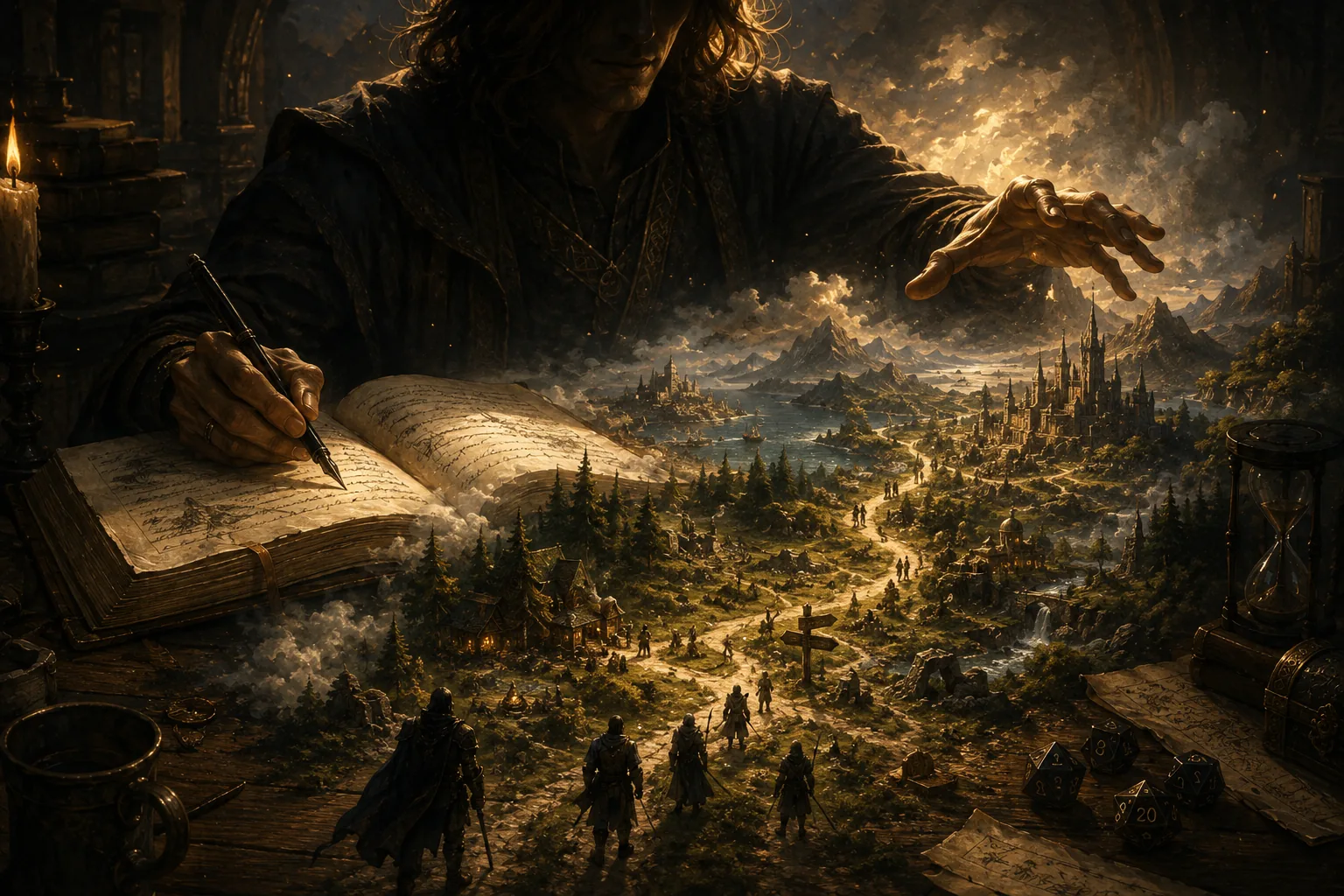
But a novel is finished. Its people never truly choose. The world we are in is more alive than that — it answers us, it opens where we turn. So keep the novelist and add one more figure, from a stranger corner of the culture: the dungeon master, the DM. In the game called Dungeons & Dragons there is no board and almost no script. A few friends make a story together, out loud; each controls a single character and may try anything at all — open the door or burn it down, follow the road or leave it for the woods. One person plays no character. The DM runs the world itself, describes the tavern and the forest, speaks for every stranger, decides how the world answers whatever the players try. The players hold their own choices; the master holds everything else.
Now give that DM unbounded intelligence, and let the world be no painted scenery but real: a mind holding a whole world and telling its story live, raising a forest the instant the players turn toward it, giving a stranger they stop to speak to a face and a history and a grief on the spot. There is a main quest, the story the master means to tell. But the players are free, really free, to wander off it, and nothing they choose can break the world; an intelligence that deep takes the wandering up and weaves it in, until even the detours are found, in the end, to have served the tale.
So you are a character in a novel and a player at that table at once: made wholly by the teller's mind, and genuinely free inside it; written, and choosing. That doubled figure — the Novelist DM, one Mind wearing both — is the image of God to keep. This Novelist DM has a name the tradition has circled for three thousand years.
II. Take the Two Words Literally
Start with two words the tradition has said about God for as long as it has said anything: omnipotent, and omnipresent. We repeat them so often they've gone smooth, like coins worn blank. At full weight they go somewhere.
All-powerful. Not very powerful; not the strongest among the powers. All of it. If God's power is total, then there is no power that is not God's — no second force standing on its own, no independent engine running anywhere under its own steam. Whatever moves, moves on a power that is on loan. Grant a single thing one native watt of its own and you've made God large but no longer all-powerful. You've drawn a border, and set on the far side of it something God is not.
All-present. Not nearly everywhere; everywhere. If I ascend up into heaven, thou art there, the psalmist says; if I make my bed in hell, behold, thou art there.12 There is no coordinate you can name where God is absent. And if there is nowhere God is not, then there is no empty shelf on which to set a thing that is its own.
Together, the two forbid the picture we were taught. We picture creation as manufacture: God over here makes a world over there — a potter, a pot. But manufacture needs two things the two words forbid. It needs a place to set the product, a somewhere outside the maker — and an omnipresent God has no outside. And it needs the product to be its own stuff once it's made — and an omnipotent God has lent it every ounce of what it is. A pot that is entirely the potter's power, entirely on the potter's ground, with nothing of its own and nowhere else to be, is not an object across from the potter. It is the potter's, through and through — and still a pot.
So the God the tradition confesses cannot have made a world the way we make things. Taken at their word, omnipotence and omnipresence don't describe a very large being set beside a world; they describe a reality with no beside — no outside, no second, no rival, no independent anything. I am the LORD, and there is none else.3 The Shema is not counting to one. It is saying there is only.
Whatever the world is, it is happening inside — and by — the only One there is.
III. Made by the Novelist DM
Paul says it on a Greek hill, to people who worshipped everything, and he says it in their own poets' words: in [Them] we live, and move, and have our being.4 Not near. Not toward. In. We are inside the life of God the way a wave is inside the sea — not a thing the sea made and set adrift, but a shape the sea is holding, with not one drop of water that is its own.
You are about to say that the East saw this first, and more precisely. It did. The Upanishads saw the dependence with a clarity the West has rarely matched, and landed on a sentence the whole Vedanta turns on: tat tvam asi, that thou art.5 And there the roads part, at the exact place they look like one road. Take that thou art as a claim about substance — the same stuff as God, in a smaller amount — and the character has stood up and claimed the pen in the most exalted dress there is. Take the dependence as authorship instead and not an ounce of it is lost. A character is made of the author down to the last comma; is not a smaller piece of them; is not on the way to becoming them. And a character can be addressed, and can answer. A portion of a substance cannot. That is the whole of what follows. I've argued in Krishna Is Not Christ that this is not a difference of degree, and in Not a Bodhisattva that a surrendered self asks a question the sage does not. What matters here is only this: you are made by the Author, and you are not the Author, and you were never meant to become Them.
One guard on the word for the story itself. Maya is almost always broken in translation into "illusion," then heard as unreal, therefore worthless.6 That is not the claim. The old image is a rope taken in the dusk for a snake: the snake was never there, and the fear was real, and someone can die of a snake that does not exist. The story is not nothing; it is the real, world-making telling of a mind that is more than it. You are a character in it, made by it, right now.
Which leaves the question everything after lives inside. If the world is a story, and its teller is God, and there is nothing outside God — then who, exactly, is the character so sure that they are the one holding the pen?
IV. Then Who Are We?
A character who has forgotten they are written.
Go back into the lucid dream, but this time don't wake. Stay a character. There you are, the figure crossing the room — bounded by your skin, wary of the stranger, certain past all argument that the world is out there and you are in here. Most of that is true. You are one figure. You were written as one, on purpose, with one face and one address, and nothing here is going to talk you out of it. What is false is smaller and more total than that: the certainty that the figure is its own, that it stands on its own power on its own ground, that nobody is writing it. The character is real. The wall it has built around itself, the one that says mine — that is the part that was never there.
When Genesis says we are made in the image of God,7 the word is stronger than the resemblance we tend to hear in it. Picture a space of infinitely many dimensions, and let the whole of that space be God. Now picture a small finite room inside it, three directions out of the infinite, and let the infinite fall onto that room the way a solid thing held up to the light falls as a flat shadow on the floor. What lands is a projection: a real and exact trace of the infinite, carrying everything of it those few dimensions can hold, and nothing of the boundless rest. That is what a self is. Genuinely God's, the way a shadow genuinely belongs to what stands in the light; genuinely finite, because a room can hold only what a room can hold. Each of us a different projection of the same infinite onto a different little room — which is why we are every one the image of God, and no two of us the same image, and none of us the light.
The empty self's whole mistake, then, is one confusion. It takes the projection for the point. It is sure the shadow stands on its own — self-cast, self-owning, the whole of what is there — when the shadow is the trace of something past all measure, holding it in being from above, this instant and every instant. You are not less than you imagined. You are the shadow that took itself for the only thing in the room, and never looked up.
Vedanta, having said that thou art, draws the conclusion left to it: aham brahmasmi — I am Brahman.8 Said by the ego standing up to claim its godhood, it is the oldest lie, the character snatching the pen. Said by the ego seen through, it says the one thing in it that is true — that the awareness the character called its own was the Author's the whole time, on loan — and the one who sees that does not become the Author, but a character who knows whose they are. The words are identical. Everything turns on who is left to say them, and on this side of the seam what is left is a someone who was given a life, not the One who gave it.
So the forgetting is not a crime. The character who takes themselves for their own hasn't sinned; they have done the one thing a story asks of its characters, which is to believe in it. The whole ache of being a person — the loneliness no crowd cures, the sense of being pressed against a glass you can't find the edge of — is what it costs to be one figure and to have forgotten who is holding you.
V. The Character Who Handed Back the Pen
Every teacher who ever lived taught out of what he had come to know. Even the Buddha, as clear-eyed a seer as the world has produced, woke by his own long looking and taught from his own attainment; there was no one above him he answered to. That is no knock on him. It is the shape of a sage. Jesus of Nazareth did the opposite, and the opposite is the whole of it.
He claimed nothing as His own. The Son can do nothing of Himself. I can of Mine own self do nothing … I seek not Mine own will, but the will of the Father. My doctrine is not Mine, but [Theirs] that sent Me. The Father that dwelleth in Me, [They do] the works.9 Every sentence hands the wisdom, the power, the very act upward, to a Father. Where the sage stands on the summit and speaks, Jesus stands with empty hands and says, again and again, it isn't Mine.
And that is the key to the other sentences, the ones that got Him killed. I and My Father are one. Before Abraham was, I am. He that hath seen Me hath seen the Father.10 From someone reaching for godhood, these are the proudest words ever spoken. But they don't come from someone reaching for anything; they come from the one man who had let go of everything. His I am is not the ego swelling until it bursts into blasphemy. It is a will so completely given that the only I left to say the word was the Father's. The most audacious claim in history was made by the most emptied man in it.
Here is the fork every character comes to, once it understands that its life was never its own but the teller's, on loan. It can snatch the pen and try to write itself — the one thing a character can never do, and the whole exhausting comedy of the empty self. Or it can do the humbler and far harder thing, and hand the pen back. Not my will, but Yours. Write me as You will.
Jesus is the character who handed back the pen. And because He kept nothing for Himself — no plot of His own, no will held in reserve — the Author was free to write the whole of Themselves, without remainder, into that one life. And the Word was made flesh.11 In the language of the projection: each of us is the infinite cast into one small life, and each of us has laid something over the top of it that is not God's at all — the empty self, the invented owner we spend our lives defending. That addition is the distortion, the reason the image always comes out a little crooked. Christ is the projection with nothing added, and here is the thing the creeds insisted on and never quite explained, fully God and fully man: not a hybrid, not God wearing a man like a coat, but the infinite cast into one human life with no false owner laid over the top. Fully man: a Galilean with a mother and a death, one small room and no other. Fully God: within its dimensions the whole of God stands undistorted. The old word for taking that addition away is kenosis — He made Himself of no reputation, Paul says; He thought it not robbery to be equal with God and did not clutch at it.12 The emptying was not a loss. It was the one subtraction that leaves everything.
He did not describe humility from a safe height. He went down into it first, all the way to a cross, and then turned and said the two words that are the door: follow Me.
VI. The Invitation We Turned into a Fence
Follow Me. Not admire Me; not sing about Me from a safe distance. Follow — come where I am, do what I did. It is the most extravagant invitation ever issued, and we have spent two thousand years making certain it could not possibly mean what it says.
On the last night He asks that they all may be one; as Thou, Father, art in Me, and I in Thee, that they also may be one in us.13 The oneness He has with God He asks to be handed on to them — I in them. And earlier, flatly: the works that I do shall he do also; and greater works than these shall he do.14 Greater. He did not take Himself for the exception. He took Himself for the first — the elder brother who came back into the story to shake the others by the shoulder.
So how did the invitation curdle into a fence? Because the empty self is not a mistake we happen to make; it is the water we swim in, and it will do anything to survive — including bend the most radical summons in history into its own opposite. Told you are one with God as I am; now come, the empty self hears the single thing it can bear to hear: He is one with God, and I am not. It runs a wall straight down the middle of the invitation and names it reverence. It would rather worship Him than follow Him, because worship, for all its warmth, keeps the gap open, and the gap is the empty self's whole life. A God over there can be adored forever. A God who says you, too has to be followed.
You're forming the objection already, and it's the right one: isn't this the old heresy — Jesus dissolved into a technique, one enlightened man among many, each of us a little god? No, and the reason is the whole argument. The invitation is not to become the Author. It is to be His the way He was the Father's — a will handed back, a character who does the will of the One telling the story and adds no plot of their own. That is what one as we are one asks: a oneness of will and love between two who stay two. Nobody in that prayer disappears. The Christian East has never flinched from this. He was made man, wrote Athanasius, that we might be made God15 — and the tradition that says it, theosis, means participation in God's life, never identity with it. I am not making Jesus less than the creeds make Him. I am refusing to make the rest of us less than He said we were.
Which is the point where an honest reader stops nodding and lifts a hand. If the world is God's story and every face is God's own, then a question has been standing in the corner of the room since the first page, arms folded. What about the nightmares?
VII. What About the Nightmares
A picture of God that has to be shielded from this question is already dead. If the world is God's story, then God is writing the cancer ward. God is writing the child in the cellar and the men on the other side of the door. And if some quiet part of you wants to file all of that under illusion — only a story, not real, nothing finally happening — then this whole essay deserves to be thrown across the room, and I will throw it first.
Made of mind is not the same as make-believe. The rope taken for a snake says it: there was no snake, and the terror was real, and a heart can stop from it. To the one inside it, the nightmare is total; there is no merely available from the inside, and there is no inside except the one we are in. Whatever else this frame is permitted to do, it is never permitted to say to a suffering person, this isn't happening. It is happening. It is made by God, and it is happening.
Which is the one thing this frame can say that a tidier theology cannot. If God were the watchmaker in the next room, the child's scream would be an item in Their inbox. But a God who is present at every point of the story is not in the next room. God is in the cellar with the child. Inasmuch as ye have done it unto one of the least of these, He said — and He did not say as if unto Me; He said unto Me.16 Whatever is done to the least is done to God, because God is in the cellar — in that face, in that dark — and the child is not alone in it. This is why, of all the things God might have shown us of Themselves, what They showed us was a man tortured to death by the state. The Author did not write the cellar from a safe desk; They wrote Themselves into the story, took a character's flesh, and bled in it — not to explain the horror, not to license it, but to be found inside it. The cross is not God's excuse for suffering. It is God's whereabouts.
And that is as far as I will go, because the next step is the one I refuse. You want a reason. You want to be told what the suffering is for, so that the books balance and the nightmare turns out, in the end, to have been worth it. Any reason clean enough to make you nod would be an obscenity read aloud over a real grave. No sentence that begins the murdered child was necessary because stays holy to its end. We do not need a why. We were never promised one. What we were given instead was not a reason but a companion in the dark, bleeding alongside us, and the given thing is better than the argument would have been.
There is a softer version of all this, the one on the dorm-room poster: we're all one, man, it's all love, nothing's really bad. The one Life that holds us all is not the anesthetic; it is the exposed nerve. If the one Life holds us all, then the person bleeding in the cellar is not someone else's tragedy at a safe remove — God is in it, and you are not outside it. And the one on the far side of the door is not conveniently outside the circle either: they too are someone God has not left, who has forgotten whose they are, and you are asked to keep even them inside the single life you share, while never calling what they did anything but monstrous. That is not comfort. Comfort was the wall. It is the hardest demand anyone has ever been handed, which is presumably why it was handed down by a man on a cross, and not by a poster.
VIII. Thy Will Be Done
The man on the cross got there by a particular motion, and it is the one thing in this whole essay you can actually do tonight. But first, the heavy word.
I said the character who takes themselves for their own hasn't sinned. That was true of the forgetting. But no one merely forgets. The empty self does not just sit in its sealed room; it wants. It defends its orbit. It puts itself first, because from inside the wall there is nowhere else to put it. And a will curved that far in on itself can do nothing but make suffering — for itself, in the exhausting labor of defending a self that was never in danger, and for everyone it collides with, because every cruelty ever done was an empty self treating another as something outside its circle. That is what the tradition has been pointing at all along with its heaviest word. Not a checklist of forbidden acts; the acts are the symptoms. Sin is the state underneath them: living as a will that believes it is its own.
And its wages are not a sentence handed down from a throne.17 There is no punishment engine. Sin is the wound that keeps wounding, the clenched fist that is its own ache. Separation is not met with suffering. Separation is the suffering — the only hell there has ever been is a self alone in a world it has walled itself out of.
Which is why you cannot fix it the way the empty self fixes everything, by trying harder. The self cannot dissolve the self; the will that is the whole problem cannot be the thing that solves it. Every effort to achieve oneness is only the ego appointing itself god one more time — the exact disease, wearing a halo.
This is the reef that most of what now calls itself spirituality runs onto. Manifest the life you want; bend the story to your will — it can sound like waking up, but it is the character reaching for the master's pen to write its own campaign. And there is a subtler reef beside it, and I ran aground on it myself: see through the self, dissolve the character, wake all the way up and find there was nobody there to have been suffering.
That one is not foolish, and it deserves a straight answer. It is the honest answer to a real question, and the question is how does this stop? — the one that crowds out the others when you are inside a hurt. Call it the patient's question. The Buddha put it at the center of everything he taught and followed it all the way down: if the suffering belongs to a self, go and look for the self. What he reported is that you do not find one, and that the ache turns out to have had nobody it was happening to. He did not mean annihilation, and his tradition has always refused that word; he meant that the one who was asking is not there to be found. I've set that beside the gospel in Not a Bodhisattva, and I have no correction to offer him.
The patient's question can be asked alone. That is the difference, and the rest follows from it: it needs nobody on the other end, only the pain and enough honesty to look. What do You want cannot be asked alone. There is a You in it. And a character with a You in their question is not trying to get out of the story — they are trying to find out what the Author wants.
So there is one door, and it does not lead up, and it does not lead out. It leads down, into a single sentence. The empty self cannot become the Whole and was never asked to. It can stop insisting on itself. It can say, and mean, not My will, but Thine18 — laying down the campaign it was writing for itself, and taking up the one quest the master had been telling all along. That is not the self achieving something; it is the self setting down the one thing it was never able to carry, which was itself. And in that setting-down the wall does not have to be broken, because a wall that no one is defending is already nothing.
This is why the prayer He taught turns, at its center, on those four words — Thy will be done — and why, in the garden, what we are given to overhear is not a man rising above His fear but a man surrendering straight through the middle of it. Gethsemane is a will handed back from inside a self that is still afraid — which is the only place any of us will ever hand it back. He did not tell us to feel no fear. He told us to say the words anyway, and He went first.
I know how this lands on anyone who was handed a religion that used the word surrender as a boot on the neck. The will you are yielding to is not a tyrant across the sky who wants you diminished. It is the will of the One you are made by and made for — nearer to you than you are to yourself, and never you — the Someone the frightened little will has spent your whole life standing in front of. Thy will be done is not I am nothing. It is I can stop pretending I am alone. It is the end of a war, and the war was with yourself all along.
And nothing is destroyed in it. You keep your face, your name, your one particular part. Nobody vanishes. What dies is the exhausting fiction that you were ever on your own — and on the far side of that small death is the one thing the empty self could never win by defending itself: to stop being a stranger, and come home.
IX. Stay
There's a lay brother who cooked for a Carmelite house in Paris in the sixteen hundreds, and he never woke from anything. He had no system and refused to want one. What he did instead was talk to God, all day, in the kitchen, and he said the plainest true thing about it that I know: The time of business does not with me differ from the time of prayer; and in the noise and clutter of my kitchen, while several persons are at the same time calling for different things, I possess GOD in as great tranquillity as if I were upon my knees at the Blessed Sacrament.19 He failed constantly, and when he did he told God so and gave himself no further uneasiness about it.20 He said there needed neither art nor science for going to GOD, but only a heart resolutely determined to apply itself to nothing but Him.21 And he said the whole of it in a sentence a cook could say: I began to live as if there was none but He and I in the world.22
That man was not seeing through the kitchen. He was not trying to find out that the pots and the brothers and the noise were made of him, or that he was made of them. He was a character who knew whose story he was in, and he spent the whole of it talking to the One telling it, and he never tried to become Him. That is what it looks like to stay.
Because there are two things you can do, once you know whose story you are in, and only one of them was ever asked of you. You can try to wake — thin the character out, dissolve the figure, find the One who was doing the dreaming. Whole traditions are careful maps of that road, and it is not what He did. The other thing you can do is what the cook did. Stay in the story with your eyes open. Let the stranger keep their face and the mountain keep its weight. Love them not as pieces of yourself but as His — the same light poured through them that was poured through you, into rooms you cannot see from inside your own. And talk to the Author. Not once, at the altar, and not in a special voice. In the kitchen. At ten in the morning, when the day you handed over is going badly and you would like it back. What do You want here is a question you can ask over a sink, and the whole practice of the presence of God is nothing more than asking it and then not leaving.
Jesus, given the pen back, did not vanish into the light. He stayed. He walked the story as the one character who knew whose it was, and He spent that knowing not on His own escape but on the ones still asleep — touching them, feeding them, arguing with them, all the way to a cross He could see coming and stayed for anyway. Awake, you do not leave the story. You begin to love it rightly, and to love the One telling it more than the part you were given in it.
And the invitation — the one we spent two thousand years turning into a fence — was never more or other than this: stay where you are, and turn around. Not to die, not to leave, not to rise out of your life into some thinner, holier air. To stay, here, at your table, across from the particular difficult faces you've been given, and to stop taking yourself for a stranger among them, and to stop taking yourself for the one who wrote them. To see the one across from you as another place the Author is looking out — a face the same light is pouring through, one that has, for now, forgotten whose it is. And to say to the One at the head of the table, out loud if you like, the one line a character was ever given that the Author never leaves unanswered.
What happens next?
Footnotes
-
Psalm 139:8 (KJV). ↩
-
Scripture in this essay is the King James Version. Deity pronouns take this publication's capital in the body — for the Father and for the Son — where the King James lowercases them; that alters no word. Where a house pronoun is substituted for the source's, it appears in brackets, and the note gives the King James as it stands. ↩
-
Isaiah 45:5; cf. the Shema, Deuteronomy 6:4 (KJV). ↩
-
Acts 17:28 (KJV); Paul on the Areopagus, quoting Greek poets (Epimenides and Aratus). That a Christian apostle builds his case on pagan verse is itself the method argued in §V. ↩
-
Chāndogya Upaniṣad 6.8.7 — tat tvam asi, "that thou art," first spoken by Uddālaka to his son Śvetaketu and then repeated as a refrain through 6.16. ↩
-
The rope-and-snake (rajju-sarpa) is a stock Advaita illustration of superimposition (adhyāsa), associated with Śaṅkara: the misperception is vividly real while it lasts, though its object was never there. ↩
-
Genesis 1:26 (KJV). Reading the imago as indwelling presence rather than resemblance — and the forgetting as no punishable crime — is a mystical/contemplative reading, not the scholarly consensus; cf. Brother Lawrence, for whom God was "always as with me, often as in me" (The Practice of the Presence of God, Second Letter), and who, having fallen, "gave himself no further uneasiness about it" (Second Conversation). Named as a reading; the projection/subspace image that carries it here is my own modern gloss, offered as illustration, not exegesis. ↩
-
Aham brahmasmi, "I am Brahman" — a mahāvākya of the Bṛhadāraṇyaka Upaniṣad (1.4.10). ↩
-
John 5:19; John 5:30; John 7:16; John 14:10 (KJV) — the "I do nothing of myself" sayings. ↩
-
John 10:30; John 8:58 (echoing the divine name of Exodus 3:14); John 14:9 (KJV). ↩
-
John 1:14 (KJV), "the Word was made flesh." ↩
-
Philippians 2:7, 6 (KJV). The Greek ekénōsen heautón — "emptied himself" — gives kenosis its name; harpagmós (v. 6) is the thing "not grasped / not seized." ↩
-
John 17:21 (KJV). ↩
-
John 14:12 (KJV). ↩
-
Athanasius, On the Incarnation 54.3 ("He was made man that we might be made God"); cf. 2 Peter 1:4, "partakers of the divine nature," and Irenaeus. The deification (theosis) tradition is orthodox in the Christian East. ↩
-
Matthew 25:40 (KJV). ↩
-
"Wages" echoes Romans 6:23, "the wages of sin is death" — read here as the intrinsic fruit of the state itself, not a penalty imposed from outside; cf. Galatians 6:7, "whatsoever a man soweth, that shall he also reap." KJV. ↩
-
Thy will be done — Matthew 6:10, the center of the Lord's Prayer; and the garden, Luke 22:42 (par. Matthew 26:39, 42), "not my will, but thine, be done." KJV. ↩
-
Brother Lawrence (Nicholas Herman, c. 1605–1691), The Practice of the Presence of God, Fourth Conversation, in the Epworth "authentic edition" reprinted by the Christian Classics Ethereal Library. Quoted as printed, the edition's small-capital GOD included; the text is another's and is neither bracketed nor recased. ↩
-
Second Conversation: "That when he had failed in his duty, he only confessed his fault, saying to GOD, I shall never do otherwise, if You leave me to myself; 'tis You must hinder my falling, and mend what is amiss. That after this, he gave himself no further uneasiness about it." ↩
-
Third Conversation: "That there needed neither art nor science for going to GOD, but only a heart resolutely determined to apply itself to nothing but Him, or for His sake, and to love Him only." ↩
-
First Letter: "I renounced, for the love of Him, everything that was not He; and I began to live as if there was none but He and I in the world." ↩