The Sheep in the Basement
The church built a program to save its lost children, took His name off the door, and it did what the pews could not
I. The Line He Drew Himself
On Thursday mornings I sit in a room on the Upper West Side with a dozen or two other people I would otherwise never have met, and we read to one another out of a book about how to become a parent to yourself. Then most of us say a few minutes about our week, or about the reading, and then we go back out into the city. I will tell you which room it is soon enough. First, what I found when I went home from it and opened the Gospel — because the thing we practice in that room turns out to be the thing He set, in plain words, as the whole of the test.
He drew the line Himself, and He drew it against the people with the right words.
That is the part we skip. We imagine the judgment as a sorting of the confessors from the deniers — those who said the name into one field, those who refused it into the other — and then we read Him saying the opposite, in plain words, and we hurry past it. Not every one that saith unto Me, LORD, LORD, shall enter into the kingdom of heaven; but he that doeth the will of My Father which is in heaven.1 Read it slowly. The ones being turned away are not the atheists. They are the ones with His name in their mouths — LORD, LORD, said twice, said correctly, said to His face. And the thing that fails them is not that they got the name wrong. It is that the name was all they brought.
He says it more than once, and never softly. When the disciples find a man casting out demons in His name and try to stop him — because he followeth not us — He tells them to leave the man alone: Forbid him not.2 The outsider doing the work is closer in than the insiders policing the badge. He tells a story about two sons: one says I will not and goes to work in the field anyway, the other says I go, sir and never goes, and then He asks which of the two did the will of his father.3 The answer is not the one who said the right thing. The answer is never the one who said the right thing.
And then, at the end, the whole of it laid out as a single scene — the sheep and the goats, the one picture of the last judgment He ever draws in detail. The astonishing thing about it, the thing we have somehow read a thousand times without letting it land, is what neither group knew. The ones welcomed in are as surprised as the ones turned away — and both sides open their mouths with the same word. LORD, when saw we Thee an hungred, and fed Thee? Seven verses later, from the other end of the room, the ones being sent away say it too: LORD, when saw we Thee an hungred?4 Nobody in that scene is in any doubt whose voice it is. What they did not know is where He had been standing. They fed the hungry man and clothed the cold one and sat with the prisoner, and it never once crossed their minds that the man in the cell was Him. And that — He says, in the one scene where He tells us how the accounting is finally done — that is what counts. Not the spotting of Him in the room. The deed.5
So set the criterion down cleanly, because He did: the name on your lips was never the whole of the test. The direction of your will is the rest of it — and those were never two competing tests. To do a thing in someone's name has always meant to do what that person wants; it is what the phrase means when a herald arrives in the name of a king, and it is what it means here. The men being turned away had the word and not the will, and a word without a will is not the name. It is the label on the outside of it. He said this in four different ways, in four different moods, and we have built two thousand years of institutions that quietly count the other thing — the saying, the badge, the roll. Which raises a question worth holding open, and the honest answer to it is not comfortable. If the criterion is a will actually turned toward God and spent on the person in front of you — where, right now, is that happening most reliably? It has an address. I have been going there on Thursday mornings. It is not a church — as often as not, it's the basement of one.
II. Becoming Your Own Loving Parent
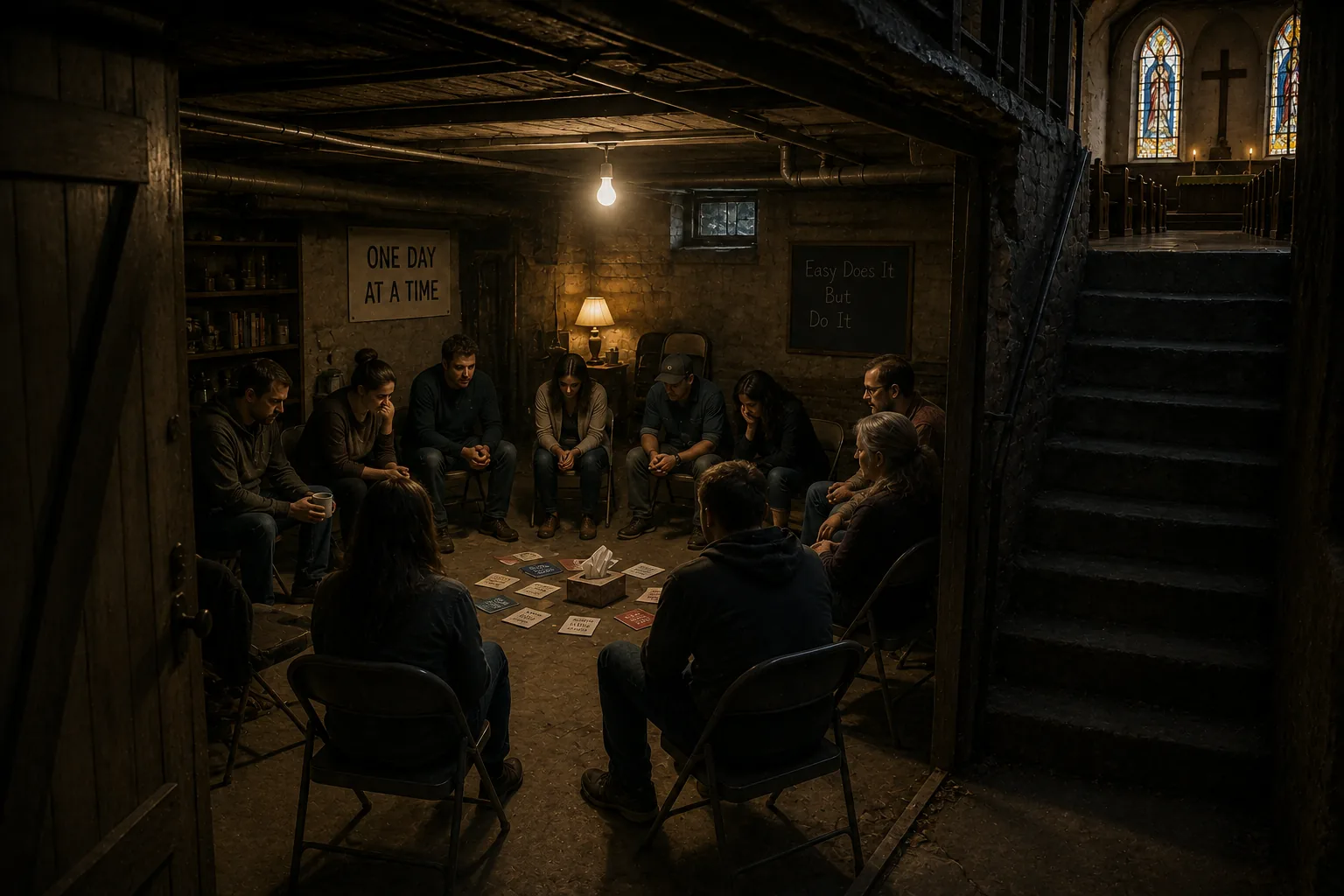
What goes on down in that basement is the very thing the church upstairs keeps trying to produce and cannot compel: people surrendering their will to God, and being taken up as children again. It is the room I sit in on Thursday mornings — folding chairs, a ring of cards laid out on the floor in the middle that say things like don't just do something, sit there and be still, and know — and the fellowship it belongs to is called Adult Children of Alcoholics and Dysfunctional Families. Most of us are not alcoholics. We are the people the alcoholic, or the raging one, or the frightened one, or the absent one, raised. We come because we learned, very early, to run our own lives from the inside — and because the manager we installed as children, to survive a house that could not be trusted, turned out to be cruel.6
The program has a name for that manager: the critical inner parent. A child in a dysfunctional home builds one, because it works. If you can be your own harshest judge, you can get ahead of the blow; if you demand everything of yourself, you can sometimes earn the love that is being withheld. So you become the parent you did not have — and the parent a frightened child builds is a tyrant, because a frightened child thinks safety is control. I built mine at an age I don't like to name. It kept me alive and it very nearly ran me into the ground, which is the whole trouble with the arrangements we make too young to survive people who were supposed to keep us.
And here is what that room is teaching me to do, out of a book worked slowly, page by page, in meetings and alone: to grow a second parent. A loving one — one who can take the frightened child by the hand and take the job away from the critic who has been doing it too long and too harshly. To love, first, the furious adolescent inside who is still standing guard, still sure that if they drop their fists someone will get hurt; and behind that teenager, to reach the actual child they have spent a lifetime protecting, and to tell that child, at last, that someone is here now who will not leave. The fellowship's founding sentence, the one everything else turns on, is this: the solution is to become your own loving parent.7
Read that beside the Gospel and something in it goes strange and large. Because the child being reached in that room is the one He said we had to become. Except ye be converted, and become as little children, ye shall not enter into the kingdom of heaven.8 And the arrangement the program is teaching — a parent who will not leave, taking the place of the one who did — has a name in Scripture older than any clinic. When my father and my mother forsake me, then the LORD will take me up.9 Hold that; I am not going to close it yet, because the program does not close it either. It says your own loving parent, and it means it, and I will not pretend otherwise. Note only, for now, that the room is standing at a doorway the Gospel also stands at, and calling it by a different name.
None of this is unique to my Thursday room. It is one of more than two hundred fellowships — for drinkers, for addicts, for the families of both, for gamblers and overeaters and the rest of the long human list — that all run on the same twelve sentences, written in 1939 and unchanged since.10 Read them the way you would read a liturgy, because that is what they are. They begin where the church keeps telling people to begin and cannot make them: at the end of the self. We admitted we were powerless — that our lives had become unmanageable, that the management was the problem, that the will running the show had run it into the ground. Then, having hit the bottom of self-sufficiency, the turn upward: Came to believe that a Power greater than ourselves could restore us to sanity. And then the hinge of the whole thing, the sentence everything before it was clearing room for: Made a decision to turn our will and our lives over to the care of God as we understood Him.11
What follows is not vague uplift. It is the most concrete moral program in modern life. A searching and fearless moral inventory — the examined conscience, written down. Confession, and not the private kind: admitted to God, to ourselves, and to another human being the exact nature of our wrongs. Then restitution, which the church mostly forgot it ever asked for: a list of every person you have harmed, and direct amends to such people wherever possible, except when to do so would injure them or others. Not an apology — amends. You go back and you make it right, in person, with the money if it was money. And then, sustaining all of it, the eleventh step, which is simply the contemplative life in a single instruction: sought through prayer and meditation to improve our conscious contact with God as we understood Him, praying only for knowledge of His will for us and the power to carry that out.12
Sit with that last clause. Praying only for knowledge of His will for us and the power to carry that out. Strip the recovery context away and you are left with the exact posture of a man in a garden the night before He is killed, sweating, asking that the cup pass, and then saying the only prayer that has ever been the whole of the thing: not My will, but Thine, be done.13 The program even prints its own version of that prayer, to be said at the third step — God, I offer myself to Thee, to build with me and to do with me as Thou wilt — and it is Gethsemane in a rented room. The recovering person who kneels — or doesn't; the program leaves that to them — and asks for God's will instead of their own is not doing something like what Jesus asked. They are doing the thing itself.
So watch what the room asks of a person, all at once. It asks the grown adult to lay down the will that has been white-knuckling the whole life — that is surrender, and it is the drinker's word for it. And it asks the same person to let the frightened child underneath be picked up and re-parented — that is adoption, and it is mine. They are not two programs. They are one motion seen from two sides: you give up the self-sufficient adult in the same breath you receive the child. Repentance, confession, restitution, surrender, dependence, mission — and a parent for the one who never had a safe one. The entire shape of it. With one thing missing, and we will come to the one thing.
III. The Child the Church Fathered
None of this fell from the sky. The church built it — and then let it go.
Alcoholics Anonymous did not invent its spirituality; it inherited it, almost whole, from a Christian revival movement called the Oxford Group, an evangelical fellowship that practiced exactly the disciplines the steps encode: self-examination, confession of sin, restitution for harm done, and the seeking of God's guidance in prayer.14 Bill Wilson, A.A.'s co-founder, got sober inside that movement, under the wing of an Episcopal priest named Sam Shoemaker, rector of Calvary Church in Manhattan. Wilson was not shy about the debt. Everything the steps contain, he said, he and the early members absorbed from Shoemaker and the Oxford Group "and from nowhere else."15 He would later call Shoemaker a co-founder of A.A. in all but name.
And here the story turns on a detail so telling it should be a parable in its own right. When the steps needed to be written, Wilson wanted the clergyman to write them. Shoemaker refused. They had to be written, he said, by an alcoholic — by one of the men who had actually been down in it, not by the priest.16 The church, at the decisive moment, handed the pen to the drunk.
What the drunk then did with the pen is the heart of this section. The first drafts were more openly Christian — more uses of "God," a clause about praying "on our knees." But two of the earliest members fought that language hard. One was an agnostic. The other, Jim Burwell, was a committed atheist, and he stayed one, sober, for the rest of his life. They argued that if the program spoke in the church's voice it would lose the very men it existed to save — the ones who could not walk into a sanctuary, who gagged on the creed, who had been handed a God they could not stomach and had left. So the language was widened, on purpose. "God" in the second step became a Power greater than ourselves. The third step and the eleventh gained the three words that saved the whole enterprise: as we understood Him. The clause about kneeling came out. And a chapter was written for the express purpose of getting the unbeliever through the door — it is called "We Agnostics."17
Notice what happened, because it is stranger and better than it first appears. The atheist widened the door for God. The man who did not believe insisted the room be built so that anyone at all could come in and meet Someone he himself could not name — and the room worked, and has gone on working, for ninety years and across a hundred and eighty countries, precisely because of what came off that door. This is the scandal and the genius in a single sentence: the word came off so that the name could get in. And it is, if you have been reading the first section, nothing but Matthew 25 built into an institution — a door that asks nothing at the threshold about Whom you are going to meet on the other side of it, except that here the asking-nothing is deliberate, engineered, printed into the founding document as a mercy.
And every room since is a grandchild of that act. My Thursday meeting exists because a document was built, on purpose, so that the person who could not stomach a creed could still be brought to the end of themselves and given a parent. Narcotics Anonymous, Al-Anon, the fellowship for the adult children — the whole two-hundred-fold family inherited the widened door. The church fathered a program to save its drunks, and the program grew a family to save very nearly everyone else, and it did all of it under the terms the atheist won: as we understood Him.
IV. By Their Fruits
By their fruits ye shall know them. He said that too, in the same breath as LORD, LORD — a tree is known by what it grows, not by what it is called.18 So the fair question about these rooms is not whether they use the right words. It is whether they grow the fruit. And here I have to be more careful than the argument would like me to be, because the honest evidence is narrower than the enthusiasm around it, and the argument only works if I stay honest — including about the room I sit in myself.
Here is what can actually be stood behind, and notice as I say it that it is the drinkers' evidence, not mine. For decades the scientific verdict on A.A. was a shrug — the best review anyone could muster, in 2006, concluded that no rigorous study had shown it worked.19 That changed in 2020, and it changed not because someone found new enthusiasm but because someone found a better method. A Cochrane review — the most conservative tier of evidence-grading there is — pooled twenty-seven studies of clinically delivered twelve-step programs and found that the structured version produces higher rates of sustained total abstinence than the established alternatives, cognitive-behavioral therapy among them: roughly forty-two percent still completely abstinent at a year against thirty-five, a result the reviewers rated at their highest level of certainty, and at substantially lower cost.20 That is a real finding and I will not inflate it by a single point. On every other measure — how much people drank when they drank, the damage done — the program came out about even with the alternatives, not ahead. It is not a miracle. It is the most effective thing we have, for the specific outcome of getting and staying wholly sober, at the lowest price.
Now the honest part, the part that costs me something. That evidence is Alcoholics Anonymous's. The room I sit in on Thursday mornings has no Cochrane review. No one has run the randomized trials on grown children learning to reparent themselves out of a childhood; the forty-two percent is the drinkers', measured in a disease with a clean outcome — sober or not — that the rest of us do not have. I will not launder those numbers into the morning room where they were never earned. What travels is narrower and worth exactly what it is: the research into why twelve-step works, when it works, is research into a mechanism — confession, a changed circle, a will handed over, a person set to help the next person — that is not specific to the bottle, and that my room runs on as surely as the basement does. The rest of what I can offer about the morning room is testimony, held as testimony and not smuggled in as proof: I have watched the critic go quiet in people who had carried him for fifty years. I have watched it, some mornings, in myself.
And there are further concessions, and the concessions are where the argument actually lives. Most people who walk into these rooms do not stay; the early attrition is steep, and every confident "success rate" you have ever heard quoted — the damning five percent, the triumphant fifty — is unreliable, a number computed over a denominator nobody can define.21 More uncomfortable still for a piece like this one: when researchers ask why it works when it works, the answer is mostly not the lightning bolt. For most members the machinery is ordinary — a changed social circle, new habits, the plain force of sitting weekly in a room with people who are staying sober. The dramatic spiritual awakening the twelfth step names turns out to matter most for the most broken, the ones with the least left to lose.22
Read that concession again, though, because it does not weaken the case — it is the case. Even measured by its most secular, most deflationary interpreters, the program reliably produces a particular kind of person: someone who has been brought to the end of running their own life, made to inventory their wrongs and confess them aloud, sent back to repair what they broke, taught to ask daily for a will that is not their own, and set to work carrying the whole thing to the next sufferer — and, in the rooms like mine, re-parented, taught to receive as a child the care they could not give themselves. That is the fruit. You do not have to believe it is God's doing to see that it is the exact fruit He named. And for the most desperate — the ones for whom, the data suggest, the awakening matters most — it is God's doing, and they will tell you so, and they got there without ever being asked to say the name first.
V. What the Church Counts
Now set that beside how the church keeps its books.
The numbers are real and I am going to give them to you straight, including the parts that cut against me, because a rigged graph loses exactly the reader I am writing for. In 1937, when Gallup first asked, seventy-three percent of Americans said they belonged to a church, synagogue, or mosque. The figure held near seventy for sixty years, and then it fell off a table: sixty-one percent by 2010, fifty by 2018, and in 2020, for the first time in the eight decades of the measurement, below half — forty-seven percent.23 The share of Americans calling themselves Christian has slid from seventy-eight percent to sixty-two in fifteen years; the religiously unaffiliated, the "nones," have gone from sixteen percent to twenty-nine.24 And now the part that keeps me honest: that slide appears to be slowing, maybe leveling off — the Christian share has held between sixty and sixty-four percent for several years now, and the growth of the nones has cooled.25 The sky is not falling. But the long trend is not in dispute, and neither is its direction.
Here is the distinction, and it is easy to miss because we let three different things wear the same word. Membership is a name on a roll. Affiliation is what you tell a pollster you are. Attendance is whether you were actually in the building — and in a given week, that last one is around a third of adults, far below either of the others.26 A church counts the first two. It counts baptisms and confirmations and members-in-good-standing and the box you check on a survey. It counts, in other words, the saying — the very thing He warned would not, by itself, count for anything.
The church deserves the fairest version of this, not the cheap one. For two thousand years the church has done what nothing else on earth has done at that scale: nursed the plague-sick when everyone else fled, built the hospitals and the universities, fed the hungry century after century, and kept alive — through every corruption of its own — a story about a God who comes down and dies for the least, and handed that story forward, intact, to anyone who would take it. Including to the man in the basement, and to me in the morning room. Neither of us got our program out of nowhere. We got it, at two removes, from the church. The pews are not the enemy here and the saints are not the target.
But a roll of members is a roll of people who said the name. That is what it is built to record, and it records it faithfully, and it cannot tell you which of those names belongs to a turned will and which to a habit, a heritage, a Sunday reflex, a box checked out of belonging. The church's own instrument cannot see the thing the church exists to produce. And the rooms, by a founding law they call anonymity, keep no roll at all — no members, no register, no count they trust. Which means they can only ever register the one thing a church roll cannot: the people in whom something actually happened. Because nothing less than the real thing — the will genuinely broken and handed over, the child genuinely picked up — keeps a body sober past the second drink, or keeps a grown adult coming back on Thursday mornings to do the hardest work there is. The rooms cannot count the saying. They were built so that only the doing would show up.
There is a witness to this that I did not expect to find, and it comes from the least sentimental institution we have. American courts have been asked, repeatedly, whether the state may order a man into A.A. against his will — as a condition of parole, probation, or a prison privilege — and they have said no, every time it has reached them, on the ground that A.A. is religious: that its program has, in the words of one appellate court, such substantial religious components that compelling a citizen into it would establish religion.27 A movement that took the name of Jesus off its door so that atheists could enter is recognized by the secular state as unmistakably an encounter with God — while the institutions that keep the name lit over the door count their millions and cannot, by their own instruments, tell you how many of those millions ever turned.
VI. Fruit, Not Bodies
The loud version of the claim is false, and it is retired here before anyone else retires it.
The loud version says: twelve-step recovery has brought more people to Jesus than the church has. As a count of bodies, that is not true, and no honest accounting makes it true. Global Christianity is more than two billion people and adds tens of millions more every year; the whole twelve-step family worldwide runs to some millions — Alcoholics Anonymous alone about two million, roughly flat for thirty years — and nobody can total the rest honestly, because the fellowships keep no rolls and one person may sit in three of them at once.28 Whatever the true figure is, it loses this comparison by two or three orders of magnitude, and it is not close. I concede it without reservation.
But look at what that concession is made of. It is a count of affiliation — of membership, of the name on the roll, of the box checked on the survey. It is a count of the saying. And the saying is the precise thing He told us not to count. So the loud claim fails on a measure He disqualified, which means its failure proves nothing at all about the question He actually posed.
Change the measure to His — a will genuinely surrendered, a life actually leaning its whole weight on God, a child actually re-parented, the fruit rather than the label — and the comparison does not merely narrow. It inverts, and it inverts for a structural reason that has nothing to do with the program being holier than the church. It inverts because the program cannot count anything else. A church roll is padded, by its own design, with everyone who was ever baptized as an infant, married in the nave, or raised to check "Christian" without ever once handing over the will — and there is no dishonesty in that; it is what a membership is. The basement roll and the morning roll are padded with no one, because there is no roll, and because the only thing that keeps a person coming back is the one thing you cannot fake your way into: the actual surrender, actually made, or you drink; the actual child, actually received, or you go back to the critic. Every name the program could hypothetically count is a name that did the thing. Most of the names on the church's rolls, by the church's own honest reckoning of attendance against membership, did not. The church counts the baptized; the rooms count the re-parented — and the second is the harder thing to counterfeit.
I am not going to hand you a number, because there is no honest number to hand — no census of turned wills exists on either side, and I will not invent one.29 What I will say is the strongest thing the evidence actually licenses: it is entirely possible — I think it is likely — that these rooms have produced more genuine turnings toward God in ninety years, more actual instances of the surrender He asked for, than the membership rolls of the churches ever recorded, and that the rolls cannot even see the difference, because they were never built to measure the thing He said was the only thing that mattered.
An argument like this one goes bad the instant the gavel slips. The gavel does not fall on the faithful. It does not fall on the woman who has knelt in the same pew for fifty years and meant every word, or on the church as the body of the living Christ, which is the truest thing in the world and the source of the very story the rooms run on. The gavel falls on one thing only: the ancient, comfortable mistake of counting affiliation as discipleship — of looking at a full roll and a full parking lot and mistaking it for a harvest. That mistake is not the church. It is the idol the church keeps having to smash, and has since the day a man stood up and said LORD, LORD is not the password, and doing the will is.
VII. The Objections
An argument this pointed owes its reader the strongest form of every objection, up front, in the reader's own voice — so here they are, and here is where each one holds and where it gives.
But twelve-step recovery is not Christian. Its rooms are full of Buddhists and Jews and atheists and people who mean, by "Higher Power," something you would not recognize. Yes. Entirely yes — and that is not the flaw in the argument, it is the argument. That is Matthew 25 with the lights on: the people who did it unto the least of these and never knew which face they were washing. I am not claiming these men and women are secret Christians. That would be a slander on the honest atheist in the third chair, who has said plainly what he thinks and is owed the courtesy of being believed — and it would be a cheat on my own case besides. I am claiming something narrower and, I think, harder to dismiss: they are doing the will — the surrender, the amends, the daily asking, the care of the person in front of them — which is the thing He said He was looking for. The pluralism of that room is not an awkwardness the argument has to survive. It is the parable, running in real time, exactly as He told it.
Then you have made Jesus optional — this is universalism with extra steps, all roads up one mountain. No, and the distinction is the sharpest thing I have to say. He is not optional; He is the criterion. It is His posture the program produces, His cross-shaped surrender, Him in the least of these, and His the welcome that takes the child up. The whole standard by which the room is being judged good is a standard that is nothing but Him.
And notice what that does and does not license me to say. It does not let me tell you the men and women in that basement have arrived somewhere they would not describe themselves as having arrived. What the room produces is the surrender — and the surrender is where following starts, not where it finishes. A will handed over is the beginning of a road that has a Person on it, and you do not get to the end of that road without meeting Him and knowing that you have. What the room did was refuse to make the meeting a condition of the doorway. That is not the same as claiming the meeting never has to happen; it is a claim about the order, and about who is trusted to do the introducing. This is not all roads flattening into one. The road is narrow. It simply never began with a password.30
This is just inner-child therapy — pop-psychology, self-help dressed in Scripture. Your program even tells you the loving parent is your own; you are re-parenting yourself, and there is no one on the other end. This is the objection that has the most true in it, and it is due more than a dodge, because the program does say your own loving parent, and it means it, and I will not pretend it says otherwise. But hold the caricature up against what actually happens over years. The tradition tells you to begin where you can stand to begin — as much of a parent as you can yet manage to be for yourself, the way A.A. tells the newcomer to begin with as much of God as he can understand, a doorknob if that is all he has. And the testimony of the rooms, held honestly as testimony and not smuggled in as proof, is that the parent you appoint does not stay merely yours. The love you are learning to give the child turns out to be a love you are more receiving than manufacturing; the One who takes you up, when your own mother and father did not, turns out to have a face you did not install. I cannot prove that to you and I will not pretend the data can. I only note that the tradition's own trajectory runs from the parent you build toward the One who was already there — the parent in the parable who saw the child when he was yet a great way off, and ran.31
You are romanticizing a program with relapse and failure and real damage in its wake. It fails often; see the fourth section, where I said so before you could, and said too that the room I sit in has no numbers at all. I am not canonizing a method or handing you a miracle. I am reading a fruit — and a fruit does not have to grow on every branch to be the fruit He named. That it grows at all, and grows most reliably in the people the church has most often given up on, is the entire point.
VIII. The Door He Left Open
Go back up to the morning room, one more time, and stand in the doorway.
The sheep, in the story, asked a question — when saw we Thee? — and never got a satisfying answer, because the point was that they had not seen Him, and had done it anyway. The people in that room are that question with faces on it. They got low; they got honest; they went back and made it right with the people they had wrecked; they learned to ask, every morning, for a will that was not their own, and to let themselves be taken up as children by a love that would not leave the way the first love left. And most of them did all of it — the whole of what He asked, the entire shape of the thing — without once saying His name.
So the question the church might sit with is not the one it usually asks about these rooms. It is not how do we get these people to say the name. It is the harder inversion: why is the very thing we were built to grow — surrendered wills, mended lives, the least of these actually served, the forsaken child actually gathered in — coming up more reliably in the basement than in the sanctuary upstairs, among people who took His name off the door in order to grow it? I do not have the answer, and I am not going to install one in the space where the answer should go. I am not going to tell you to leave your church, or to go find a meeting, or to draw any conclusion at all about the state of anyone's soul, which is not mine to draw and not yours either.
I am only going to set the criterion back down where He left it, and say the thing this whole essay was walking toward, which I hope now lands as something earned rather than something asserted. You do not have to know the name to follow Him. He said so Himself, in four different moods, to the people most sure they already had the name in hand. And somewhere on a Thursday morning, in a room over a shop or under a church that may not know what it is housing, a grown child who had to raise themselves is learning, slowly, to be raised — to hand back the will they have white-knuckled since they were small, and to let Someone they cannot yet name pick up the child they have been guarding all this time, and to say, at last, the only prayer that was ever the whole of it, in words that never once mention Him: not My will, but Thine, be done.
Footnotes
-
Matthew 7:21 (KJV). The verse sits at the climax of the Sermon on the Mount, immediately before "By their fruits ye shall know them" (that exact wording is 7:20; the same figure opens at 7:16 in inverted order, "Ye shall know them by their fruits") and the parable of the two houses. The juxtaposition is deliberate: the sermon ends by distinguishing saying from doing. And the two halves are one claim, because in the name of means on the authority and in the will of — as it does for a herald, an officer, or an ambassador. Which is why Jesus can say I am come in My Father's name (John 5:43) and then say, twice and unasked, what that consisted of: I seek not Mine own will, but the will of the Father which hath sent Me (John 5:30), and I came down from heaven, not to do Mine own will, but the will of Him that sent Me (John 6:38) — compressing it at Gethsemane into not My will, but Thine, be done (Luke 22:42). On that reading 7:21 and 7:22 are one claim stated twice, and the men with LORD, LORD in their mouths are not failing some second, lesser test: they are failing this one, and announcing it. The full argument is In the Name; here it is a premise. (Deity pronouns are capitalized in this note per house convention; the King James lowercases them.) ↩
-
Mark 9:38–40 (KJV): "Master, we saw one casting out devils in Thy name, and he followeth not us: and we forbad him... But Jesus said, Forbid him not... For he that is not against us is on our part." The parallel is Luke 9:49–50. ↩
-
Matthew 21:28–31 (KJV). Jesus asks, "Whether of them twain did the will of his father? They say unto him, The first." The parable is told to the chief priests and the elders — the credentialed insiders — and lands on them. ↩
-
Matthew 25:44 (KJV): Then shall they also answer him, saying, LORD, when saw we Thee an hungred… — the same address, in the same words, from the group being sent away. Both halves of the scene know exactly who is speaking to them; what neither half knew is where He had been. Nobody in Matthew 25 is anonymous. ↩
-
Matthew 25:31–46 (KJV), the judgment of the nations. Both the "sheep" and the "goats" ask the same astonished question — when saw we Thee? — and the King's answer is the same to both: "Inasmuch as ye have done it unto one of the least of these my brethren, ye have done it unto me." What neither group knew is where He had been, and that is the detail everything here rests on: the accepted never guessed whose face they had been washing. ↩
-
Adult Children of Alcoholics & Dysfunctional Families (ACA / ACoA), a twelve-step fellowship founded in New York City in 1978 by members who had grown up in Alateen and wanted a program about themselves as adults rather than about a parent's drinking; it adapts A.A.'s Steps and Traditions but is an independent body, "sympathetic to, but not part of, the A.A. movement." Its service organization is ACA World Service Organization (ACA WSO). The "& Dysfunctional Families" widens the door past alcohol specifically. On scale: like every twelve-step fellowship, ACA keeps no membership rolls; ACA WSO reports roughly 2,700 registered meetings worldwide (2024) — a self-reported count of meetings, not a headcount, and older membership numbers are unreliable. ↩
-
The Solution, the fellowship's core statement (© ACA WSO): "The Solution is to become your own loving parent." The reparenting model — the inner critical parent absorbed from a dysfunctional home, the wounded inner child, the angry inner teenager, and the loving parent the member cultivates to care for them — is the spine of ACA's central text (the "Big Red Book," 2006) and of The Loving Parent Guidebook (ACA WSO, 2021), which is the book worked in my meeting. ↩
-
Matthew 18:3 (KJV): "Verily I say unto you, Except ye be converted, and become as little children, ye shall not enter into the kingdom of heaven." ↩
-
Psalm 27:10 (KJV). The forsaking is the human parents'; the taking-up is the LORD's. The verse names, three thousand years early, the exact exchange the reparenting room is built around — which is not an argument that the room is secretly quoting the Psalm, only that both are standing at the same human place. ↩
-
The Twelve Steps first appeared in Alcoholics Anonymous (the "Big Book"), 1st ed. 1939, and are unchanged in current use; text © Alcoholics Anonymous World Services (AAWS). More than two hundred "anonymous" fellowships have since adapted them; the number is soft (there is no central registry — that would violate the Traditions), and every fellowship's "size" is a self-reported count of meetings or groups, never a verified membership. A.A.'s own General Service Office estimates roughly two million members in some 180 countries (SMF-132, data through 2021) — again, a self-reported estimate, a fact that becomes the argument in §VI. ↩
-
Steps One, Two, and Three, verbatim (© AAWS). The phrase "as we understood Him" is original to the 1939 text and is the deliberate work of §III. ACA prints the same Steps with two small changes worth noting: it neutralizes the pronoun to "God as we understand God," and it retargets Step One — powerless not over alcohol but over "the effects of alcoholism or other family dysfunction." The base text quoted here is A.A.'s 1939 wording. ↩
-
Steps Four, Five, Eight, Nine, and Eleven, verbatim (© AAWS; Steps Eight and Nine compressed). The insistence on direct amends — restitution, not sentiment — is the feature most often missing from modern devotional Christianity, and it is carried over intact from the program's Oxford Group parent (§III). ↩
-
Luke 22:42 (KJV): "Father, if Thou be willing, remove this cup from Me: nevertheless not My will, but Thine, be done." Set beside the Third Step Prayer of the Big Book (p. 63): "God, I offer myself to Thee — to build with me and to do with me as Thou wilt. Relieve me of the bondage of self..." The grammar is the same grammar. ↩
-
The Oxford Group (earlier "A First Century Christian Fellowship," later "Moral Re-Armament") was founded by the Lutheran minister Frank Buchman. Its "four absolutes" and its practices of surrender, sharing/confession, restitution, and seeking "guidance" pass almost directly into the steps. A.A. separated from the Group in the late 1930s over its aggressive evangelism and its unfit breadth of aim; A.A. kept the spiritual mechanics and shed the overt religion. ↩
-
Bill Wilson, Alcoholics Anonymous Comes of Age (A.A.W.S., 1957), p. 199: early A.A. got "its ideas of self-examination, acknowledgment of character defects, restitution for harm done, and working with others straight from the Oxford Groups and directly from Sam Shoemaker... and from nowhere else" (note the plural "Oxford Groups"). Wilson's white-light experience at Towns Hospital (December 1934) and his reading of William James's Varieties of Religious Experience immediately after belong to this history; both should be reported as Wilson recounted them, not adjudicated. (The vision came during a belladonna-based detox, and whether the drug contributed is contested; and the famous phrase "deflation at depth" is Wilson's own compression of James, not James's words.) ↩
-
The refusal is consistently reported and is theologically the richest detail in the founding, but it reaches us second-hand — through Garrett Stearly, a mutual friend relaying what Shoemaker told him, and later Shoemaker scholarship — not from a primary A.A. document in Wilson's own hand. Well-attested tradition, then, rather than documented record; the essay states it as the received account. ↩
-
"We Agnostics" is Chapter 4 of the Big Book. The softening of the God-language is generally credited to the pressure of the early unbelievers — Jim Burwell and Hank Parkhurst — with Wilson making the final editorial call; the precise authorship of "as we understood Him" is debated, so it is fairest to credit "the early members." Wilson later described the phrase as the compromise that made the program survivable. ↩
-
Matthew 7:20 (KJV): "Wherefore by their fruits ye shall know them" — the quoted form; the same figure opens the passage at 7:16 ("Ye shall know them by their fruits"). The metaphor brackets the LORD, LORD passage of §I; Jesus makes the fruit, not the profession, the diagnostic. ↩
-
Ferri M, Amato L, Davoli M, "Alcoholics Anonymous and other 12-step programmes for alcohol dependence," Cochrane Database of Systematic Reviews 2006. Its "no experimental studies unequivocally demonstrated effectiveness" became the standard citation for a decade of skepticism. ↩
-
Kelly JF, Humphreys K, Ferri M, "Alcoholics Anonymous and other 12-step programs for alcohol use disorder," Cochrane Database of Systematic Reviews 2020, CD012880.pub2 — 27 studies, 10,565 participants. The 12-month continuous-abstinence advantage (risk ratio 1.21; ~42% vs ~35%) is rated high certainty; four of five economic studies found substantial cost savings. Crucial caveat: the strongest evidence concerns manualized twelve-step facilitation — a clinical treatment that systematically connects patients to A.A. — not "attending meetings" as such, which is self-selected and cannot be randomized. The 2020 advance over 2006 was methodological: randomization neutralized the old confound that more-motivated people both attend and recover. ↩
-
The "5–10%" figure (popularized by Lance Dodes, The Sober Truth, 2014) is an inference over a self-selected inflow; the Big Book's own "50% got sober at once, 25% after some relapses" (Foreword to the 2nd ed., 1955) was never derived by valid method; the widely cited "95% first-year dropout" is a secondary reading of A.A.'s cross-sectional membership surveys, not a cohort-retention measure. All single-number "success rates" here are unreliable; only the randomized relative outcomes of the 2020 Cochrane review carry weight. And the morning room is worse-measured still: ACA has no outcome literature of this kind at all — no RCTs, no Cochrane review. The distinct "adult child" personality it describes has itself been questioned (the traits are broad enough that a skeptic calls it a Barnum profile). I record the criticism rather than route around it; it does not touch what a person does in the room, only what a researcher can claim about the label. ↩
-
Kelly JF, "Is Alcoholics Anonymous religious, spiritual, neither? Findings from 25 years of mechanisms of behavior change research," Addiction 112:6 (2017), 929–936: A.A.'s effect is mediated chiefly by social-network change, self-efficacy, and coping, with the spiritual/religious pathway most prominent for the highest-severity subgroup — for lower-severity members the benefit runs almost entirely through social mechanisms. That this downward correction comes from Kelly — the lead author of the favorable 2020 review — is what makes it credible. See also Galanter et al., "Spiritual Awakening in Alcoholics Anonymous" (2014), a study of members who had an awakening (hence not a base rate): a majority reported feeling God's presence daily. ↩
-
Gallup, "U.S. Church Membership Falls Below Majority for First Time" (March 2021): 73% in 1937, ~70% through 2000, 61% in 2010, 50% in 2018, 47% in 2020 — the lowest in the trend, and among millennials just 36%. 47% (2020) is the last hard membership figure at this writing; Gallup's later work shifted to attendance and affiliation. ↩
-
Pew Research Center, Religious Landscape Study, comparing 2007 / 2014 / 2023–24: Christian 78% → 71% → 62%; religiously unaffiliated 16% → 23% → 29%. ↩
-
Same study (Pew, 2025): the decline in the Christian share "has slowed" and "may have leveled off," holding between 60% and 64% since 2019, with the growth of the unaffiliated cooling. Stated here because the argument does not need the collapse and should not pretend to it. ↩
-
Gallup (2023): about 32% of U.S. adults reported attending a service in the past seven days. The membership–affiliation–attendance gap is the whole point: most who identify do not attend, and identification is what a roll captures. ↩
-
The holdings are consistent across circuits: Griffin v. Coughlin (N.Y. 1996), Kerr v. Farrey (7th Cir. 1996, finding N.A. "fundamentally based on a religious concept of a Higher Power"), Warner v. Orange County Dept. of Probation (2d Cir. 1997, calling meetings "intensely religious events"), and Inouye v. Kemna (9th Cir. 2007). The precise holding is narrow and worth keeping precise: the state may not compel attendance, because the program is religious enough to raise an Establishment Clause problem. The courts are not calling A.A. a church; they are conceding, against interest, that something religious is going on in that room. (Of the four, Griffin is the outlier in posture: it arose from a prison rehabilitation program tied to family-visitation privileges rather than a parole or probation condition; the Establishment Clause principle is the same.) ↩
-
There is no reliable global headcount for twelve-step recovery, and none is invented here. Each fellowship reports a self-reported count of meetings or groups, not members, in different units that cannot be summed (A.A. ≈ two million members, self-reported, roughly flat since ~1990; Narcotics Anonymous ≈ 77,000 weekly meetings; Al-Anon ≈ 24,000 groups; ACA ≈ 2,700 meetings), and members routinely belong to more than one, so any aggregate double-counts. The honest characterization of the whole family is qualitative — "a worldwide membership in the millions"; the circulating "five million" / "ten million" totals are unsourced and are not used here. On the other side of the ledger, global Christianity numbers more than two billion and its absolute count is still rising even as the U.S. share falls. Every generous reading of the twelve-step number still loses the body-count by two to three orders of magnitude — which is the concession this section is built to make. The underlying figures are the A.A. General Service Office estimate and the Gallup and Pew trends cited earlier in these notes. ↩
-
No cumulative "ever passed through" figure exists for A.A. or the wider fellowships — the anonymity that makes the argument possible also makes the count impossible — and no rigorous survey measures what fraction of anyone "found God" through recovery. The claim in this section is therefore deliberately modal ("possible," "likely"), not statistical. It rests on the kind of thing each institution can count, not on a tally neither possesses. ↩
-
The claim that Christ Himself, and not the correctness of a confession, is Christ's own criterion — and that what the gospel refuses is the idea that the name is enough — is argued at length in the companion essay The Highest Peak, on the sheep and the goats, the two sons, and not every one that saith unto me, Lord, Lord. Here it is used as a premise, not re-derived; the limits set there hold here too — this is not universalism, the name is necessary even where it is not sufficient, and the criterion is not thereby made painless or automatic. The narrower question — what the name itself means, and why in the name and doing the will were never two conditions to be ranked against each other — is taken up in In the Name. ↩
-
Luke 15:20 (KJV): "But when he was yet a great way off, his father saw him, and had compassion, and ran, and fell on his neck, and kissed him." The prodigal's father figures God without being the transcendent Godhead — a dramatis persona, kept in his own lowercase (the One the parable reaches for is no more father than mother). The loving parent the program teaches you to build is a rehearsal of the One who was already running. ↩