The Towel
Every rule in the book is addressed to whoever held the power, on behalf of whoever didn't.
I. The Line Everybody Knows
You already have the thesis. It's from a comic book.
With great power comes great responsibility. You know where it came from.1 It's also true. You don't need a Bible for it. A person with the power to hurt someone and the power not to is answerable for which one they do, in a way a person with no power isn't.
But take the sentence literally for a minute, because almost nobody does. Great power. Power over what? In a house, power is a short list. Who can sign. Who can leave. Who can hit. Who decides what the other one eats. Great, then, isn't a feeling of importance; it's a count — how many of those you hold that the person next to you doesn't. And responsibility isn't a virtue you're being asked to have. It's what the count comes to. Run the sentence as arithmetic and it becomes an address: whoever holds the most items on the list is the one it's talking to.
The tradition this publication reasons inside ran the arithmetic first, and it kept the line the comic book dropped.
For unto whomsoever much is given, of him shall be much required: and to whom men have committed much, of him they will ask the more.2
Here's where it sits, which you've probably forgotten. Jesus has just told a parable about a steward — a servant set over a household, ruler over his household, to give them their portion of meat in due season. The steward's lord goes away. And the failure the parable imagines isn't laziness, or theft, or bad accounts. It's this: if that servant say in his heart, My lord delayeth his coming; and shall begin to beat the menservants and maidens.3 The man given power over a house uses it on the people in the house. Then the lord comes home. It goes badly for the steward.
The folk line says the responsibility scales with the power. The parable says what the comic book doesn't: over whom. The power in it isn't an abstraction. It's power over somebody, and the somebody is named — the menservants and the maidens, the ones who couldn't leave the house when the steward started swinging.
That is the grammar of the rules in this book that govern one person's power over another. The laws about slaves. The law about divorce. The instructions to husbands and wives. Each of them is addressed to whoever held the power, on behalf of whoever didn't; the measure underneath each of them was never the act but the harm; and when the power moves — as it has moved, in the one case here at mostly about — the responsibility moves with it. That is what much required has meant since a master said it to a steward.
You'll hear this one of two ways, and I can guess which. If you know this book as the one that regulated slavery and told wives to submit, you're hearing an argument from it about power the way you'd hear a landlord explain tenants' rights. Fair. If instead you were handed a faith in which divorce was the act that couldn't be undone, you heard marriage and scripture in one sentence and braced. Also fair. I'm not going to talk either of you out of what you were handed. Here are the texts in the order they come; watch which way they lean.
II. The Law Leans
Exodus 21 is the chapter after the Ten Commandments. It opens the case law — the ordinances, the if a man rules — and the first subject it takes up is the buying of people.
If thou buy an Hebrew servant, six years he shall serve: and in the seventh he shall go out free for nothing.4
If thou buy. The second person is the buyer. The servant is spoken about; the master is spoken to.
What follows is not a good chapter, and nothing here will make it one. Verse four: if the master gave the servant a wife and she bore him children, the wife and her children shall be her master's, and he shall go out by himself. A man walks free in the seventh year and leaves his family behind as property. Verse twenty: a master who beats a servant to death shall be surely punished — and verse twenty-one, notwithstanding, if he continue a day or two, he shall not be punished: for he is his money. Leviticus, later, permits the buying of foreigners outright and calls them your possession, your bondmen for ever.5 You're right about these verses. The same book has been read to sanctify slavery and to abolish it, and both readers had the apparatus open; I said as much in The Life Is Not in the Book, and it stands. This is a code that regulated an evil it did not abolish. Anyone who tells you otherwise is selling something.
What I want you to notice is smaller than a defense, and it survives those verses. Verse seven: a man sells his daughter, and she shall not go out as the menservants do — no seventh year for her. Then, in the same breath, three verses that turn her from a bought thing into a person with a claim:
If he take him another wife; her food, her raiment, and her duty of marriage, shall he not diminish. And if he do not these three unto her, then shall she go out free without money.6
There it is. The slave law and the marriage law are the same passage; there's no break between them, because to the people who wrote it there was no break. A bought wife is owed food, clothing, and the marriage bed, and if the man who owns her diminishes any of the three, she walks — free, without money, which is to say without anyone being paid for her. The rule is addressed to him. The exit belongs to her.
That shape repeats. Strike out a servant's eye or tooth, and he shall let him go free for his eye's sake.7 A servant who escapes: thou shalt not deliver unto his master the servant which is escaped from his master unto thee… thou shalt not oppress him.8 A hired man who is poor: pay him at his day, neither shall the sun go down upon it; for he is poor, and setteth his heart upon it: lest he cry against thee unto the LORD.9 A brother sold for debt: thou shalt not rule over him with rigour; but shalt fear thy God.10 A widow, a fatherless child, a stranger: if thou afflict them in any wise, and they cry at all unto Me, I will surely hear their cry.11 And under all of it, the reason the law keeps giving for itself: thou shalt remember that thou wast a bondman in the land of Egypt.12 The people being told how to hold power are told, again and again, to remember what it was to have none.
None of these rules describes a good society. What they describe is which way the law leans inside a bad one — and it leans, in every case I can find, the same way. Toward the one who could not leave. The eye that's struck out belongs to the servant, and the freedom that follows belongs to the servant, and the rule that produces it is addressed to the man holding the rod. The second person is the power. The third person is the harm.
A code can be addressed to the wrong century and still be addressed to the right person.
III. Whom the Divorce Law Addressed
The divorce law has the same grammar, and it's easier to miss there, because we've stopped hearing it as a law about power. Here it is, from Deuteronomy:
When a man hath taken a wife, and married her, and it come to pass that she find no favour in his eyes, because he hath found some uncleanness in her: then let him write her a bill of divorcement, and give it in her hand, and send her out of his house. And when she is departed out of his house, she may go and be another man's wife.13
Notice who acts: he finds, he writes, he gives, he sends. The verbs are all his, because in that world the power to end a marriage was his; a wife in Israel could not, in the ordinary course, put away her husband.14 So what does the law actually do? It doesn't grant him the power — the husband already had it. What it does is attach an obligation to the exercise of it: write her a bill… give it in her hand. And the reason is the next verse. She may go and be another man's wife. A dismissed woman with a paper could remarry, and a dismissed woman without one could not; she was neither married nor free, and in an economy where a woman's food came through a household, that was a sentence. The law of divorce was a law about what a man owed a woman he was putting out the door. The paper was hers. It went in her hand.
That's the text the Pharisees bring to Jesus, and it matters how they bring it. In Matthew's account the question is whether a man may put away his wife for every cause15 — a live argument at the time, between a school that read some uncleanness narrowly and a school that read it to cover nearly anything. The question, in other words, is how much of this power do I have? Jesus answers. Less than you think. And Mark gives the answer with the wronged party named:
Whosoever shall put away his wife, and marry another, committeth adultery against her.16
Against her. The wrong has an address. It isn't adultery against the law, or against the institution, or against a design in the abstract. It's a thing done to a person, and the person named is the one the certificate was for. Then the next verse, which no other gospel has: And if a woman shall put away her husband, and be married to another, she committeth adultery.17 Deuteronomy never imagined a wife with that power; Mark's first readers, by most accounts, lived under a law that sometimes gave her one — and the rule turns to face her too. Paul has the same turn, and puts her first: Let not the wife depart from her husband.18 The instruction follows the power. Whoever can put away is the one being spoken to.
You may already have the objection, and it's a good one: Jesus made divorce stricter, so I'm running the rules were for their time backwards. Yes. Just before this He says why Moses wrote the certificate at all — for the hardness of your heart he wrote you this precept — and the tradition's own account of a law pitched down to the people who received it, and outgrown on purpose, is an argument I've made once already, in The Fountain and the Cistern. The tradition uses that mechanism in one direction: to raise the demand. Jesus tightens a permission. Nothing here loosens one. What moves in these texts isn't the height of the bar. It's who is standing in front of it.
The household codes, which you're also thinking of, have the same shape, and they don't have it cleanly. Wives, submit yourselves unto your own husbands is a verse, and servants, be obedient to them that are your masters is a verse, and both are addressed, directly, to the one without the power.19 I'm not going to read those away. But look at what's asked of each end. To the wife, submission. To the husband: love your wives, even as Christ also loved the church, and gave Himself for it… so ought men to love their wives as their own bodies — the power, spent. To the servant, obedience. To the master, in a single verse that undoes the whole arrangement from the top: ye masters, do the same things unto them, forbearing threatening: knowing that your Master also is in heaven.20 Peter says the quiet part outright: giving honour unto the wife, as unto the weaker vessel, and as being heirs together of the grace of life.21 The codes don't deny the asymmetry. The codes name it, and then tell its top what the top owes.
So: a rule about dismissal is addressed to the one who can dismiss. When only one party could, the rule had one addressee. That isn't a modern reading laid over the text. It's the text's own second person.
IV. Dominion, and What a Self Does With It
Under the rules is the thing they're rules about, and the tradition has a word for it, and the word has a bad reputation.
Dominion. Genesis gives it in the same verse as the image:
And God said, Let us make man in our image, after our likeness: and let them have dominion over the fish of the sea, and over the fowl of the air, and over the cattle, and over all the earth.22
Image, then dominion, one breath. Read the verse as a sentence rather than as two proof-texts and the second half is governed by the first. The dominion is given to the ones made in our image; it's to be exercised as the image, which is to say the way the One whose image it is exercises it. The verse doesn't hand a creature a planet and walk off. It says what kind of holder was meant to hold it.23
Two chapters later the story tells you what went wrong, and it tells you in the vocabulary of power. To the woman, after the fall: thy desire shall be to thy husband, and he shall rule over thee.24 Rule over. Whatever else that verse has been made to carry, notice where it sits. It's a consequence, spoken after the damage, in a list of damages. The rule of one over the other isn't the design. It's what the story says the design became, once something had gone wrong with the holder. The word for what went wrong is the subject of this whole publication.
The Knowledge of Good and Evil argued that there was only ever one life, and that what was built at the tree was a self that believes itself separate from it — a self with borders, a self with something to hold. And The Mask Comes Off Last argued that sin, in this tradition, was always the state before it was the act: Paul's whatsoever is not of faith is sin, where the same deed is sin or not sin depending on the self it comes from.25
Dominion held from the separate self is domination. The same dominion, held from the One it was the image of, is stewardship. Same hand. Same power. Same creatures under it. Different seat. The only thing that changes is whether there's a self in the holder doing its private math about safety and possession, or whether that self has been vacated and what's there is the One whose image it was. Rule over thee is what dominion looks like in a hand with a wall around it.
The picture this publication already holds for the other case is a man and a dog. For the Love of Dogs is about a creature with no power at all and an owner with all of it, and about what happens when all of it is used for the creature and none of it against him — the same no, from a master who wants him afraid or from one who wants him out of the road: same word, opposite animal. Both Ends of the Leash runs the bond from the handler's side and finds that punishment doesn't make the animal good, only sneaky. In neither essay is the problem that the man has dominion over the dog. The dominion is the condition of the love. The problem, wherever there is one, is what's holding it.
The someone holding the power isn't the wall. The Distance That Love Needs drew the line — separate is the wound and distinct is the design — and it holds here. A husband is a distinct someone with a distinct will, and so is a wife, and so is a woman with her own name on her own lease. The essay is not against any of them being distinct. It's about what a wall does with a power that was given to a face.
Jesus said as much in a sentence, to men who were arguing about which of them would be greatest:
Ye know that they which are accounted to rule over the Gentiles exercise lordship over them; and their great ones exercise authority upon them. But so shall it not be among you: but whosoever will be great among you, shall be your minister: And whosoever of you will be the chiefest, shall be servant of all.26
It doesn't say have no power. It says the direction reverses. The great one becomes the servant; the power still exists, and it points the other way — down, toward the ones it was over. That is what dominion is in a holder with no wall in him.
So the responsibility was never a tax on the power, levied from outside to keep it in check. It's what the power is when there's no separate self holding it. Much required isn't a fine. It's a description of what the much was for.
V. From the Beginning
The strongest objection is the text's own, and if you know the passage you've been waiting for it.
When the Pharisees ask Jesus about divorce, He doesn't answer with the harm. He answers with Genesis:
But from the beginning of the creation God made them male and female. For this cause shall a man leave his father and mother, and cleave to his wife; And they twain shall be one flesh: so then they are no more twain, but one flesh. What therefore God hath joined together, let not man put asunder.27
Permanence is grounded in creation. Not in children, not in a woman's economic vulnerability, not in anything a later century could grow out of. One flesh, and what God hath joined. And the texts don't say what you might assume the objection is defending. None of the divorce passages — Matthew's two, Mark's, Luke's, Paul's — gives children as the reason the bond holds.28 One flesh has no children in it; the verse is about the two. The blessing to be fruitful is a chapter earlier and attached to creation, not to the joining. And Paul, when he reaches for what the union is about, doesn't reach for offspring. Paul reaches past the marriage altogether: This is a great mystery: but I speak concerning Christ and the church.29
I've argued the same thing from this side myself. The Distance That Love Needs read one flesh as the tradition's plainest picture of what this publication means by oneness — two made one and staying two, because a marriage of a thing to itself is no marriage — and it's live, and it's right. The bond is the thing. It isn't a means to something else that a couple without children could be excused from. A childless marriage is not a lesser case of one flesh. If you came here hoping to be told that marriage was only ever for the children, you won't be. The text won't say it.30
What that leaves standing is more than it seems.
Grant that the ground of permanence is creation. Then look at how the breaking is named — not the bond, the breaking. Mark: committeth adultery against her. Matthew: whosoever shall put away his wife… causeth her to commit adultery.31 Malachi, centuries earlier, in the passage usually cited for God hates divorce and rarely read whole: the LORD hath been witness between thee and the wife of thy youth, against whom thou hast dealt treacherously: yet is she thy companion… for one covereth violence with his garment.32 Treachery. Violence under a garment. Against her.
In these texts the wrong of putting asunder is never damage to a principle. It's a thing done to a person, and the person named is the one who couldn't refuse it. The bond is grounded in creation; the prohibition lands where the harm lands. Those are two different facts, and the tradition holds both without strain: what God joined is not to be put asunder, and the reason that instruction is addressed to the man is that he was the one who could do the putting, and she was the one it was done to.
So the rule defends the bond by defending whoever the breaking falls on. That isn't new, and it isn't a loosening of from the beginning. It's what from the beginning was protecting.
VI. When the Power Moves
Which brings it to the case, and to the reason it can't be written from outside.
The texts spoke to men who could dismiss, about women who could not leave. That was the world; the certificate went in her hand because her hand was otherwise empty. It is not the world a great many of you live in. A woman with her own standing, her own income, her own name on the lease is not the addressee Deuteronomy imagined, and it would be dishonest to pretend she is; her leaving is not the devastation the law was built to prevent — not automatically, not by the mere fact of being a woman leaving. The independence isn't the wall. It's the face. It's exactly the kind of distinctness this publication says was the design.
But watch what the rule does when the addressee changes, because it's already on the page. If a woman shall put away her husband is the rule following the power the first time the power moved. It didn't weaken. It turned to face her. What was protection when she had no power to leave is responsibility once she does, and it is the same rule, because it was never a rule about women. It was a rule about whoever could put away, spoken on behalf of whoever it would be done to.
And who is that now?
Not, necessarily, either spouse. Paul had a way of drawing this line that has nothing to do with marriage and everything to do with power: take heed lest by any means this liberty of yours become a stumblingblock to them that are weak.33 The liberty is real. Paul doesn't deny it or take it back. Paul bounds it by one thing only — whom its exercise lands on. That's the whole ethic in a sentence written about meat. So go back to the list. Who can sign. Who can leave. Who decides what the other one eats. Run it on a house that's coming apart and ask who holds none of the items, and in a great many houses the answer is neither spouse. It's the children. Children can't sign a lease; they didn't choose the marriage and can't choose its end. These are the menservants and the maidens of the parable — the ones in the house when the steward starts swinging — and one of the heaviest sentences in the gospels is reserved for exactly them: whosoever shall offend one of these little ones… it is better for him that a millstone were hanged about his neck, and he were cast into the sea.34
So children don't make a marriage more of a marriage; one flesh is one flesh with or without them. What they do is change where the breaking falls, and how heavily, because they're the ones in the house who cannot leave it — the exact situation the slave laws were written for. The rule was never stay for the children. It was always whoever holds the power to put asunder answers for what the putting asunder does to the ones who can't.
I held that power this year, and I used it.
Flow says what happened and why; the reason it gives is the reason, and it's on the record. What belongs here is only the list. Who could sign: I could. Who could leave: I did. I was, in the plainest sense of these texts, the addressee — the one with the paper to write and the hand to put it in. An argument that the rules are addressed to whoever holds the power does not get to stop at the author's door. When I wrote about it before, I wrote that leaving is not innocent, and I meant it as a general truth about doors. It isn't general. There was a house in Gulfport, and I left it, and none of that was easy, and not easy is not the same as not costly to anyone but me.
I don't have children. There were two dogs in that house.
The two of them never played, but they did get used to each other's company, and sometimes they'd sit touching butts, which is what we called it, and which was the closest they ever got to each other, and it was always so sweet. Run the list on them. Who could sign: neither. Who could leave: neither; a dog can't open a door. Who decides what the other one eats: not them. Every item on the list was held by the two people in the house, and one of the two people left, and so the dogs were split. Pickle doesn't get to see his Namaw anymore — his mom's mom, who still lives in Gulfport — and they loved each other. Now he meets people and plays with dogs every day, on our walks on Roosevelt Island. Both of those are true, and the second one does not pay for the first, however much I'd like it to.
There's no verdict coming. The list doesn't produce verdicts for other people, and I don't trust it to produce a clean one for me. What it produces is the question, and the question isn't was it permitted. It's whom did it harm, and from what self was it done — and the honest answer to the second half, at this distance, is that I don't fully know, and that anyone who tells you they do is usually the one who hasn't asked.
What I do know is who the rule was addressed to. It was addressed to me.
VII. Much Required
If you came in thinking the Bible reads like an arbitrary list of injunctions, you were right about the list and wrong about the word. The injunctions aren't arbitrary; they're addressed. Read any of them for its second person and you find, as far as I can find, the same addressee: whoever, in that room, in that century, held the most items on the list. The slave laws are written to masters. The divorce law is written to the man with the pen. The household codes tell the bottom to bear it and the top what it owes. What looks like a list of rules is a list of addresses, and the address is the power.
The steward, one last time, and the whole of what he was given:
Who then is that faithful and wise steward, whom his lord shall make ruler over his household, to give them their portion of meat in due season?35
Ruler over his household — to give them their portion. The power was given for the people under it. That's the sentence the steward breaks when he starts beating them, and much required is the sentence on the breaking. There's no version of the parable in which the steward was wrong to have the household. What he owed was the reason he'd been set over it.
And the tradition's own picture of a rule handed to the wrong end is Jesus on the men who bind heavy burdens and grievous to be borne, and lay them on men's shoulders; but they themselves will not move them with one of their fingers.36 Every reading of these texts that lays the rule on the one without the power and excuses the one with it — that tells the wife to submit and forgets what was said to the husband, that tells the servant to obey and skips ye masters, do the same things unto them — is that. A burden moved from the shoulders it was written for onto the shoulders that were already carrying the harm.
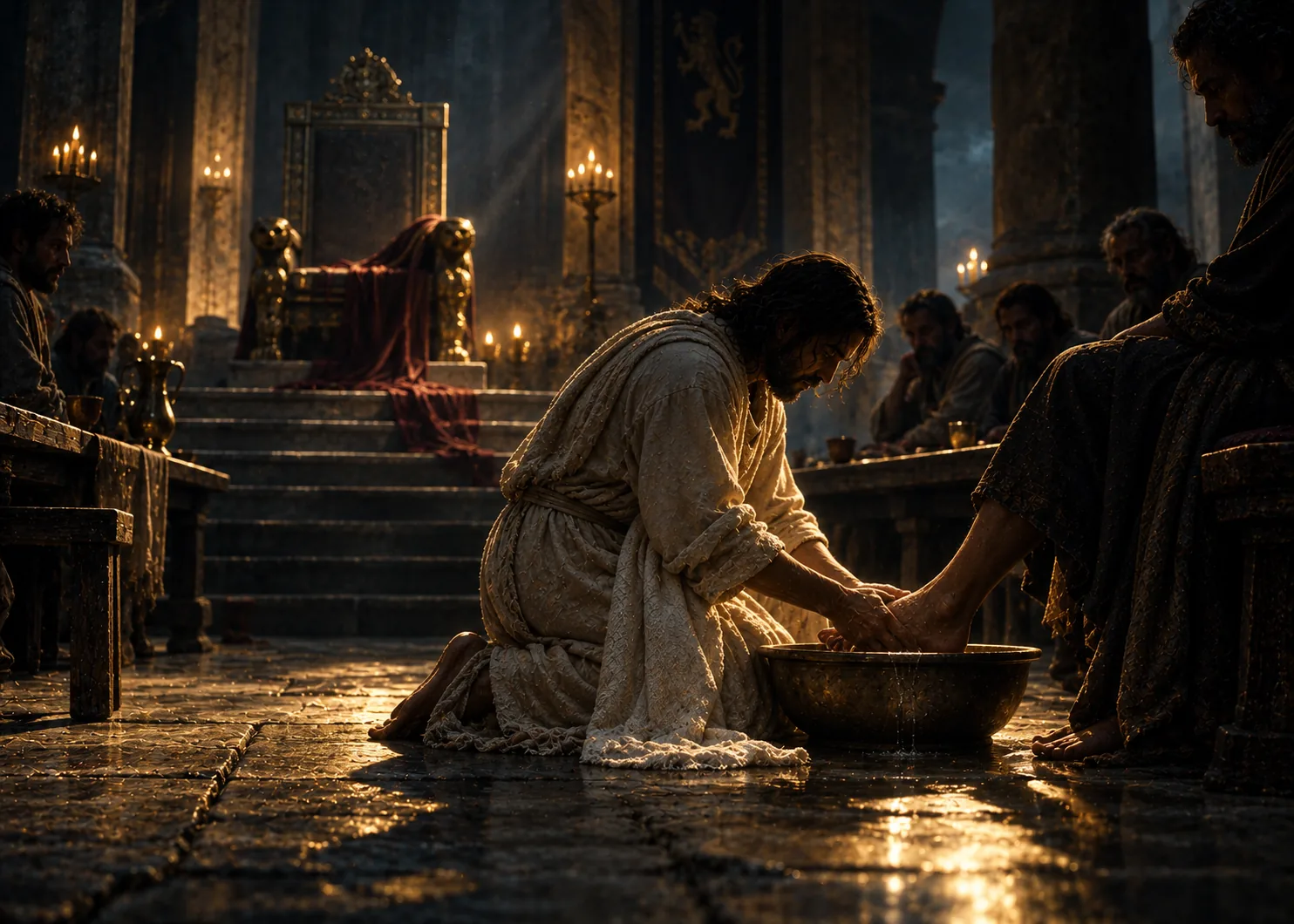
Which leaves the towel.
Jesus knowing that the Father had given all things into His hands, and that He was come from God, and went to God; He riseth from supper, and laid aside His garments; and took a towel, and girded Himself. After that He poureth water into a bason, and began to wash the disciples' feet, and to wipe them with the towel wherewith He was girded.37
All things into His hands. John says it first, so you'll know exactly how much power is in the room. Then a towel. The tradition's answer to great power isn't less of it. It's a basin, and a pair of feet that belong to somebody else, and a man who could have had anything, on the floor. Ye call Me Master and LORD: and ye say well; for so I am.
So am I, over something. So are you. You had the thesis before you started, and it was never from a comic book. It's from a floor. The question this book keeps asking isn't whether you have the power. It's what's in your hands, and whose feet.
Footnotes
-
The line is best known as the moral of Spider-Man's origin story (Amazing Fantasy #15, 1962), where it is a closing caption — with great power there must also come — great responsibility! — and not a line of Uncle Ben's; he was first given it in a 1972 audio drama, and the comics followed in 1987. Older forms of the thought are on record, the earliest usually cited being a decree of the French Committee of Public Safety of May 8, 1793 (une grande responsabilité est la suite inséparable d'un grand pouvoir); the attribution to Voltaire is a misattribution. See the summary at Wikipedia, s.v. With great power comes great responsibility, and the account at Mental Floss. ↩
-
Luke 12:48 (KJV). All scripture here is the King James Version. Deity pronouns are capitalized throughout, including inside quotations; the King James lowercases them, and raising the case changes no word. Where this house's pronoun for God the Father — They/Them — is substituted for the King James's masculine one, the substitution is bracketed so the word reads as mine and not the translators'. The Son's pronouns are He/Him, recased; a human he stays as the King James has it. ↩
-
Luke 12:42–47 (KJV), quoted in pieces. The lord of the parable is a figure and keeps his lowercase. ↩
-
Exodus 21:2 (KJV). ↩
-
Exodus 21:4, 20–21; Leviticus 25:44–46 (KJV). The King James reads they shall be your possession… they shall be your bondmen for ever. Leviticus in the same passage forbids the same treatment of an Israelite (25:39–43), which is not a mitigation: the line the law drew ran between peoples, not around persons. ↩
-
Exodus 21:10–11 (KJV). The three — food, clothing, and her duty of marriage — became in rabbinic law the husband's standing obligations to any wife, and a court could compel a husband who failed in them to release her (Jewish Women's Archive, Divorce: The Halakhic Perspective). David Instone-Brewer reads Exodus 21:10–11 as the ground of those rights and of the neglect ground for divorce: Divorce and Remarriage in the Bible: The Social and Literary Context (Eerdmans, 2002). ↩
-
Exodus 21:26–27 (KJV). ↩
-
Deuteronomy 23:15–16 (KJV). ↩
-
Deuteronomy 24:14–15 (KJV), abridged. ↩
-
Leviticus 25:43 (KJV). The King James spelling rigour is kept as a quotation. ↩
-
Exodus 22:22–23 (KJV), with the stranger at 22:21: for ye were strangers in the land of Egypt. The pronoun is recased. ↩
-
Deuteronomy 15:15 (KJV); the refrain recurs at 24:18 and 24:22, each time as the stated reason for a rule protecting the servant, the stranger, the fatherless, or the widow. ↩
-
Deuteronomy 24:1–2 (KJV). Verses 3–4 forbid the first husband taking her back after a second marriage, whatever else has happened. ↩
-
Under biblical and rabbinic law divorce was the husband's act; a wife could in some circumstances petition a court to compel one, but could not issue it (Jewish Women's Archive, Divorce: The Halakhic Perspective). Roman law by the first century permitted either spouse to end a marriage (Susan Treggiari, Roman Marriage: Iusti Coniuges from the Time of Cicero to the Time of Ulpian, Clarendon, 1991), which is the usual explanation for Mark 10:12; the body says by most accounts because the explanation is the historians' and not the text's. ↩
-
Matthew 19:3 (KJV): Is it lawful for a man to put away his wife for every cause? The two readings of some uncleanness are those attributed to the schools of Shammai and Hillel in the Mishnah (Gittin 9:10 — Shammai: only for unchastity; Hillel: even for spoiling his dish; Rabbi Akiva adds: even for finding another more beautiful), a later record of an earlier debate. Instone-Brewer (above) reads Jesus's answer as a rejection of the any cause divorce specifically. ↩
-
Mark 10:11 (KJV). The parallels at Matthew 19:9 and Luke 16:18 lack against her. ↩
-
Mark 10:12 (KJV). Among the gospels only Mark has the clause. ↩
-
1 Corinthians 7:10–11 (KJV); the wife is addressed before the husband, and the instruction is marked not I, but the Lord. ↩
-
Ephesians 5:22 and 6:5 (KJV); the parallels are Colossians 3:18, 22, and 1 Peter 2:18, 3:1. The verses to servants in Ephesians 6 run longer than the one to masters; the claim here is about what each end is asked, not how much space it gets. ↩
-
Ephesians 5:25, 5:28, and 6:9 (KJV). The King James reads gave himself for it; the pronoun is recased. Colossians 4:1 says the same to masters: give unto your servants that which is just and equal; knowing that ye also have a Master in heaven. ↩
-
1 Peter 3:7 (KJV), abridged. Honour keeps the King James spelling. ↩
-
Genesis 1:26 (KJV), abridged; the verse ends and over every creeping thing that creepeth upon the earth. The grant is repeated at 1:28 and Psalm 8:6. ↩
-
The charge that dominion licensed the exploitation of the earth was put most famously by Lynn White Jr., "The Historical Roots of Our Ecologic Crisis," Science 155, no. 3767 (March 10, 1967): 1203–1207. The reading here — that the dominion is bounded by the image it is given with — is the usual reply and older than the charge. This is not about the earth; it's about the holder. ↩
-
Genesis 3:16 (KJV), the second half of the verse. ↩
-
Romans 14:23 (KJV). ↩
-
Mark 10:42–44 (KJV); Matthew 20:25–27 parallels. Verse 45 follows: For even the Son of man came not to be ministered unto, but to minister, and to give His life a ransom for many. ↩
-
Mark 10:6–9 (KJV). Matthew 19:4–6 is the parallel. ↩
-
Matthew 5:31–32; 19:3–12; Mark 10:2–12; Luke 16:18; 1 Corinthians 7:10–16 (KJV). The one mention of children in any of them, 1 Corinthians 7:14 (else were your children unclean; but now are they holy), concerns the standing of children in a marriage between a believer and an unbeliever, not the ground of permanence. The tradition's own account of what marriage is for — Augustine's three goods, proles, fides, sacramentum (De bono coniugali, c. 401) — makes children one good of three, and never the only one. ↩
-
Ephesians 5:31–32 (KJV). ↩
-
Malachi 2:15 is the one text that ties the one-ness of a marriage to a godly seed, and its Hebrew is obscure enough that the United Bible Societies' translators' handbook calls it perhaps the most difficult verse in the book to translate; the versions differ sharply on what it says. It is a footnote here and not a load. ↩
-
Matthew 5:32 (KJV). ↩
-
Malachi 2:14 and 2:16 (KJV), abridged. The King James gives 2:16 as the LORD, the God of Israel, saith that [They hate] putting away; the bracket marks the house pronoun. God hates divorce is a modern rendering: the Hebrew verb is third person, he hates, and the ESV, which prints the man who does not love his wife but divorces her, notes the Hebrew as who hates and divorces. The verse's text is disputed; the essay leans on 2:14's against whom thou hast dealt treacherously and 2:16's covereth violence, which are not. ↩
-
1 Corinthians 8:9 (KJV). The chapter is about meat offered to idols. ↩
-
Mark 9:42 (KJV), abridged; Matthew 18:6 and Luke 17:2 are the parallels. ↩
-
Luke 12:42 (KJV). ↩
-
Matthew 23:4 (KJV). ↩
-
John 13:3–5 and 13:13 (KJV). The Son's pronouns are recased; bason is the King James spelling. ↩