The Way Home Is Down
The problem was never the ledger. It was the gavel.
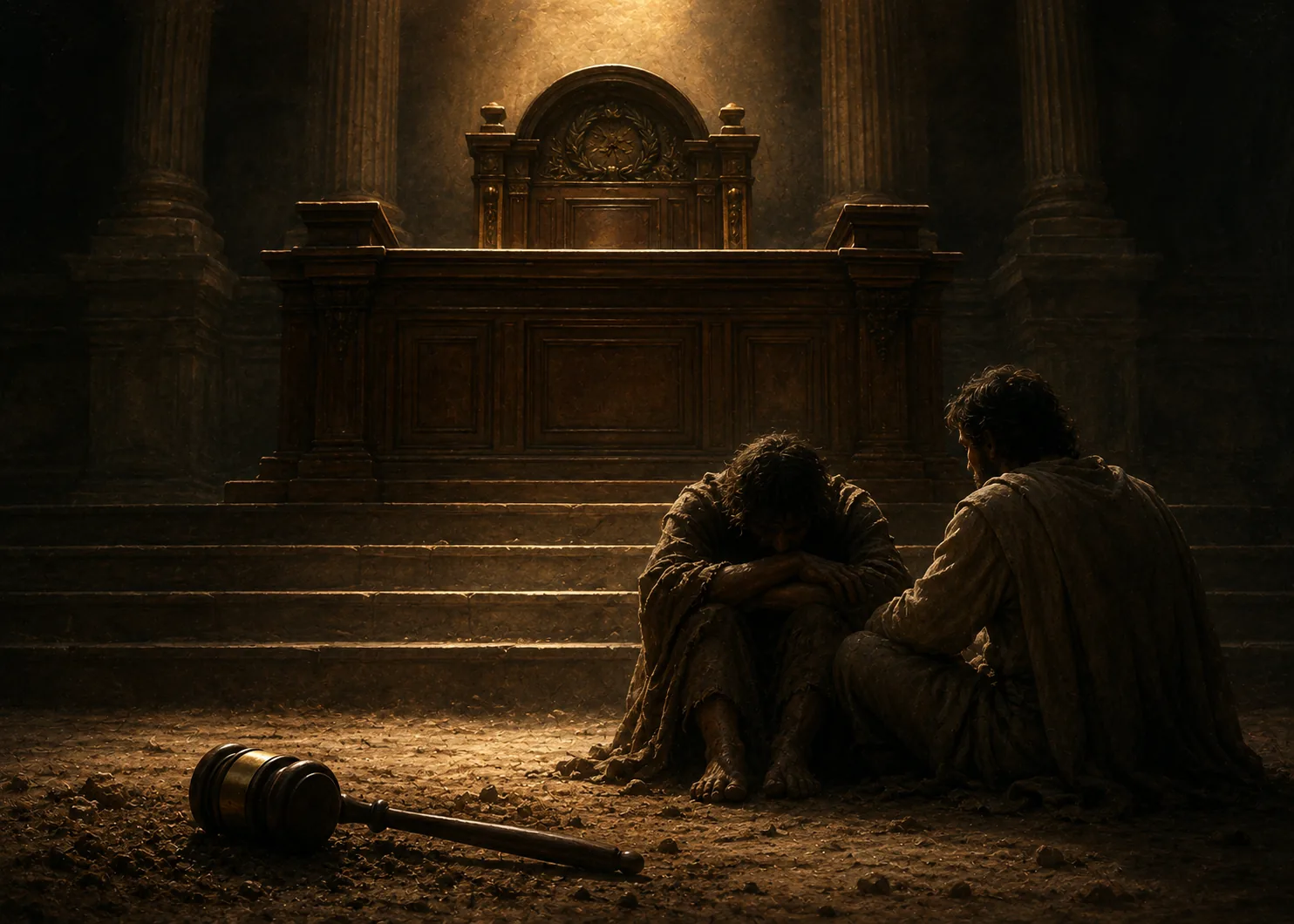
I. The Bench
I have a doctorate in machine learning, and I can tell you the exact sound the world makes when someone who has built a whole life on being smart hits a wall they can't think their way through. It sounds like nothing. It sounds like sitting at a desk, unable to focus, unable to work, with no word for what is happening except a borrowed clinical one: burnout. So I did what a person like me does with a problem. I treated it as an engineering fault. I went to a meditation retreat to strengthen my prefrontal cortex, I actually said, so I could get back to work.
What I found there was not a better prefrontal cortex. It was the bottom of the thing. I had spent my whole life, the degrees, the research, the relentless proving, demonstrating to the world that I was smart, because being smart was how, as a child, I had learned to be loved. The achievement had never been about the work. It was a bill I had been paying for the right to be loved at all.
I start there because it is the cleanest specimen I own of the thing in question, and the thing turns out to be very old.
We are told the trouble started with a piece of fruit, and we are usually told it wrong. The tree in the garden was not the tree of disobedience, and the first sin was not that a rule got broken. Read the name the text gives it: the tree of the knowledge of good and evil.1 Not the tree of wickedness. Not the tree of rebellion. The knowledge of good and evil, the power to divide the world in two and rule on which half is which. What was seized there was a seat. The bench, the gavel, the verdict. To eat was to climb onto a judge's chair that was never ours and take, by grasping, the deciding of good and evil that belonged to Someone else.
The sin was never that verdicts exist, that there are real accounts, that wrongs are done, that some things are truly owed. All of that is real, and much of what follows insists on it. The sin was reaching for the gavel: taking into a private hand the rendering of the verdict. The problem was never the ledger. The problem was the gavel. And the ache the gavel is trying to soothe is never cured by pretending nothing is owed, because that is the same theft, turned inside out.
I was fluent in the gavel. My whole apparatus of achievement was a verdict machine, and it ran on two rails at once. Turned inward, it kept a running judgment on my own worth: smart enough today to deserve loving, or not. Turned outward, it had already ruled on other people, most confidently on the ones I had never met. I was raised in an anti-theist house in an anti-theist city, where the devout were understood to be simple people who needed a comforting story, and I had passed sentence on all of them without a trial. Believers were the ones who weren't strong enough to face a meaningless universe. I was. That was the verdict, and I never suspected it was a verdict. It felt like intelligence.
My claim is that nearly everything that has gone wrong with us runs back to that one seizure, and that the man the tradition says it follows spent His life trying to hand the gavel back. You assume, as I did, that the way home to God is up: up the ladder of being good, of getting the verdict right, of finally being proven to have stood on the correct side. The oldest story says we climbed once already, and fell. The gospel's counter-claim runs the other direction. Not up onto the bench. Down off it, into the dust, next to the one who is suffering, with nothing in your hands. The way home is down. I did not reason my way to that sentence. I was dragged to it, and this is the argument for it I can make now that I'm there.
II. The Grasp
Go back and read what the serpent actually says, because it is not what most of us were taught. The pitch is not break the rule. It is subtler and worse: "ye shall be as gods, knowing good and evil."2 Underneath it is the suggestion that something is being withheld, that the Giver is not generous, that you are on the outside of the gift and will have to reach in and take what you need. That is the lie, and I have come to think it is the only lie there has ever been.
Look at the man it worked on. He had been given an entire world. He was walked with in the cool of the day. Nothing was being kept back from him, and he reached out anyway, which only makes sense if he had already been persuaded he was not loved. A creature convinced it is not loved must grasp, because grasping is the only way left to get anything once you no longer trust that it will be given. Every grasp since has been the same motion: a starving heart trying to seize what can only ever be received.
I know the motion from the inside, which is the only reason I trust the diagnosis. I was the child who learned that love arrives when the report card is good and cools when it isn't, and I grew up unable to stop earning, because producing was the only floor I had ever stood on. My burnout was not a malfunction in the machine. It was the machine running out of the one fuel it had. I had mistaken the bill for the love. Everyone does. That is the fall, and it is not a single event in the deep past.
It is a posture, available every hour, and it does its work by prying you out of the present. The gavel needs a past to arraign and a future in which the sentence is paid, so it can never rest here, where the settling isn't yours to do anyway.3 The account may be entirely real. What cannot happen in the present tense is my picking it up and working it myself. Eden, then, is not a walled garden somewhere behind us in geological time. Eden is presence without adjudication. Not a world with no justice in it, but a world in which I am not the one holding the gavel, because I trust the One who is. The accounts are kept. They are not kept by me.
Which throws a hard light on the strangest detail in the expulsion. God posts cherubim and a flaming sword at the gate, "lest he put forth his hand, and take also of the tree of life, and eat, and live for ever."4 We read that as punishment. Irenaeus, in the second century, read it as mercy, and he was right: the way to the tree of life was barred so that a broken condition would not be made immortal, so that death would set a limit on the wound instead of sealing it in forever.5 Death, on this reading, is not the warden's revenge. It is a quarantine. We were not locked out of joy. We were locked out of making our starvation permanent.
And then, at the center of the tradition's story, the guard comes down. The veil of the temple was woven with cherubim, the same figures set at Eden's gate, and at the crucifixion it is torn, the Gospels are careful to say, "in twain from the top to the bottom": from the God-ward side.6 The sword was not sheathed. It was passed through. The tree it guarded is still standing at the far end of the whole book, and the last time we are shown it, the bar is gone. We will end there.
III. We Love Because We Were First Loved
If the disease is grasping, the cure cannot be a better grip. This is the first place almost every religion I know of takes a wrong turn, by making love a command performed rather than a gift received.
The hinge verse sits one line above the one everyone quotes. Before "God is love," John writes the sentence that makes it operable: "We love [Them], because [They] first loved us." And in the next breath, the test: "If a man say, I love God, and hateth his brother, he is a liar."7 These are one argument, not two. The love is not generated by me. It arrives, and the most I contribute is to fail to stop it, and then it goes out of me toward the person in front of me, and if it does not go out, that is the evidence it never came in. The horizontal is the proof of the vertical, never the payment for it.
You cannot do it by deciding to. That is the part the moralist cannot hear, and I would have told you, before, that I understood it. I did not understand the first thing about it, because you cannot argue your way into being loved, and argument was the only instrument I had. Here is how it happened to me. I was hunting for an apartment on Roosevelt Island on a Thursday, and I passed a small stone chapel, the Chapel of the Good Shepherd, though I did not yet hear the joke God was making with the name, and went in. Nobody was there but a public safety officer in the basement, who told me I could come back Sunday. I did. And somewhere in the singing, they call it worship, for a reason I could not yet have told you, something went straight past the part of me that argues and spoke to a part of me I had spent a career keeping quiet. I had felt the edge of it once before, chanting kirtan years earlier in Santa Monica, the same strange opening of a door I had assumed I'd sealed; that story is in Krishna Is Not Christ, and the week on the island is in Flow. I did not think my way in. I was let in, under the intellect, through a song. The man who lived by being smart was reached by the one road that does not run through being smart at all.
That is the whole reversal. The work is not produce love. The work is stop refusing to receive it, and receiving is not an achievement, it is the opposite of one, and it is the one thing the grasping hand cannot do while it is grasping. Nobody starving can be argued out of stealing bread. They can only be fed. The void the grasp keeps trying to fill, with verdicts, with money, with someone else's approval, with the narcotic of being right, is a void shaped exactly like love, and nothing that is not love will fit it. Fill it, and the hands come open on their own. No quantity of instruction has ever emptied anyone's hands, because instruction was never the thing that was missing.
Two disciplines keep this from curdling into an excuse. It is not a diagnosis to aim at other people: they are cruel because they were unloved is a theory of another person's interior that lets me feel wise while consulting no one, so the lens turns only inward, onto my own posture. And it does not exonerate, least of all me. The wound explains the grasp. It does not excuse it. Sometimes I am not a starving man who reached but a well-fed man who chose, and knew, and did it anyway. The turn the gospel asks for, metanoia, is a turn of the will, not only the opening of a mouth to be fed. Being fed is half of it. Turning is the other half, and it costs something real.
There is one way this whole picture could still be gamed, and it was my own first instinct. If I love in order to come home, if I make love the coin I pay for my admission, then I have climbed back onto the bench and written my own verdict: acquitted, admitted, home. Which is why it had to be love that serves as the criterion, and nothing else. You can perform belief, doctrine, ritual, and correct opinion, and be credited for all of them. You cannot perform love as a means to an end and have it remain love; it curdles into calculation the instant it is aimed at a payoff. The Accuser knew the exact spot to press. Doth Job fear God for nought?8 Strip a man of everything, and find out whether the love was ever love, or only the price he had been quietly paying for the life he got to keep.
IV. The Friends, and the Seven Days
There is one book in the canon entirely about a man on trial for nothing, and the friends who could not bear to let him be. If you have read the book of Job as the story of three villains, you have missed the most frightening thing in it, which is that the friends are us, at our most sincere and most religious. I know them from both sides now. I spent years being the confident explainer myself, only my system filed believers under comforting story, and the certainty felt exactly the same.
The friends begin by doing the single most right thing anyone does in the entire book. They come, and they sit down with him on the ground, and for seven days and seven nights they say nothing at all, "for they saw that his grief was very great."9 Nobody in scripture does better than that. That silence was Eden: presence without adjudication, the gavel laid down. They lost it the instant they opened their mouths, because the moment they spoke they began, on their friend's ruined body, to know good and evil.
What they build across the three cycles of speeches is impeccably orthodox. God is just; the just prosper and the wicked suffer; your suffering is therefore evidence of your sin, so confess it. They did not invent this. It is the plain covenant arithmetic of Deuteronomy and much of Proverbs, and the book of Job exists, in large part, to say that it is false.10 Scripture is arguing with itself across these pages, out loud, and the book of Job has already chosen a side. The friends' sin is not cruelty; cruelty is the symptom. Their sin is that they possessed a system which made all suffering intelligible, and when a man turned up whom the system could not account for, they defended the system by falsifying the man, until at the last Eliphaz simply invents crimes for Job to have committed: thou hast taken a pledge from thy brother for nought, and stripped the naked of their clothing… thou hast sent widows away empty.11 There is no evidence for any of it. The theory required it, so he supplied it. They loved their explanation more than they loved their friend. They picked up the gavel to rescue the ledger, and it is always in that order.
Then comes the verdict that ought to stop cold anyone who builds arguments about God, including me. When God finally speaks out of the whirlwind, the anger falls not on Job but on the friends: "ye have not spoken of me the thing that is right, as my servant Job hath."12 Consider who that vindicates. Job, who has spent the whole book accusing God of hunting him like a lion, cursing the day of his birth, demanding a court date. That is what God calls speaking rightly. The friends, who said only decorous and pious things, God calls liars. Whatever else the ending means, it means at least this: God does not want to be defended with lies about the suffering of the innocent.
There is an old distinction that names why. The Ignatian examen separates two interior movements it calls consolation and desolation, and its insight is that neither is the same as pleasure or pain. Consolation is the movement outward, toward God, toward the neighbor, toward the open, and a person can be square in the middle of it while weeping. Desolation is the turn inward: the closing, the curling, the reach for the gavel.13 On that reckoning Job on the ash heap is in consolation; his whole cry is flung outward, God-ward, refusing to let go. Eliphaz, comfortable, correct, well fed, defending God with a lie, is in desolation. Which is why a victim's fury hurled at heaven can be the most God-ward thing in the room, and the serene theological defense of God the farthest from it.
Any argument, then, including this one, that codes rage and grief and accusation as a failure of love would have expelled Job and canonized his friends. The survivor's rage is Job's rage, and God has already ruled on it. What that leaves us with, when the suffering in front of us is not ours and we did not cause it and cannot interpret it, is no explanation at all. It leaves presence: the ground, and the seven days, and the mouth kept shut.
V. The Cry
So the way back cannot be the way up. Adam grasped upward, at equality with God, and fell. The hymn Paul quotes to the Philippians says the second Adam did the exact reverse: He "thought it not robbery to be equal with God," did not clutch it, "but made himself of no reputation" and went down.14 The direction is the whole doctrine. The way back is not ascent. It is descent, and it is not a lovely abstraction to me. To even consider that the gospel might be true was the most humbling thing that has happened to me. Everything I was raised to be, the smart one, the strong one, the one who did not need a comforting story, had to be walked down off its bench before I could hear a word of it. Jesus finding me was not the summit of my thinking. It was the surrender of the part of me that had always won by thinking. It felt, precisely, like losing.
Which runs us into the hardest problem this argument has to face. Job insists the innocent are not guilty and that suffering is not a verdict. The cross appears to say that an innocent one suffers for the guilty. Left there, it is a transaction sitting at the dead center of a case I have been building against transaction. If the cross is God collecting a debt of pain from a substitute, then the gavel is not overthrown at all; it has been relocated to Golgotha and handed a bigger docket.
Listen to what the man on the cross actually cries: "My God, my God, why hast Thou forsaken me?"15 That is Job's line. It is the accusation, the demand, the cursing of the day, and now it is in the mouth of God. The whirlwind never did answer Job's question. Here God answers it, not with an argument but by climbing inside it. This is not a payment God requires from someone else; it is a cost God absorbs. Not the ledger balanced by a formula, but the ledger picked up and carried down into the dark by the very One to whom the debt was owed. God did not, in the end, explain the suffering of the innocent. God came and did it.
There is a story people tell about that kind of coming down. It is not from scripture, and probably from no real courtroom, one of those tales that survive because they carry something true. A king sets a penalty for theft from his treasury: forty lashes, a count no back is meant to survive. A thief is taken in the vault, and the day of the sentence comes, and the whole court assembles to watch the law keep its word. They lead the prisoner out, bare the back, bind the wrists, bend her over the post, and it is his daughter. The king sits his throne while they make her ready, the court watching to see whether his own law will bend for his own blood. He grants no pardon. He lets them read the full count aloud. The man with the whip sets his feet and draws back his arm, and at the last instant the king says: wait. He comes down from the throne, crosses the floor, and lays the length of his own body over hers, his back to the sky. Then, quietly: begin.
You can bend that back into the very thing it refutes, so watch the shape. It is not a quota of pain that had to be wrung out of someone before mercy could be allowed; that is the ledger running the universe again, with God promoted to chief clerk. The king was not paying a fee his own law charged him. He was doing the one thing love does when the sentence is real and it falls on the beloved: he got underneath it. The innocent one takes the blow not because justice demanded a substitute, but because love would not leave the guilty one alone in the dark. The account is not waved off. It is not collected, either. It is carried, on the body of the one who never owed it.
And see what that carrying frees. If the debts of this whole grasping world have been gathered onto one innocent body and borne, then I am no longer the one left to collect mine. He took it all up, the tradition says, so that we could forgive one another: the account between me and the person who wronged me is no longer mine to settle, because it has already been carried to the one place accounts are actually answered. That is the load-bearing move of the Christian claim. Not the ledger abolished, the injured are not erased and the wrong is not called nothing, but the ledger answered, at a cost I did not pay, which turns out to be the only thing that ever lets a clenched hand come open.
If the story stopped at the cross it would be Holy Saturday forever. A God who climbs down into the forsakenness and stays there has proven only a love willing to drown alongside us. The resurrection is the refusal of the drowning: the one who went all the way down was raised, and the grave did not get the last word. Put the ledger down, it is being carried is a lovely sentiment with nothing under it, unless the One carrying it walked out of the tomb. Easter is the guarantor of the whole sentence. So the kingdom is here, present, refused hourly, and it is coming, not as a wage I earned or a schedule I am owed but as the answer to the oldest question in the book. That tension is not a problem to be solved. It is the shape of living in the meantime.
VI. The Sheep Did Not Have the Theory
If the way home is down and not up, then the people who arrive will not, as a rule, be the ones who understood the map. Jesus says this outright, and it is one of the most quietly disorienting things He said. In the only extended scene He gives of the last judgment, the criterion is not the completeness of anyone's theology. It is a plate of food. I was an hungred, and ye gave Me meat.16
Watch the detail that gives the parable away: the ones welcomed in have no idea what they have done. LORD, when saw we Thee an hungred, and fed Thee? They are surprised — not about Whom they are addressing, which they name in the same breath, but about where He turned out to have been. They had love to give and gave it, never guessing it was Him in the cell, and it does not count against them in the slightest, because love, it turns out, is not a doctrine you affirm but a thing that reached you and came back out of you as soup. The King is not stationed at the gate collecting passwords. He is in the neighbor, and the sentence lands with no as if in it: inasmuch as ye have done it unto one of the least of these… ye have done it unto Me.17
I have a particular reason to find this the most humbling scene in the Gospels, and to trust it anyway. I was the man with the complete theory. I had the metaphysics, the arguments, the whole confident apparatus for sorting what was real from what was a comforting story, and it did not save me. It could not even find the exit. What reached me was not an argument I finally lost. It was beauty, and a song, coming in under the intelligence I had spent my life sharpening, past every defense the theory had built. So, against my own interest as someone who writes theological essays: a person who cannot read and carries soup to a sick neighbor has arrived exactly where I, with the complete and correct metaphysics, had not. Right seeing does not save. That does not make right seeing worthless, or I would not be writing these thousands of words, but it dethrones it. Trust, in the only sense that finally matters, is fidelity to a Person, not the possession of an accurate theory, and the sheep were bound to the hungry One and never guessed where He had gone. Fidelity is not the same thing as being right. It is the thing being right was always supposed to be in service of.
One move in the scene forecloses the obvious abuse of it, the reading where I say fine, then I will feed people and be admitted. The sheep are surprised. Nobody keeping their own score is among them. The moment you are feeding the hungry in order to be counted as one of the sheep, you have stopped being one. And when a lawyer asked who is my neighbour, the answer was a story in which the respectable religious men cross to the far side of the road and the help comes from a despised outsider with, by the lawyer's lights, the wrong theology entirely.18 The neighbor is the person you would not have chosen. And the command is not merely love your neighbor but love your enemies, which is not an appendix to the ethic but its stress test.19 A love only ever tried on people I already like is preference wearing the mask of a principle, and if the thing does not hold under maximum load, it does not hold.
VII. The Account That Is Not Mine
Everything so far could be turned into a weapon. An argument whose only named sin is judging too harshly is a toy, and worse than a toy, because it can be turned against the one person who most needs it kept out of the wrong hands. So this part is about atrocity, and about the survivor. Nothing in my own comfortable story earns me the right to be casual here.
Atrocity is the grasp in its terminal form. The torturer sits maximally on the seat Eden was about: the torturer has decided that this person is available, that their pain does not signify, that a verdict may be written directly onto a human body. And yes, I have argued all essay that a grasp of that kind is a starving heart doing what the void makes people do, and I hold to it. But hear the next sentence, because everything else rests on it. It explains the torturer. It does not excuse the torturer, and it does not lay the smallest obligation on the person the torturer destroyed. I know how the rest of this can be used, they were hurt too, can't you find some compassion, and the answer, on behalf of the one who was harmed, is no. Not from the survivor. Not on anyone's timeline but the survivor's own, and possibly not in this life at all.
Here is the thing it is most tempting to flee. The account is real, and the reality of it is not first of all a threat to the guilty. It is a mercy to the wronged. Take the ledger as the book it is. There is a page with the survivor's name at the top, and under it an entry for what was done to them, in the hand of Someone who saw it. That entry is the only place in the universe where the thing that happened is written down as having happened. Tear out the page to spare the guilty, and you have not comforted the survivor. You have erased them. This is the exact inverse of what the softer versions of grace suppose. If nothing was ever owed, nothing was really done. The only reason the martyrs' cry how long? is a coherent demand and not a delusion is that the book exists, and will be answered.20 To take the ledger away in order to spare myself the sight of my own name in it is to lift the murdered out of it in the same motion.
Which is why forgiveness, properly understood, does not dissolve the ledger; it needs it. You cannot release a debt that is not there. A "forgiveness" that says it was nothing is not mercy. It is denial with better manners, and it is an insult to what was done. This is the whole of Bonhoeffer's distinction between grace that is cheap and grace that is costly: cheap grace pretends the account away; costly grace leaves it entirely intact, real, named, terrible, and carries it.21 The debt is not annulled. It is borne.
Three disciplines keep that from sliding into an instrument of abuse, and each one is scriptural. Naming the harm is required: God rebukes the friends by name out of the whirlwind, the prophets do almost nothing else, and Jesus overturns the tables in the temple court. To refuse to name a wrong is Eliphaz inverted, falsifying reality to protect a theory of niceness. Resisting the harm is required: love of neighbor means putting your body between the wolf and the one being eaten, and enemy-love has never meant handing your neighbor over to be devoured. And the final verdict on a soul is not mine: Vengeance is mine; I will repay, saith the LORD.22 Read that not as a threat but as a restraining order with a promise folded inside it: put it down; it was never yours to carry; it is real, and it is being carried toward an answer by the One to whom it belongs. That is the entire difference between letting go and looking away. Looking away says the wound was never there. Letting go says the wound is real and is held, by hands more just than mine, moving toward a settlement I do not have to author and cannot schedule. Only the second is possible for someone who actually saw what happened.
One thing here will not resolve, and I am not going to pretend it does. Jesus does bind the forgiver: forgive us our debts, as we forgive our debtors, and the servant who would not forgive is handed to the tormentors.23 He means it, and He means it about me and my debtors. What He never does is hand that command to a bystander to lay on a stranger's neck. That His word falls hard on the unforgiving is true; that it is never mine to press onto a survivor is also true; both at once. Ivan Karamazov, refusing every theodicy, insists that a mother has no right to forgive her child's torturer on the child's behalf, and about that he is simply right: forgiveness can be extended only by the one who was harmed.24 It can be asked of me regarding my own debts. It can never be scheduled for someone else, and some of it will go to the grave unspoken. When Simon Wiesenthal was brought to the bedside of a dying SS soldier begging a Jew's absolution, he listened, and then he walked out in silence, and spent the rest of his life asking others what they would have done.25 That silence is the honest shape of this, and I am not going to improve on it.
VIII. The Objection, Named Before You Raise It
By now you have an objection, and it is a good one. I can make it in my own former voice, because for most of my life I was the objector. This is exactly the comforting story I always said it was. A smart, unhappy man hit a wall, went looking for relief, found a beautiful building and some moving music, and reasoned himself into the belief that would make him feel held. Of course the way home is "down" and "receiving" and "you were loved all along"; that is what a person in pain wants to hear. You have not discovered anything. You have been consoled, and dressed the consolation up in Job and Bonhoeffer.
I take the force of that completely, because I would have written it, and meant it, and thought myself brave for it. Two things to say back, and neither is a knockout, because knockouts are what the gavel deals in.
The first is that the objection proves too much. "You believe it because it comforts you" explains away any belief held by anyone who is not miserable, but it works just as well in reverse. I disbelieved it because that comforted me: it flattered me as the strong one, the one who did not need the story, and there is no vanity quite like the vanity of the disillusioned. If we are going to discount conclusions by the comfort they provide, my atheism has to go on the scale too, and it was carrying more of my ego than my faith ever has. The motive behind a belief is not evidence about whether the belief is true. It never was. That is the genetic fallacy, and I used to deploy it in only one direction.
The second objection I care about more, because it is not about me. It is the mirror image of Part VII. This is spiritual bypass with better footnotes. "It's all carried, let it go" is precisely what abusers and the institutions that shield them have always told the people they harmed. Grant it, because the abuse is real and common. But everything in Part VII was built to make this misuse impossible from the inside. A grace that requires the harm to be named, that requires the wolf to be resisted, that hands the verdict to God precisely because the account is real and will be answered, and that reserves forgiveness to the one who was harmed, on no one else's schedule: that is the opposite of bypass. Bypass says the wound was nothing. This says the wound is everything, and is held.
A related worry: that putting the gavel down means making no judgments at all, a mush that cannot tell Bonhoeffer from the regime that hanged him. It does not. Discernment reads an act: this is cruelty, that is a lie, this arrangement is grinding people up, and love then requires me to name it and stand against it. The gavel renders the final verdict on a person, files a human being whole onto the far side of a line marked evil so that I may stop owing them anything. It is the person who has stopped needing to damn the sinner who becomes free to name the sin without flinching, because they no longer have a self to defend in the naming. What is forbidden is not judgment. It is the seizure of a verdict that was never ours, on a soul whose case is not before our court.
Here is the test I am asking you to hold me to, since I am asking you to trust an argument made by a man with an obvious motive to believe it: any use of these ideas that makes it easier to hurry a survivor, to hush a victim, or to spare a perpetrator the naming of what was done has inverted the argument into its enemy. If you can turn any of this into a muzzle, I have written it badly, and I would rather know.
IX. The Yard, and the City
Jesus ends one of His own stories in a yard, at night, with the party going on inside and a man refusing to come in. There are two ways to stand outside the feast, and holding them apart is the last thing this argument has to get right.
You know the shape of the parable. A younger son takes his share, wastes it, comes to himself in a far country, and turns for home rehearsing a confession he never gets to finish, because the father sees him "a great way off" and runs.26 The welcome was never withdrawn and it is entirely unconditional, and still the boy had to get up out of the pigsty and walk the road. Welcome is not the same as arrival. The door being open is not the same as walking through it.
But it is the older brother I cannot stop looking at, because he was me for most of my life. He never left. He was welcome the entire time. And there he is at the very end of the story, standing out in the dark, refusing to go in: these many years do I serve thee, neither transgressed I at any time thy commandment, and yet thou never gavest me a kid.27 Look at what he is clutching: a grievance, itemized, kept warm, over a goat. He would rather be owed than forgiven, because to be forgiven he would have to admit a debt of his own, and a man who keeps the books on everyone else cannot bear to become a debtor himself. The grudge is the yard. He is Eliphaz with a father. He is Adam listening to the serpent inside a garden that was already given to him.
Everything depends here on holding two figures apart who can look, from a distance, like the same figure. The self-exclusion of the older brother is real, and it is first person only. It is the man nursing a slight over a goat. It is never the one who cannot forgive an atrocity. Both may be standing outside the lit house; only the first can be told, by himself and no one else, that he is doing it to himself. For the second, forgiveness is the interior release of a real debt, on their own clock or never, not reconciliation, not proximity, not a deadline anyone else is permitted to set, and the father is out in the yard pleading with them too, in their own time. Not forgiving keeps me out of the feast is a true and searching sentence about me and my goats. It is a millstone the moment it is hung on the neck of someone who was destroyed.
And notice that the father comes out. In the middle of his own feast, with the music already playing, he leaves the table and walks into the dark and pleads with the son to come in, which is the thing God has been doing since the garden, and which the cross was, and which has not stopped. I have felt the pleading from the inside now, and it has rearranged how I sit with other people. I am in a small group of men who meet and talk about the things breaking us, and the deepest change grace has worked in me so far is an almost boringly practical one. When a friend is suffering I no longer reach for the fix. I don't diagnose the sin under their trouble the way Eliphaz would, and I don't hand them a system. I tell them something true from my own life, I offer the only things I actually have, come work beside me for an afternoon; come with me to this yoga class, and then I leave it with them. They are loved whether they take the invitation or not, and the loving was never mine to make conditional. That is the whole of what I know how to do now. It is the father in the yard, scaled down to a Tuesday.
The parable does not tell us whether the older brother ever goes inside. Luke lays down the pen with the father still out there in the dark, talking. Leave it unfinished, because the unfinishedness is the truest thing in it: the door open, the feast loud, the welcome total, the father pleading, and a man entirely able to stand there with his arms crossed, running the numbers, until the music stops.
Until the music stops. That is the not yet, quietly present in the gentlest thing the gospel ever says.28 The welcome is now; the door is open now; and there is a when past which the yard is only the yard. It is mercy, not menace. A coming when is frightening only to the one determined to keep standing outside.
For the shape of that when, the tradition reserves its strangest book, and Revelation resolves the whole argument rather than betraying it. The book that looks most like a ledger maximal, the great white throne, the books opened, every deed tallied, is not an audit at all. It is resistance literature, written to people being fed to animals for refusing to call Caesar lord, and its engine is not the judge's gavel but the martyrs under the altar crying how long?29 The entire book is the answer to that cry. The account they died holding is not erased. It is answered. And look where the answer happens: God does not haul the redeemed up to a courtroom in the sky. The new Jerusalem comes down: "Behold, the tabernacle of God is with men, and [They] will dwell with them."30 In the last vision it is God who makes the descent, all the way, to live with us.
And the tree returns. Barred at the beginning by the flaming sword, guarded lest a broken thing be made immortal, it stands now in the middle of the city, unbarred, "and the leaves of the tree were for the healing of the nations."31 The quarantine is lifted. The wound death was mercifully keeping from becoming permanent is not, in the end, sealed in forever; it is healed. The sword that passed through on the cross is gone from the door. You may eat. Even the ledger comes doubled at the last, and the doubling is the tenderest thing in the book: there is a book of deeds, and beside it "the book of life," which tallies nothing and holds only names, and it is the second book, the one that keeps no accounts at all, that decides. Grace, it turns out, keeps its own books, and they are books of names.32
The reframe under all of this, anti-gavel, not anti-ledger, is exactly the kind of idea to distrust, because it clicks into place a little too well, and resonance is not the same thing as truth. So the seams stay visible: the account is real, against the wish to abolish it; it is not mine, against the reflex to seize the bench; it is neither denied nor scheduled. And a former atheist testifying to his own rescue is not evidence you should take on trust. So don't. The argument needs readers who will fight it, someone who knows the Hebrew, someone who has suffered in ways I have not and can say where it goes thin. And if any part of it ever helps me explain another person's suffering to them, I have broken it, and I would rather it be broken and known to be broken than intact and quietly cruel.
The measure was never whether the argument is elegant, or even whether it is correct in every joint. The measure is whether it makes me kinder at four in the afternoon on an ordinary Tuesday, to someone who is difficult. If it does not do that, it is a better-built chair for Eliphaz to sit in. I was a long time on that bench, ruling on my own worth and everyone else's, certain that the way up was the way home. It was the other direction the whole time. Off the bench, into the dust, next to your friend, with nothing in your hands. When the city finally comes, it comes down too.
I told you at the start what the wall sounds like. It sounds like nothing. So does the way home.
Footnotes
-
Genesis 2:9, 2:17. The reading of the fall as the birth of a judging, divided consciousness — rather than first as the arrival of moral guilt — runs through the contemplative tradition; it is developed in the companion essay The Knowledge of Good and Evil. Offered as a reading, not as the scholarly consensus on Genesis 3, which centers on disobedience and its consequences. ↩
-
Genesis 3:5. ↩
-
The link between adjudication and time — that the judging self must live in a remembered past and an anticipated future, and so can never be present — leans on the classic definition of eternity as interminabilis vitae tota simul et perfecta possessio, "the whole and perfect possession of unending life all at once" (Boethius, Consolation of Philosophy V.6). God's life is the present tense; the gavel's is not. ↩
-
Genesis 3:22–24. ↩
-
Irenaeus, Against Heresies III.23.6 — the barring of the tree so that the human being would not remain a sinner forever, with death setting a bound to sin. (Locus to be confirmed against the text.) ↩
-
Matthew 27:51; Mark 15:38. The veil "wrought with cherubims": Exodus 26:31. The reading of the tear as from the God-ward side is interpretive — the texts specify "from the top" — and is offered as such. ↩
-
1 John 4:19–20 (KJV: "We love him, because he first loved us"). On the house pronoun for God, see the note at Part IX. ↩
-
Job 1:9. ↩
-
Job 2:13. ↩
-
The retributive scheme — the righteous prosper, the wicked suffer — as covenant logic: e.g. Deuteronomy 28; Proverbs 11–13. The book of Job (and much of Ecclesiastes) is the canon's own dissent from it. ↩
-
Job 22:6–9 (Eliphaz's invented charges). ↩
-
Job 42:7. ↩
-
Ignatius of Loyola, Spiritual Exercises — the Rules for the Discernment of Spirits. The point pressed here is Ignatius's own: the two movements are distinguished by direction, not by comfort. ↩
-
Philippians 2:6–8. The Greek harpagmos — a thing to be grasped, seized, held onto by force — sets the deliberate contrast with Adam's grasp at Genesis 3:5; the "emptying" is kenosis (2:7). ↩
-
Matthew 27:46, quoting Psalm 22:1. ↩
-
Matthew 25:35 (the sheep and the goats, 25:31–46). ↩
-
Matthew 25:40. ↩
-
Luke 10:29–37 (the good Samaritan, answering "who is my neighbour?"). ↩
-
Matthew 5:44. ↩
-
Revelation 6:9–10 — at the opening of the fifth seal, "the souls of them that were slain for the word of God" cry "with a loud voice… How long, O Lord, holy and true, dost Thou not judge and avenge our blood on them that dwell on the earth?" The persecuted dead demanding the account be settled. (Cited again in the Revelation passage at Part IX.) ↩
-
Dietrich Bonhoeffer, The Cost of Discipleship (1937), ch. 1 ("Costly Grace") — cheap grace as "the preaching of forgiveness without requiring repentance… grace without the cross"; costly grace "because it costs a man his life." ↩
-
Romans 12:19, quoting Deuteronomy 32:35. ↩
-
Matthew 6:12; the unforgiving servant, Matthew 18:23–35. ↩
-
Fyodor Dostoevsky, The Brothers Karamazov (1880), "Rebellion" — Ivan's refusal of a harmony purchased by a tortured child's suffering, and his insistence that no one has the right to forgive on the sufferer's behalf. ↩
-
Simon Wiesenthal, The Sunflower: On the Possibilities and Limits of Forgiveness (1969) — the dying SS man, Wiesenthal's silence, and the symposium of replies he later solicited. ↩
-
Luke 15:20 (the parable of the prodigal son, 15:11–32). ↩
-
Luke 15:29. ↩
-
"The gentlest thing the gospel ever says" is the essay's characterization of the parable of the prodigal son (Luke 15:11–32), not a quotation. The music is in the text: the elder son, coming in from the field, "heard musick and dancing" (Luke 15:25), and the father "came out, and intreated him" (15:28). "Until the music stops" extends that scene — reading the feast's music as the now whose implied end is the not yet. ↩
-
Revelation 6:9–10 (the martyrs under the altar: "How long, O Lord…"). ↩
-
Revelation 21:2–3 (the new Jerusalem "coming down from God out of heaven"). ↩
-
Revelation 22:2 (the tree of life, "and the leaves of the tree were for the healing of the nations"). ↩
-
Revelation 20:12 (the books opened, and "the book of life"); 21:27 (only those written in "the Lamb's book of life"). The house pronoun for God in the Being Good essays is They/Them (capitalized), never he/him/it; Jesus the Son takes He (capitalized in reverence), and His own Me keeps that capital inside quoted scripture, a casing convention and not a change of wording; the LORD is set in capitals wherever it names God, own prose and quoted scripture alike, while a footnote that records the source keeps the King James's Lord; and the figures inside a parable — the father, the sons, the king — keep the lowercase pronouns of their own story. ↩