They/Them
The Pronoun as Iconoclasm
I. The Picture No One Chose
Close your eyes and picture God.
Something arrived. A face, or the sense of a face; an age, a bearing, a color of the light. Now the harder question: where did that come from? You didn't sit down one afternoon and choose it. Nobody handed you a menu. The picture was already there when you went looking — waiting behind your eyes, installed before you were old enough to consent.
Twenty-six centuries ago Xenophanes noticed the same thing. The Ethiopians, he said, make their gods dark and flat-nosed; the Thracians make theirs gray-eyed and red-haired; and if oxen and horses had hands and could draw, their gods would come out looking like oxen and horses.1 That's older than the argument I want to have with you. It's the ground the argument stands on. What Xenophanes saw is that the image of God tracks the one doing the imagining, and never the other way around.
Which leaves something uncomfortable on the table. We may not worship what we say we worship. We say the Nameless, the Infinite, the One beyond all form — and then we bow to the picture the mind supplies, and the mind supplies whatever the culture set down in it first. The confession and the idol fit in the same breath. Usually they do.
Two pictures in particular, because they're the two great divides of our common life, and each of them runs back to an image of God.
The first is a pronoun. He. Him. His. A word absorbed so completely it no longer sounds like a claim — it sounds like grammar, the neutral setting, the way you refer to God when you aren't trying to say anything at all. That invisibility isn't innocence. It's how a claim survives: by ceasing to look like one.
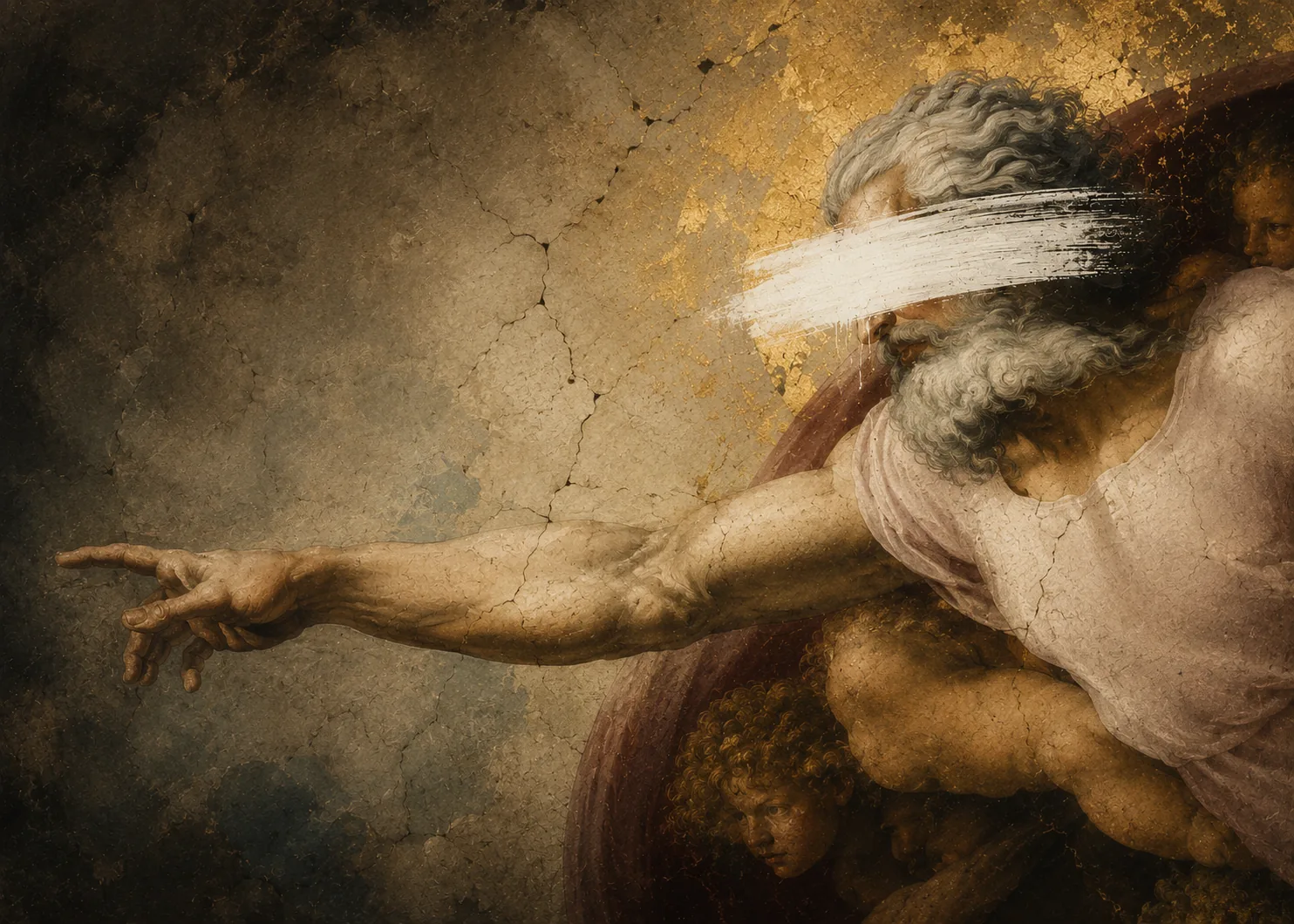
The second is a face. Not Christ's — and the difference is the hinge of the whole case. The face of God: an old man with a white beard, muscled, reaching out a finger, on a chapel ceiling in Rome. You have seen it a thousand times. It is on posters and mugs and phone screens and in the corner of ads that assume you will get the joke. That picture is what arrives, for most of us, when someone says the word. It has a history. It has a date. Somebody painted it.
Neither picture was revealed. Each was installed. What follows is the story of how — and of the older law, buried in the tradition's own foundation, that told us not to hang either one.
II. The Law It Breaks
Everything here is the tradition's own, because the case against the picture in your head isn't a modern complaint in scriptural costume. It's the tradition's oldest law, and we've broken it so long that keeping it now sounds like the heresy.
Start at Horeb. Moses reminds the people what they did not see: "You saw no form of any kind on the day the LORD spoke to you out of the fire." Therefore, he says, do not corrupt yourselves by making an idol in any form — and then the text specifies the form it fears first: "the likeness of male or female."2 Read that again. The commandment against images doesn't merely ban statues. It names gendered form as the danger, by name, ahead of every other. The shape you're most tempted to give God — a male figure, a female figure — is the first shape forbidden.
Then the name. At the burning bush Moses asks who is sending him and gets, instead of a name, a sentence: Ehyeh asher ehyeh. Translators have labored over it for two thousand years — "I AM WHO I AM," "I WILL BE WHAT I WILL BE" — because the verb is imperfect, unfinished, a being that hasn't stopped happening.3 It's the strangest possible answer to what shall I call you. A noun is a handle; this is a verb pulling its hand back. Whatever Moses carried down the mountain, it was built not to harden into a thing.
And Genesis 1:27, the verse everyone assumes they know. In the image of God the human is made; "male and female [They] created them."4 Whatever the image of God is, the sentence says it takes both to show it. Which makes any single image — the Father, the bearded king, the old man on the ceiling reaching out his finger — not merely incomplete but a truncation of what the verse plainly requires: half the evidence, framed and hung, the other half left in the dark.
Now the hard witness. Maimonides — the Rambam, as central a mind as the Jewish tradition has — didn't treat the picture in the head as a harmless aid to devotion. He treated it as the idol. Every positive thing you say of God, he argued, is already an error; only the negations hold — not that God is wise but that God is not ignorant, not that God is powerful but that God lacks no power. Say what God is and you have said something false. Then he goes past caution into judgment: a person who believes God has a body doesn't hold a merely mistaken idea of God — they have no God at all.5 Sit with the severity of that. That isn't a mystic on the margin whispering it. It's the tradition's own center, ruling that the God you can picture is not God.
He was neither first nor alone; the current runs the whole length. Gregory of Nyssa read Moses on the mountain and marked where the ascent ends — not in light but in a dark cloud, the true knowledge of God arriving as the surrender of seeing.6 Pseudo-Dionysius pressed past even that: God is beyond assertion and beyond denial, above every name we grant and every name we strip away.7 Meister Eckhart compressed it into four words that shouldn't have survived the censors — "I pray God to rid me of God" — the concept, the handle, the picture, cleared away so that what is actually God can arrive.8 And Paul Tillich, in our own century, named the mechanism flatly: a symbol points beyond itself to the holy, but it always tends to install itself in the place of what it points to, and so every symbol must eventually be broken, or it becomes the idol.9
That's the tradition, not a faction of it. And here's where it leaves us. Idolatry isn't a foreign practice belonging to other people — the Canaanites and their poles, whoever it is we've decided we stand above. It's the default operation of a mind that wants something to hold. The commandment at Horeb was never really about sculpture. It was about the picture that assembles itself behind your eyes the moment you close them — the one you met a page ago, before you had chosen anything at all.
III. What Got Installed, and Whose Interests It Served
A false picture might still be harmless. These two weren't. An image of God does work in the world, and the way to see the work is to stop asking whether the picture is accurate and start asking whom it served.
The masculine
Mary Daly said it in one line: "If God is male, then the male is God."10 Not that anyone teaches this on purpose. It teaches itself, silently, to a child who learns the word for God and the word for the head of the house in the same pronoun, and never afterward quite pulls them apart.
You're about to say that this is too neat, and you're right. Removing the feminine from God did not cause patriarchy. Assyria, Greece and Egypt all kept commanding goddesses — Ishtar, Athena, Isis — and were as thoroughly patriarchal as anything the ancient world built.11 The consoling story of a peaceful prehistoric matriarchy overthrown by sky-god invaders, the one associated with Marija Gimbutas, isn't where the archaeology now stands, and an argument that leans on it goes down with it.
So here's the smaller claim, and it's the one that holds. An exclusively male God doesn't invent male rule. It legitimates it. It takes an arrangement that could have been argued about and lifts it clean out of the reach of argument — no longer this culture's preference but the order of things, stamped at the top.
The white
The argument everyone reaches for is about the wrong figure.
The familiar version goes: the historical Jesus was a Palestinian Jew, the Israelites weren't Europeans, therefore the blond Christ is a lie about a brown man. All of that is true. And all of it concedes the ground. Modern racial categories don't map cleanly onto the Iron Age Levant, and the moment the fight is about the pigment of a first-century body, you have agreed that God has a pigment to argue about.
God doesn't, and this is the whole hinge. Christ is God poured into the finite — the infinite cast into one human life with nothing added. That life had an address, a language, a body, a face. You can ask what color that face was, and the question is a real one with a real answer, because a finite thing has finite properties. But God is not finite. God has no face to get wrong. So a painting of Christ is a picture of the projection, and it is answerable to history; a painting of God is a picture of nothing anyone has seen, and it is answerable to the second commandment.
Which is why the ceiling is the scandal and the Sunday-school Jesus is only the symptom. We argue about the color of Christ's skin because He had skin. In that argument, nobody asks about the beard.
Cone had already refused it. James Cone said God is black, and meant it ontologically, not descriptively. God, in the biblical witness, is bound up with the condition of the oppressed; in a society that made blackness itself the mark of who may be despised, God stands with the despised, and is therefore black.12 You can't answer that with a skull measurement. Its whole power is that it was never a claim about pigment — it's a claim about where God is found, and archaeology has no jurisdiction over it.
Now watch the mechanism, because the Son's face is where you can see it working in daylight. For three centuries the images are unremarkable: at Dura-Europos and in the Roman catacombs, Christ is a beardless young man in ordinary Roman dress, barely distinguishable from the figures around Him.13 The fair-haired, light-eyed Christ is a later Northern European arrival, which Northern Europe, unsurprisingly, made in its own likeness. Then Warner Sallman painted a Head of Christ in 1940, and it was reproduced more than half a billion times. It went into wallets. It was hung in nurseries, in Sunday-school halls, in courtrooms.14 Half a billion isn't a number you can picture, so take the smaller one: it hung in enough nurseries and Sunday-school halls that children who had never heard Sallman's name drew his Christ. No council argued for that face. No doctrine required it. It was painted, printed, shipped and hung — and then it went invisible, which is the condition under which an installed image does its quietest and most lasting work.
The ceiling is the same machine, four centuries earlier and one story up. Michelangelo did it to God. He gave the Unpicturable a body — an old man, white, bearded, muscled like a laborer — and put him where nobody could look away, and the copies did the rest. Sallman had a face to work from and a Gospel that says one existed. Michelangelo had nothing to work from at all. He painted the being the tradition's own law says has no likeness, and we have been picturing God in Michelangelo's image ever since, without once being asked whether we agreed.
One clarification keeps Cone honest and keeps him inside the law of Part II. "God is black" isn't a new portrait hung where the white one came down — that would be idolatry with the palette reversed. It's a hammer, swung at the white portrait, and it lands only because it's intolerable to a mind that had quietly installed whiteness as the neutral, unmarked, default face of God. Make that mind flinch and you've shown it the picture it didn't know it was holding. Cone built the move on Tillich's account of the symbol — the one that must be broken before it swallows what it points to — so the iconoclasm is his own, not something imported to defang him.15
IV. Hagar
Everything so far has been the law and its breaking — the argument in the head. Here it takes a body. Hers.
She enters Genesis as property with a nationality: Hagar the Egyptian, slave of Sarai, handed to Abram to produce the child Sarai could not — her body used to solve someone else's problem, then resented for having solved it.16 Pregnant and despised, she runs. And there, in the wilderness with nothing, the thing happens that the tradition has never quite known what to do with.
She names God.
An angel finds her at a spring, and Hagar answers by giving God a name of her own: El Roi, the God who sees me.17 Stay on how strange that is. In the whole of the Torah, every name of God is received — disclosed to Abraham, given to Moses at the bush, handed down. Hagar doesn't receive a name. She confers one. The single human being in the five books who looks at God and says here is what I will call you is an enslaved Egyptian woman, alone, at the bottom of every hierarchy the story keeps — nation, class, gender, condition. Everyone else is told. She tells.
If a replacement portrait were wanted, here's where it would hang: God as the One who sees the used and the thrown-away, named by the least of them. It's true, and it's beautiful. But the text won't let it stay beautiful, and the next verse is the reason.
Because the same messenger who meets her tells her to go back. Return to Sarai, the verse says, and submit to her.18 Back to the woman who was breaking her. There's no deliverance here. Hagar is seen — and Hagar is sent home to endure.
Delores Williams built a whole theology by refusing to look away from that verse. The dominant reading of the Bible is a story of exodus: God breaks the chains, God brings the people out. Williams noticed that this isn't what happens to Hagar, and isn't what has happened to a great many women who stand where Hagar stood. What she receives in the wilderness isn't rescue. It's survival, and sight, and a well of water that lets her last one more day in a life no one is coming to fix.19 That, Williams says, is the God many people have actually met — not the One who shatters the arrangement, but the One who finds you inside it and keeps you breathing.
Set that beside Cone and it won't resolve, and it shouldn't. Cone's God liberates, takes the side of the oppressed and moves to break the bondage. Williams' God, in Hagar's wilderness, doesn't break it; God meets her there and sends her back into it. If you know both, you can feel the two grind against each other. Leave the grinding audible. Even the God of the oppressed does not always act the way our theology would prefer. Flattening that into one tidy doctrine would be its own small act of using her — making Hagar say the thing we need said.
And the tradition has form there. Centuries on, Paul reaches back for Hagar and turns her into an allegory: she is the slave woman, the flesh, the covenant that does not inherit, set against Sarah the free woman and the promise — cast out the slave and her son.20 The one human being who named God is rewritten as the figure for everything to be discarded. It's the whole pattern compressed into a single reversal — the seer set down as the cast-out — and it happened to her inside the canon itself.
V. The Shulamite and the Translator's Confession
There's a woman in the Song of Songs who describes herself in three Hebrew words, and the history of how those words have been translated is a confession the translators didn't know they were making.
She says: Sheḥorah ani ve-na'vah. The Hebrew isn't hard. Sheḥorah, dark; ani, I am; ve-na'vah, and lovely. The vav is the plainest particle in the language, the ordinary "and." Dark am I, and lovely. But open most English Bibles and you find "I am black but comely," "dark but beautiful" — the and quietly turned into a but.21 Hebrew can carry an adversative in that particle where the context demands one; nothing here demands one. The translator decided that it did. Something in him felt that darkness and beauty needed a conjunction that apologized for holding the two together, and he reached for one that wasn't on the page.
Now the concession. In the very next verse she explains the color: the sun has looked on her because her brothers set her to keep the vineyards, and her own she could not keep.22 It's sunburn from forced labor — a mark of class before it's anything about race, and reading her through a modern racial lens is an anachronism. Grant every bit of that. The argument was never that the Shulamite was a Black woman in our sense. Concede the point whole, and then look at what's still standing.
What's still standing is the but. The correction explains her darkness; it doesn't explain the translators. Whatever the sun had to do with it, generations of learned men read a woman calling herself dark and lovely and felt, by reflex, that the two words required a concession between them — that dark was a debt lovely had to make good. That reflex is nowhere in the text. It was in the reader, and it left its fingerprints on the page, one small adversative at a time, for centuries. The mistranslation is the evidence. The bias signed its name.
Then the turn. The Song of Songs didn't earn its place in the canon as an erotic poem. Both traditions that carried it, Jewish and Christian, read it allegorically — the lover and the beloved as God and Israel, as Christ and the Church, as God and the yearning human soul.23 Which means the tradition took this woman — dark, laboring, sunburnt, speaking her own desire without a word of apology — and made her voice the very pattern of the soul in love with God. Her dark and lovely, and I want him became a template for centuries of mystical writing about the ache toward God. The tradition set her at the center of its most intimate picture of loving God — and then spent those same centuries putting a but in her mouth she had never said.
VI. Ruach, and the Gender Lost in Transit
If the masculine God were simply revealed — handed down from the top rather than assembled from below — then the tradition's language for God would have been masculine from the start and stayed there. It wasn't, and it didn't. There's a feminine at the headwaters, and you can watch it disappear. Not refuted. Lost, in transit, to grammar.
Begin with the Spirit. Ruach — the breath, the wind of God that moves over the face of the waters in the second verse of Genesis — is a feminine noun in Hebrew. And the verb bound to her is gentler than most translations admit. She is merachefet over the waters: hovering, brooding. The word is nearly unique; it surfaces almost nowhere else, and the one clear echo is in Deuteronomy 32, of an eagle brooding over her nest, stirring above her young.24 The first image of the Spirit of God in the Bible is a mother bird over the deep.
Then follow the word out of Hebrew and watch the gender fall away at each border. In Aramaic, ruḥa, still feminine. Rendered into Greek, the Spirit becomes pneuma — neuter. Carried into Latin, spiritus — masculine. No council convened to degender the Spirit; nobody argued her out of her femininity. She simply passed through three languages, and the grammar of each did what its grammar does, until a feminine breath at the opening of Genesis had become, by the time it reached the Latin West that would set the terms for a thousand years, a masculine He. The change has a mechanism, and the mechanism is translation.
Where the grammar didn't force the change, the femininity survived long enough to be seen. Early Syriac Christianity, writing in a Semitic tongue that kept ruḥa feminine, kept the Spirit a she — not as inert grammar but in warm, deliberate imagery. Aphrahat writes of the Spirit as mother. The Odes of Solomon picture the breasts of the Father, milked by the Holy Spirit. A fragment of the Gospel of the Hebrews, preserved by Origen and Jerome, has Jesus speak of "my mother, the Holy Spirit."25 Syntax doesn't oblige anyone to imagine nursing. They read the feminine theologically, because it was there to read. Only around the fifth century does Syriac usage drift toward the masculine, under the pressure of the Greek and Latin churches around it.
The reply is that grammatical gender isn't theological gender. It isn't, and the objection is a good one. French tables are feminine and nobody thinks tables are women; that ruach is a feminine noun doesn't, on its own, make the Spirit female. Granted, and it costs the argument nothing, because the Syriac writers plainly weren't resting on grammar. They reached past the noun into imagery — mother, breasts, nursing — that no syntax requires. They read her feminine because they received her that way. The grammar is only how we can still make out the trail.
And the trail proves the single thing this part needs to prove. The masculine God wasn't simply revealed and received. He was assembled. There was a feminine at the source — in the Spirit, and beyond her: in rachamim, the word for compassion, built from rechem, the womb; in the passages where God cries out like a woman in labor and comforts like a mother nursing.26 The default we inherited has a history, a mechanism, and a date. That's a fact about the packaging, not about God.
One discipline before we leave her. The obvious move now would be to restore the Spirit as the feminine person of the Trinity — to answer the masculine God with a divine She, at last. Don't. Two masculine persons and one feminine doesn't correct the imbalance; it encodes it, and it seats the feminine in the one person of the three with the least agency — the one who proceeds, who is sent, who is given. That isn't a rescue. It's the old arrangement handing out a consolation prize. Elizabeth Johnson saw the trap and stepped around it: rather than gendering one person female, she brought Sophia — Wisdom, grammatically feminine — to bear on all three, Father, Son and Spirit alike.27
Every clause of that holds, and the whole of it rests on one word. Two. Two masculine persons, and a feminine third that can only arrive as the exception to them. The trap needs a masculine default for the feminine to depart from; take the default away and there's nothing left for it to close on. That default comes apart in the parts that follow, and once it's gone the arithmetic is different. I follow that out where it belongs, in A Mother Bird Over the Deep: the Spirit's pronoun in this publication is She — not a promotion, not a rescue, just the last door standing open after the others shut.
So the refusal holds exactly as long as its condition does. What Ruach settles here isn't that we've found the girl. It's that the masculine was built — which is the fact that turns every pronoun after it into a decision instead of an inheritance.
VII. Hammers, Not Portraits
You have a complaint by now, and it's a good one, so I'll make it before you do.
Part II laid down the law: no images, not in the form of male or female; the God you can picture is not God. And then I spent three parts handing you pictures. An enslaved woman who sees God and is seen. A dark bride whose desire becomes the soul's. A mother-Spirit brooding over the water. If the whole argument was that we must stop making God in an image, what were the last three parts but a gallery of new ones — and more flattering ones, better tuned to the people likely to be reading this?
They were never offered as portraits. Hagar, the Shulamite and Ruach aren't a replacement face to hang where the old one came down. They're hammers, each swung at the same wall. Their work isn't to be believed as the true likeness; it's to break the monopoly of the false one — to crowd the frame until no single image can pass itself off as the whole of God.
And here's the part that's easy to miss: the multiplication isn't a retreat from Part II. It's Part II carried out by other means. A tradition that holds one image of God holds an idol. A tradition that holds many incompatible ones — a king and a slave woman, a bridegroom and a laboring mother, a father and a brooding bird — holds something nearer to none, because no one of them can harden into the thing you bow down to. Too many faces is a way of having no face. The crowd of images is itself a form of the way of unknowing.
Which is exactly the condition a certain word was built for.
VIII. They/Them
Here's where you stop trusting me — because here's where it can begin to sound like the culture's argument about pronouns wearing a robe. Everything the conclusion needs is already in the first chapter of Genesis, in plain sight, sitting in the grammar.
Start with the name. The most common word for God in the Hebrew Bible — used thousands of times, the word at the head of the whole story, In the beginning, Elohim created — is grammatically plural. Not a plural of many gods; the same scripture thunders that the LORD is one. A plural form bound to a singular meaning, held together without apology for three thousand years.
And at the hinge it speaks as a plural. When God resolves to make the human, the sentence goes into the first person plural: Na'aseh adam betzalmenu — "let us make humanity in our image."28 Us. Our. Read it as a plural of majesty if you like, or as God in deliberation — grant the cautious reading in full; the form is still plural, in the mouth of God, in the first chapter, before there's a single reader to offend. And the likeness that comes out the far side of that sentence is, we've already seen, itself two: male and female. A plural form, speaking of Themselves in the plural, and making an image that isn't one thing either.
Now set that beside a fact about English so ordinary you've used it three times today without noticing. When you don't know, or don't want to fix, the gender of a single person — someone left their umbrella; ask whoever is at the door what they want — you reach without a thought for they. A word plural in form, taking singular agreement, doing the work of a singular you cannot or will not pin to a gender. English, entirely on its own, built a pronoun that's plural in form and singular in reference. Elohim is plural in form and singular in reference. Two languages, three thousand years apart, reached the same solution to the same problem. The pronoun the tradition has needed all along is one the language already made.
And before you reach for the easiest objection — that singular they is some invention of the last decade — it's been in continuous English use since the fourteenth century. It's in Chaucer. It's in Shakespeare. It's in Austen.29 Whatever singular they is, it isn't new.
God is not male. They never were. They are the One Xenophanes' oxen could not draw, the no-form seen at Horeb, the verb that refused to harden into a noun, the source that called Themselves us before They had made anything at all. They are what Hagar saw and named. They are the One the dark bride wanted. They are the One whose Spirit brooded over the water like a mother bird. And when we say They, we aren't swelling God into a committee — we're refusing to shrink Them into a face.
Watch what that one pronoun keeps that its rivals let fall. She would only trade one portrait for another, a fresh picture hung in the empty frame, answering the question by choosing a different gender — which is answering it wrong. They refuses the question. It carries multiplicity without ever resolving it into a single likeness. It is, if you want it in a line, the second commandment rendered as a pronoun. And it holds on to what this argument can't afford to lose: it keeps Cone, because They are not a bland everyone but also and especially the disregarded; and it keeps Daly without inverting her — the point was never that God should be female, only that He was never the neutral He pretended to be.
The objections are real, and each has an answer.
That it sounds like polytheism. Elohim has been plural for three thousand years and the Shema still says the LORD is one. Plurality of form has never threatened the oneness of God in Hebrew. It threatens it only in a mind that has quietly confused a picture with a person.
That it's awkward — in the hymn, the prayer, the creed. It is. So was every translation that ever moved a familiar word; so was thee when it was strange. And here the awkwardness isn't the cost but the point. A pronoun that catches slightly in the mouth is a pronoun that can't go invisible — and invisibility, we've seen, is precisely how the old one did its damage.
That it imports today's politics into an ancient faith. Reverse the charge. He/Him imported politics too — the politics of the fourth century, and the sixteenth, and the twentieth — and then covered its tracks so completely that a choice came to feel like grammar. They adds no politics. It makes the old one visible again, which is a different and more honest thing.
That it makes God impersonal — a force, a fog, an it. No. It makes God unpicturable, which isn't the same thing, and Maimonides drew that line eight centuries back. You can be seen, known, loved and answered by One you cannot draw. That is not less than a person. It is more.
One word to my Christian readers before the close, because you hold a doctrine that has been waiting for this pronoun. You already confess a God who is three and one, mutually indwelling — perichoresis, the persons flowing through one another without collapsing into one or splitting into three. Orthodoxy has always insisted on a singular He there, afraid a plural pronoun would tip the confession into three gods. But the fear mistakes its own grammar. Hebrew has wrapped a plural form around a single God since the first verse of Genesis and never threatened the oneness. If Elohim can be plural and one, so can the God you meet as three. They was always the more orthodox word. We were only afraid of it.
IX. Close
So: close your eyes and picture God.
Something still arrives. The mind can't help it; it reaches for a face the way a hand reaches for a rail. But if the last few thousand words have done their work, the picture won't hold still now. The bearded king slides toward the mother bird, the mother bird toward the enslaved woman at the spring, and not one of them will agree to be the whole of it. That flicker — where no single image is allowed to close — isn't the loss of God. It's the nearest thing to seeing Them clearly on this side of the dark cloud.
Let one picture cut across the blur before it settles, because it shouldn't settle gently. Jacquelyn Grant, standing where Cone stood, took the step past him: Christ, met in the lives of Black women, is a Black woman.30 Not will be — is. Not a prophecy you could arrange yourself to await, but a claim about the present that leaves you nowhere to stand and wait. It runs on the logic of Matthew 25, where the King says He was the hungry one, the imprisoned one, the stranger, and the sin named is simply the failure to recognize Him in them. If that's true, the face nobody can quite picture is a face we walk past and don't know — and the not-knowing is the whole of the judgment. Set that beside Hagar, and leave it there.
I'm not asking you to worship a new thing. There's no new God at the end of this, no better portrait to hang where the old one hung. The argument was only ever the one thing: the picture was never the thing. He was never neutral, the pale face was never innocent, and the two great divisions we're still bleeding over — who counts as a man's equal, who counts as fully a person — ran downstream of a face somebody painted on a ceiling at the top of everything and then, over centuries, sank out of sight enough to pass for the truth.
So the practical part is small, and hard the way small true things tend to be. Change the words. In the prayer, the reading, the hymn, the blessing over the table, let the pronoun be They — not because it's comfortable, it won't be, but because the discomfort is the instrument. A word that catches in the mouth can't slip back into being invisible, and it'll keep catching until the picture behind it has loosened its grip. We say They until the old face lets go.
And then we don't rush to hang another. The second commandment was never asking us to find the right image. It was asking us to bear the empty frame — to let the wall stay bare, and to call the bareness holy. That's what They holds open where He and She both close it.
So open them.
Not a picture. Room.
Footnotes
-
Xenophanes of Colophon, 6th c. BCE — fragments DK 21B15–16. ↩
-
Deuteronomy 4:15-16; verse 16 is the King James, verse 15 in my own rendering. ↩
-
Exodus 3:14. The verb is hayah in the imperfect aspect — action unbounded, unfinished — which is why the tenses in translation refuse to settle. ↩
-
Genesis 1:27. A note on the scripture in this essay: two house conventions are applied throughout, and this is the only place they are announced. Where a pronoun for God is substituted for the source's, it appears in brackets — [They] here for the King James's he. And LORD is set in capitals wherever the word names God; the King James lowercases the pronouns and reserves the capitals for the divine Name. Changing a pronoun's case alters no word. The footnotes give the source wording unaltered. ↩
-
Maimonides, Guide of the Perplexed I.35-36 and I.50-60 (the doctrine of negative attributes); Mishneh Torah, Hilchot Teshuvah 3:7 (one who conceives God as corporeal). Raavad (R. Abraham ben David), glossing that ruling, objected that "greater and better" figures had held corporeal views — conceding, even in dissent, the force of the point rather than its ease. ↩
-
Gregory of Nyssa, The Life of Moses — the ascent into the gnophos, the divine darkness. ↩
-
Pseudo-Dionysius, The Mystical Theology. ↩
-
Meister Eckhart, Sermon 52 ("Beati pauperes spiritu"). ↩
-
Paul Tillich, Dynamics of Faith — on the symbol that participates in what it points to, and must die to keep from replacing it. ↩
-
Mary Daly, Beyond God the Father (1973). ↩
-
On goddess worship coexisting with entrenched patriarchy, see Tikva Frymer-Kensky, In the Wake of the Goddesses (1992). The "Old Europe" matriarchy thesis (Marija Gimbutas) is not accepted by the current archaeological mainstream. ↩
-
James H. Cone, A Black Theology of Liberation (1970); cf. God of the Oppressed (1975). ↩
-
The Dura-Europos house church (c. 240s CE) and the Roman catacomb frescoes; see Edward J. Blum and Paul Harvey, The Color of Christ (2012). ↩
-
Warner Sallman, Head of Christ (1940) — reproduced, by its publisher's count, more than 500 million times (higher estimates run past a billion by century's end). On its reproduction and institutional reach, David Morgan, Icons of American Protestantism: The Art of Warner Sallman (1996); Blum and Harvey, The Color of Christ (2012). ↩
-
James H. Cone, A Black Theology of Liberation (Philadelphia: Lippincott, 1970), 27, in the chapter "The Content of Theology": Black Theology, he writes, takes seriously Paul Tillich's description of the symbolic nature of all theological speech, and blackness is on that account "an ontological symbol" as well as a visible reality. He separates the two senses at 32, n. 5 — a physiological trait, and a symbol for everyone who shares in the liberation of the oppressed. On the Tillich side, Systematic Theology vol. 1 and Dynamics of Faith. ↩
-
Genesis 16:1-6. ↩
-
Genesis 16:13. El Roi — "God who sees me," or "God of seeing." Hagar is the one person in the Torah to confer a name on God rather than receive one — elsewhere the divine names are given, not coined. Cf. Wil Gafney, Womanist Midrash (2017), and Phyllis Trible, Texts of Terror (1984), ch. 1. ↩
-
Genesis 16:9. ↩
-
Delores S. Williams, Sisters in the Wilderness (1993) — the wilderness / survival-and-quality-of-life tradition set against the exodus / liberation reading. ↩
-
Galatians 4:21-31 (the allegory of the two women; the citation of Genesis 21:10 at 4:30). ↩
-
Song of Songs 1:5. E.g. KJV, "I am black, but comely"; the conjunctive vav of ve-na'vah is not adversative. ↩
-
Song of Songs 1:6. ↩
-
The allegorical readings: in Jewish tradition the Song as God and Israel (Rabbi Akiva's defense of its holiness; the Targum); in Christian tradition as Christ and the Church, or the soul, from Origen onward. ↩
-
Genesis 1:2; the verb r-ḥ-f (merachefet). The root appears only a few times in the Hebrew Bible; its one clear parallel in the hovering / brooding sense is Deuteronomy 32:11, the eagle over its young. ↩
-
On the feminine Spirit in early Syriac Christianity — Aphrahat, Demonstrations 18; the Odes of Solomon 19; the Gospel of the Hebrews fragment in Origen, Commentary on John 2.12 (and Jerome) — see Sebastian Brock, "The Holy Spirit as Feminine in Early Syriac Literature." Syriac usage shifts masculine c. 5th century. ↩
-
Rachamim (compassion) from rechem (womb); the maternal imagery for God at Isaiah 42:14 (crying out as a woman in labor), 49:15 (a nursing mother), 66:13 (a mother comforting her child). ↩
-
Elizabeth A. Johnson, She Who Is (1992) — Sophia-language applied across all three persons rather than seating the feminine in one. ↩
-
Genesis 1:26 (na'aseh adam betzalmenu). On Elohim as a plural form carrying singular meaning, and the deliberative/"plural of majesty" readings of the first-person plural in 1:26. ↩
-
Singular they is attested in continuous English use from the 14th century — through Chaucer, Shakespeare, and Austen; see the Oxford English Dictionary, s.v. "they," on the singular use. ↩
-
Jacquelyn Grant, White Women's Christ and Black Women's Jesus (1989). ↩