What Your Hands Have Earned
One account per soul, male or female — and every rule the book gives about women is spoken to a man.
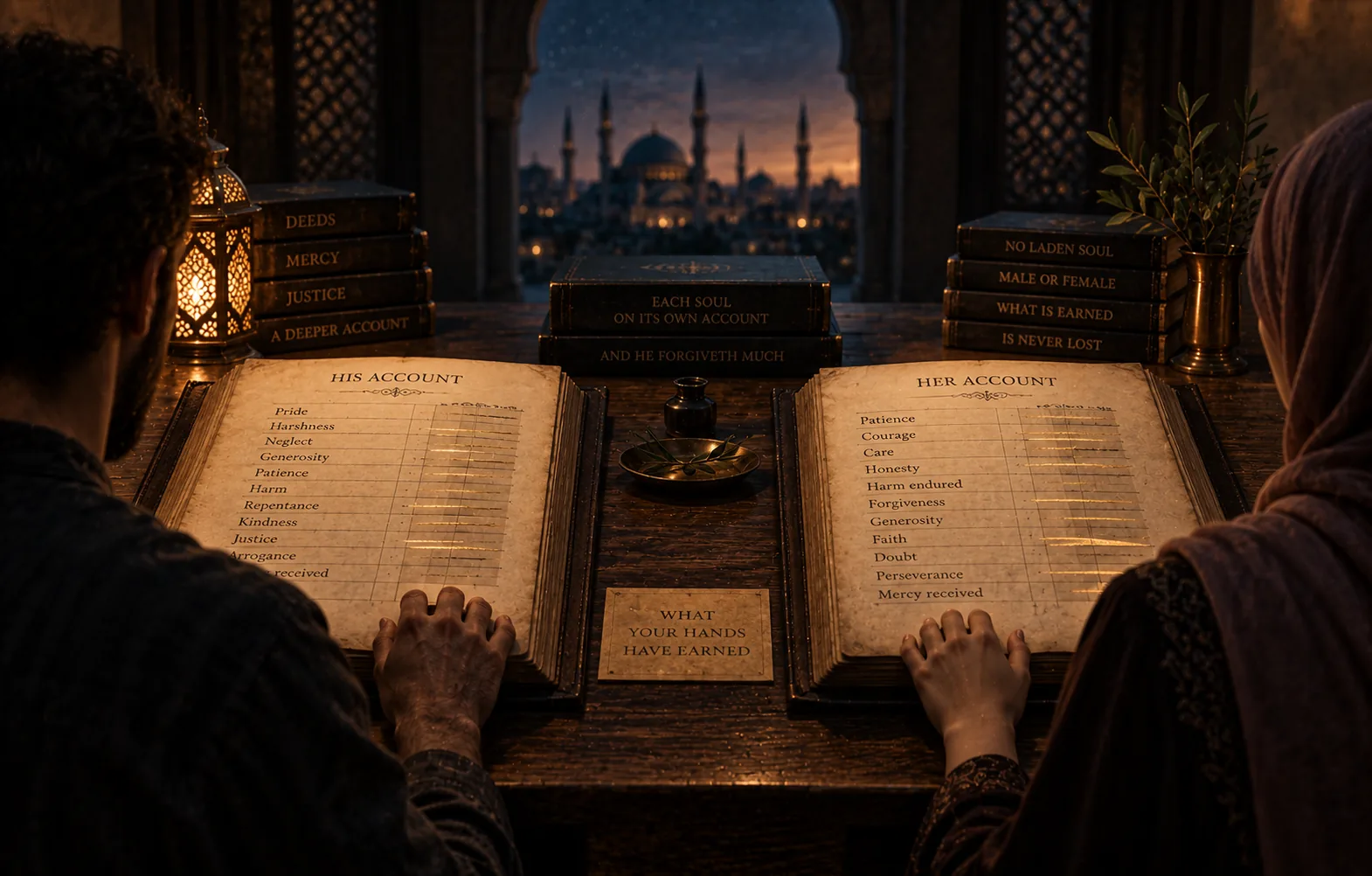
I. The Word Is Earn
Somebody told you that you reap what you sow, and they probably said it as a warning. It's Paul's, from the letter to the Galatians: Be not deceived; God is not mocked: for whatsoever a man soweth, that shall he also reap.1 Karma is what the Sanskrit traditions call the same intuition, and it has crossed into English so completely that people who've never opened a sutra use it for a parking ticket. The intuition is that the world keeps books, and that the books balance.
The Qur'an has it too, and the verb it uses isn't sow. It's earn.
Whatever of misfortune striketh you, it is what your right hands have earned. And He forgiveth much.2
Earned is Pickthall's word, and the book reaches for it constantly. Then every soul will be paid in full that which it hath earned, and they will not be wronged.3 Each soul earneth only on its own account.4 Every soul is a pledge for its own deeds.5 And at the smallest scale the book can name:
And whoso doeth good an atom's weight will see it then, / And whoso doeth ill an atom's weight will see it then.6
So far that's karma with a different accent. One account per soul, nothing lost, everything paid. If you stopped there you'd have what people mean when they call Islam a religion of justice, and you'd be right as far as you'd gone.
But read the second half of the verse I started with. And He forgiveth much. That clause does something karma can't do.
Karma, in the version that crossed into English, is a law. Nobody administers it; it has no face and no discretion, which is exactly its appeal to a certain kind of mind: the books balance, and there's no one to plead with. The Qur'an's account has someone keeping it, and the Keeper isn't bound by the books. Whoso bringeth a good deed will receive tenfold the like thereof, while whoso bringeth an ill-deed will be awarded but the like thereof.7 Ten for one on the good side, one for one on the bad. That isn't a balanced book. It's a thumb on the scale, and the book says whose thumb. Despair not of the mercy of Allah, Who forgiveth all sins.8 And a line karma has no equivalent for: of those who repent and do right, Allah will change their evil deeds to good deeds.9 Karma can't do that. Karma can only wait for you to work it off.
Two other things separate it. There's no rebirth in it: one life, one Day, on which mankind will be shown their deeds.10 And there's no transfer. No laden soul can bear another's load.11 The book says that five times, in nearly the same words, and it means it in every direction — nobody inherits your debt, and nobody pays it for you.12 I follow Jesus, and I'm not going to pretend that sentence doesn't close a door the cross walks through. It does, and the Qur'an closes the same door from the other side, by saying the crucifixion never happened.13 But watch what the sentence does inside the book, because it turns out to be the hinge of everything it says about women.
No transfer means no proxy. What your hands earned is yours, and nobody else's hands count for you.
II. Male or Female
Now the part that doesn't get quoted at parking tickets.
The Qur'an says, more than once and in so many words, that the account is kept the same way for both sexes. Whosoever doeth right, whether male or female, and is a believer, him verily we shall quicken with good life.14 And whoso doeth good works, whether of male or female, and he (or she) is a believer, such will enter paradise and they will not be wronged the dint in a date-stone.15 And in the third surah, God answering a prayer: Lo! I suffer not the work of any worker, male or female, to be lost. Ye proceed one from another.16
Ye proceed one from another. Hold that next to the verse the surah on women opens with:
O mankind! Be careful of your duty to your Lord Who created you from a single soul and from it created its mate and from them twain hath spread abroad a multitude of men and women.17
A single soul, and from it its mate. No rib. And when the Qur'an tells the story of the tree, no serpent goes to the woman first — in one telling the whisper is to Adam by name — they twain ate thereof, and the verb of disobedience is given to the man: And Adam disobeyed his Lord, so went astray.18 What Genesis says next — thy desire shall be to thy husband, and he shall rule over thee19 — the Qur'an doesn't say. There's no sentence like it in the book.20 No curse falls on the woman after the fall, because there's no fall of that shape to hang it on.
Then there's the verse that reads like a ledger drawn up so the point can't be missed — ten pairs, each side stated:
Lo! men who surrender unto Allah, and women who surrender, and men who believe and women who believe, and men who obey and women who obey, and men who speak the truth and women who speak the truth… — Allah hath prepared for them forgiveness and a vast reward.21
And the one that closes the loop back to the first section, because it uses the same verb:
Unto men a fortune from that which they have earned, and unto women a fortune from that which they have earned.22
Her earning is hers. That's the whole of the first section applied to a woman, and it's the book's own sentence.
So if you want to know whether the Qur'an holds a woman to be a full moral agent — a soul with her own account, her own earning, her own Day — the answer is on the page, and it's yes. That isn't a modern reading. It's the text's own bookkeeping.
The question a feminist actually asks is a different one, and it's harder. Not what the book says a woman is. What it lets a man do.
III. Whom the Law Addresses
The Towel argued that the Bible's rules governing one person's power over another are addressed to whoever held the power, on behalf of whoever didn't — that the second person of the law is the power, and the third person is the harm. The Qur'an has the same grammar, and it has it more plainly.
Listen to who's being spoken to:
O ye who believe! It is not lawful for you forcibly to inherit the women (of your deceased kinsmen), nor (that) ye should put constraint upon them that ye may take away a part of that which ye have given them… But consort with them in kindness.23
You — the believing men — may not inherit them. The women are the object of the sentence because in that world they were the object of the practice; it's a rule you only write where a dead man's women were passing to his kin with the rest of what he left. The rule doesn't describe a good society. It describes which way the law leans inside a bad one, and it leans toward the one who couldn't refuse.
That shape repeats, and it repeats the way Exodus repeats it. And give unto the women (whom ye marry) free gift of their marriage portions.24 A man who wants to trade one wife for another: take nothing from it. Would ye take it by the way of calumny and open wrong?25 A divorce: retain them in kindness or release them in kindness. Retain them not to their hurt.26 Expel them not from their houses.27 Lodge them where ye dwell, according to your wealth, and harass them not so as to straiten life for them.28 A nursing mother: The duty of feeding and clothing nursing mothers in a seemly manner is upon the father of the child… A mother should not be made to suffer because of her child.29 The inheritance verse gives women a share whether it be little or much — a legal share,30 which is a sentence you only need where they had none. The orphan's guardian: Those who devour the wealth of orphans wrongfully, they do but swallow fire into their bellies.31 And the practice the book names with open contempt, the father who buries a daughter:
When if one of them receiveth tidings of the birth of a female, his face remaineth darkened, and he is wroth inwardly. He hideth himself from the folk because of the evil of that whereof he hath had tidings, (asking himself): Shall he keep it in contempt, or bury it beneath the dust. Verily evil is their judgment.32
Every command in that list is in the second person, and the second person is a man; the rest describe him. Each is on behalf of somebody who isn't him. The second person is the power, the third person is the harm, and the book knows exactly which is which, because it names the class outright, twice, in the same surah:
How should ye not fight for the cause of Allah and of the feeble among men and of the women and the children who are crying: Our Lord! Bring us forth from out this town of which the people are oppressors!33
And again, excusing from a duty those who couldn't perform it:
Except the feeble among men, and the women, and the children, who are unable to devise a plan and are not shown a way.34
Read that list carefully, and notice how it's built. It isn't women and children. It's the feeble among men, and the women, and the children — and then a clause that says what the three have in common: unable to devise a plan and are not shown a way. The class is defined by a condition. Women and children are named as its usual members, in a town where they usually were. A feeble man is in it. A man who isn't feeble is out of it. The book's category is those who can't, and it tells you who was standing in it when the book was written.
Keep that.
IV. The Verses You're Waiting For
You've been waiting for one verse in particular, and I'm not going to read it away.
Men are in charge of women, because Allah hath made the one of them to excel the other, and because they spend of their property (for the support of women). So good women are the obedient, guarding in secret that which Allah hath guarded. As for those from whom ye fear rebellion, admonish them and banish them to beds apart, and scourge them.35
In charge of. Obedient. Scourge them. There it is. About that last verb, here is what I can say, and no more. Lane's lexicon, the standard one in English since 1863, opens the entry with He beat, struck, smote, or hit, him, or it — and further down, for the same verb with a preposition after it, gives He turned away from, avoided, shunned, or left, him, or it, and for another construction He journeyed in the land.36 In 2007 Laleh Bakhtiar, translating the Qur'an into English, took the second sense and rendered the verse go away from them, saying she had found the meaning in Lane and that it was what the Prophet did when he was unhappy with his wives; a critic called her rendering a modern-day revisionist report and said the well-read translations had always taken the word as something physical.37 Which construction the verse uses is a question of Arabic grammar I can't judge. The verb is on the page in the translation I'm reading, and I'm leaving it there.
But look at the because. The verse doesn't say men are in charge, full stop. It gives two grounds. The first is the one you'd expect an essay like this to skip: because Allah hath made the one of them to excel the other.38 Read it in Pickthall and notice it doesn't say which one. Two verses earlier the same word is the thing you're told not to covet, and there the book hands it out in both directions: covet not the thing in which Allah hath made some of you excel others. Unto men a fortune from that which they have earned, and unto women a fortune from that which they have earned.39 Whatever the first ground is, the book's nearest use of the word runs both ways. The second ground is an economy: because they spend of their property (for the support of women). The charge is tied to the provisioning. And that same economy is under every other asymmetry you'd cite. The son's share is double the daughter's40 — read next to that because, his share is the one that carries a household, and hers is hers outright, a fortune from that which they have earned that no husband may touch.41 Men are a degree above them comes in the middle of a verse about divorce and a husband's taking a wife back during the waiting period, one sentence after they (women) have rights similar to those (of men) over them in kindness.42 Two women witnesses to a man's one is a rule about debt contracts, and it comes with its reason attached — so that if the one erreth (through forgetfulness) the other will remember43 — a reason about memory, and not one word about which sex. And the permission for four wives opens with the orphans and closes, a hundred and twenty-six verses later, with a condition the book itself says can't be met: Ye will not be able to deal equally between (your) wives, however much ye wish (to do so).44
None of that makes the verses say what they don't say. Read them whole and what you have is a code that regulated an evil it did not abolish — The Towel's sentence for Exodus 21, and I'm not going to say a softer one about the Qur'an because it isn't my book. But every one of those rules is addressed to the man, gives its reason, and the reason is the same reason: he was the one with the property, and she was the one whose food came through his house. That isn't a reading laid over the text. It's the text's own because.
V. When the Power Moves
So here's the question the book leaves you with, and it's the one Deuteronomy left. What happens to a rule addressed to the one with the power when the power moves?
The Qur'an is unusually candid that its rules can move. The verse confining a woman guilty of lewdness to the house ends until death take them or (until) Allah appoint for them a way — and the parenthesis is Pickthall's own: (through new legislation).45 The chapter on divorce ends its first verse with it may be that Allah will afterward bring some new thing to pass.46 Even the law of retaliation carries a softening — payment accepted in place of blood — that the verse calls an alleviation and a mercy from your Lord.47 And the book states the principle outright: Nothing of our revelation (even a single verse) do we abrogate or cause be forgotten, but we bring (in place) one better or the like thereof.48 I'm reading what the book says about itself, not telling anyone what their law is, and what it says about itself is that a rule pitched to a condition can be re-pitched when the condition changes.
Now take a woman in a Western city with her own income and her own name on a lease. Run her against the list. Is she unable to devise a plan, is she not shown a way? No. She can sign, she can leave, she can eat without a household to eat through. She isn't in the class of the seventy-fifth verse. And the because of the thirty-fourth — because they spend of their property (for the support of women) — isn't true of her house, or is true of it the other way around. The ground the charge stood on isn't under her. A rule that gives its reason has told you what it was for.
That's the loosening, and it's smaller than it sounds.
It doesn't mean the rule dies. It means the rule turns to face her. The same book that put her in the protected class puts her, in another verse, among the ones protection is expected from: And the believers, men and women, are protecting friends one of another; they enjoin the right and forbid the wrong.49 Men and women, protecting friends — the same thing the oppressed in the seventy-fifth verse were crying out for. When she has the power, she's an addressee. What was protection when she couldn't leave is responsibility once she can, and it's the same rule, because it was never a rule about women. It was a rule about whoever could, spoken on behalf of whoever couldn't.
And who's still standing in that class, in her house, in a Western city? Run the list again. Who can sign; who can leave; who decides what the other one eats. It's the children. They were on the list in the seventh century and they're on it now, and the book already knows it. The verse that answers a question about women ends by naming the weak among children, and that ye should deal justly with orphans.50 The nursing verse said it in one line: A mother should not be made to suffer because of her child, nor should he to whom the child is born (be made to suffer) because of his child.51 Both parents addressed. One party protected. The one who can't devise a plan.
VI. Asked
The account is per soul. No laden soul can bear another's load. That was the hinge. It means that whatever a man did with the power the book handed him is on his page and not hers, and whatever she does with the power a later century handed her is on hers and not his. The Qur'an doesn't let anyone's hands earn for anyone else. The book that says men are in charge of women is the same book that refuses to let a man's account absorb a woman's.
Which is why the sentence about scourging isn't the one to be afraid of. This is, from the surah that opens with the sun overthrown:
And when the girl-child that was buried alive is asked / For what sin she was slain,52
Read what she's asked. Not who did it; the book has his page. She's asked for what sin she was slain — what she did to deserve it — and the only answer a newborn can give is nothing. That's the point of putting the question to her and not to him. Asked what he earned, a man has a story. Asked what she earned, the child has one word, and the word is his sentence. On the Day when every soul is shown its deeds, the one with no power in the story is handed the question, because her answer is the one nobody can argue with.
That's what a book does when it keeps one account per soul and knows who couldn't keep their own. It doesn't ask the man what he did. It asks the girl what she did, and lets nothing be the verdict.
Somebody told you that you reap what you sow, and said it as a warning. The Qur'an says it to the man holding the spade. Then it turns to the girl, asks her what she did, and waits for the answer it already knows.
Footnotes
-
Galatians 6:7 (KJV). ↩
-
Qur'an 42:30, Pickthall: "Whatever of misfortune striketh you, it is what your right hands have earned. And He forgiveth much." All Qur'an quotations in this essay are Marmaduke Pickthall's 1930 rendering, The Meaning of the Glorious Koran, with his parentheses kept; the Qur'an keeps its own pronouns for God throughout. ↩
-
Qur'an 2:281, Pickthall: "Then every soul will be paid in full that which it hath earned, and they will not be wronged." ↩
-
Qur'an 6:164, Pickthall: "Each soul earneth only on its own account, nor doth any laden bear another's load." ↩
-
Qur'an 74:38, Pickthall: "Every soul is a pledge for its own deeds;" ↩
-
Qur'an 99:7–8, Pickthall. ↩
-
Qur'an 6:160, Pickthall: "Whoso bringeth a good deed will receive tenfold the like thereof, while whoso bringeth an ill-deed will be awarded but the like thereof; and they will not be wronged." ↩
-
Qur'an 39:53, Pickthall: "Say: O My slaves who have been prodigal to their own hurt! Despair not of the mercy of Allah, Who forgiveth all sins." ↩
-
Qur'an 25:70, Pickthall: "Save him who repenteth and believeth and doth righteous work; as for such, Allah will change their evil deeds to good deeds." ↩
-
Qur'an 99:6, Pickthall: "That day mankind will issue forth in scattered groups to be shown their deeds." ↩
-
Qur'an 17:15, Pickthall: "No laden soul can bear another's load, We never punish until we have sent a messenger." ↩
-
Qur'an 6:164, 17:15, 35:18, 39:7, and 53:38. The fullest is 35:18, Pickthall: "And no burdened soul can bear another's burden, and if one heavy laden crieth for (help with) his load, naught of it will be lifted even though he (unto whom he crieth) be of kin." ↩
-
Qur'an 4:157, Pickthall: "they slew him not nor crucified him, but it appeared so unto them." ↩
-
Qur'an 16:97, Pickthall. ↩
-
Qur'an 4:124, Pickthall. ↩
-
Qur'an 3:195, Pickthall: "And their Lord hath heard them (and He saith): Lo! I suffer not the work of any worker, male or female, to be lost. Ye proceed one from another." ↩
-
Qur'an 4:1, Pickthall. ↩
-
Qur'an 20:121, Pickthall: "Then they twain ate thereof, so that their shame became apparent unto them, and they began to hide by heaping on themselves some of the leaves of the Garden. And Adam disobeyed his Lord, so went astray." The verse before it, 20:120: "But the devil whispered to him, saying: O Adam!" The same telling, to them both, at 7:20–22. ↩
-
Genesis 3:16 (KJV). ↩
-
The phrase rule over does not occur in Pickthall's Qur'an. ↩
-
Qur'an 33:35, Pickthall. The elision drops the remaining six pairs — those who persevere, who are humble, who give alms, who fast, who guard their modesty, and who remember Allah much — each stated for men and for women. ↩
-
Qur'an 4:32, Pickthall: "And covet not the thing in which Allah hath made some of you excel others. Unto men a fortune from that which they have earned, and unto women a fortune from that which they have earned." ↩
-
Qur'an 4:19, Pickthall. The elision drops "unless they be guilty of flagrant lewdness," the one exception the verse allows to the second clause. ↩
-
Qur'an 4:4, Pickthall. ↩
-
Qur'an 4:20, Pickthall: "And if ye wish to exchange one wife for another and ye have given unto one of them a sum of money (however great), take nothing from it. Would ye take it by the way of calumny and open wrong?" ↩
-
Qur'an 2:231, Pickthall. ↩
-
Qur'an 65:1, Pickthall: "Expel them not from their houses nor let them go forth unless they commit open immorality." ↩
-
Qur'an 65:6, Pickthall. ↩
-
Qur'an 2:233, Pickthall. The elision drops "No-one should be charged beyond his capacity." ↩
-
Qur'an 4:7, Pickthall: "Unto the men (of a family) belongeth a share of that which parents and near kindred leave, and unto the women a share of that which parents and near kindred leave, whether it be little or much - a legal share." ↩
-
Qur'an 4:10, Pickthall. ↩
-
Qur'an 16:58–59, Pickthall. The Qur'an's own charge against the practice is at 17:31: "Slay not your children, fearing a fall to poverty, We shall provide for them and for you. Lo! the slaying of them is great sin." ↩
-
Qur'an 4:75, Pickthall. The verse continues: "Oh, give us from thy presence some protecting friend! Oh, give us from Thy presence some defender!" ↩
-
Qur'an 4:98, Pickthall. The verse before it condemns those who "were oppressed in the land" and stayed when "Allah's earth" was "spacious" enough to leave; this one excuses those who could not. ↩
-
Qur'an 4:34, Pickthall. The verse continues: "Then if they obey you, seek not a way against them. Lo! Allah is ever High, Exalted, Great." The next verse, 4:35, sends a marital breach to two arbiters, "an arbiter from his folk and an arbiter from her folk." ↩
-
Edward William Lane, An Arabic-English Lexicon (London: Williams & Norgate, 1863–1893), entry ضرب. The bare verb: "He beat, struck, smote, or hit, him, or it"; the verb with ʿan (ضَرَبَ عَنْهُ): "He turned away from, avoided, shunned, or left, him, or it"; with fī al-arḍ (ضَرَبَ فِى الأَرْضِ): "He journeyed in the land". ↩
-
Andrea Useem, interview with Laleh Bakhtiar, Hadia Mubarak, and Bonita McGee, Beliefnet, July 2007. Bakhtiar: "Then I found Edward Lane's 1863 Arabic-English dictionary, which is still authoritative, and he said that word also means 'to go away.'" The critic is Sohaib Sultan, as the interview's introduction reports him, with the rendering called "a modern-day revisionist report" and the claim that "other well-read translations of the Qur'an have always taken the word daraba to mean something physical." Bakhtiar's translation is The Sublime Quran (Kazi Publications, 2007). ↩
-
Qur'an 4:34, Pickthall, the first ground; the whole verse is quoted above. ↩
-
Qur'an 4:32, Pickthall: "And covet not the thing in which Allah hath made some of you excel others." The same verse §II quotes for unto women a fortune from that which they have earned. ↩
-
Qur'an 4:11, Pickthall: "Allah chargeth you concerning (the provision for) your children: to the male the equivalent of the portion of two females." Pickthall's parenthesis reads the verse as a rule of provision. ↩
-
Qur'an 4:32, Pickthall; and Qur'an 4:4, Pickthall: "And give unto the women (whom ye marry) free gift of their marriage portions." ↩
-
Qur'an 2:228, Pickthall: "And their husbands would do better to take them back in that case if they desire a reconciliation. And they (women) have rights similar to those (of men) over them in kindness, and men are a degree above them." ↩
-
Qur'an 2:282, Pickthall: "And call to witness, from among your men, two witnesses. And if two men be not (at hand) then a man and two women, of such as ye approve as witnesses, so that if the one erreth (through forgetfulness) the other will remember." ↩
-
Qur'an 4:3 and 4:129, Pickthall. The permission: "And if ye fear that ye will not deal fairly by the orphans, marry of the women, who seem good to you, two or three or four; and if ye fear that ye cannot do justice (to so many) then one (only)." ↩
-
Qur'an 4:15, Pickthall: "then confine them to the houses until death take them or (until) Allah appoint for them a way (through new legislation)." Which later rule is that way is the tradition's question to answer, and I leave it there. ↩
-
Qur'an 65:1, Pickthall: "Thou knowest not: it may be that Allah will afterward bring some new thing to pass." ↩
-
Qur'an 2:178, Pickthall: "This is an alleviation and a mercy from your Lord." ↩
-
Qur'an 2:106, Pickthall. ↩
-
Qur'an 9:71, Pickthall. ↩
-
Qur'an 4:127, Pickthall: "They consult thee concerning women. Say: Allah giveth you decree concerning them, and the Scripture which hath been recited unto you (giveth decree), concerning female orphans and those unto whom ye give not that which is ordained for them though ye desire to marry them, and (concerning) the weak among children, and that ye should deal justly with orphans." ↩
-
Qur'an 2:233, Pickthall. ↩
-
Qur'an 81:8–9, Pickthall. ↩